




What are the products obtained after ozonolysis of the following compounds: 2,4,4- trimethylpent-2-ene; 2-methylbut-1-ene; 1-methylcyclohexene?
Answer
 Verified
595.8k+ views
Hint: Ozonolysis is the process when any compound (basically alkenes) reacts with ozone and followed by hydrolysis yields various compounds. This involves the cleavage of the alkene from the double bonds and then its workup to form aldehydes or ketones.
Complete answer:
Ozonolysis is the addition of the ozone molecule to the alkene. The addition of ozone, ${{O}_{3}}$to alkenes leads to the formation of an intermediate compound called ozonide. This ozonide has the oxygen atoms attached on the double bonds of the alkene. Ozonide undergoes cleavage in the presence of zinc and water to form ketones and aldehydes.
The given compounds on ozonolysis give:
-2,4,4 - trimethylpent-2-ene undergoes cleavage from the double bond to form 2,2 – dimethylpropanal and propanone. The reaction is:
${{(C{{H}_{3}})}_{3}}CH=C{{(C{{H}_{3}})}_{2}}\xrightarrow[Zn/{{H}_{2}}O]{{{O}_{3}}}{{(C{{H}_{3}})}_{3}}CH=O+O=C{{(C{{H}_{3}})}_{2}}$
-2-methylbut-1-ene undergoes ozonolysis to add oxygen on the double bonds and form butanone and methanal. The reaction is:
$C{{H}_{3}}C{{H}_{2}}C(C{{H}_{3}})=C{{H}_{2}}\xrightarrow[Zn/{{H}_{2}}O]{{{O}_{3}}}C{{H}_{3}}C{{H}_{2}}C(C{{H}_{3}})=O+O=C{{H}_{2}}$
-1-methylcyclohexene is a cyclic compound that undergoes cleavage from the double bond through ozonolysis and forms 6 – oxoheptanal. The reaction is:
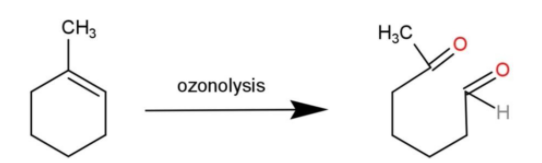
Hence, the product obtained in 2,4,4- trimethylpent-2-ene; 2-methylbut-1-ene; 1-methylcyclohexene are 2,2 – dimethylpropanal and propanone; butanone and methanol; 6 – oxoheptanal respectively.
Note:
Ozonolysis is used to detect the position of double bonds in any alkene. The reactions shown are the reductive workup reactions. The oxidative workup involves the reaction of ozonide with hydrogen peroxide. The oxidative workup will convert the aldehydes formed into their respective carboxylic acids, while ketones will remain the same.
Complete answer:
Ozonolysis is the addition of the ozone molecule to the alkene. The addition of ozone, ${{O}_{3}}$to alkenes leads to the formation of an intermediate compound called ozonide. This ozonide has the oxygen atoms attached on the double bonds of the alkene. Ozonide undergoes cleavage in the presence of zinc and water to form ketones and aldehydes.
The given compounds on ozonolysis give:
-2,4,4 - trimethylpent-2-ene undergoes cleavage from the double bond to form 2,2 – dimethylpropanal and propanone. The reaction is:
${{(C{{H}_{3}})}_{3}}CH=C{{(C{{H}_{3}})}_{2}}\xrightarrow[Zn/{{H}_{2}}O]{{{O}_{3}}}{{(C{{H}_{3}})}_{3}}CH=O+O=C{{(C{{H}_{3}})}_{2}}$
-2-methylbut-1-ene undergoes ozonolysis to add oxygen on the double bonds and form butanone and methanal. The reaction is:
$C{{H}_{3}}C{{H}_{2}}C(C{{H}_{3}})=C{{H}_{2}}\xrightarrow[Zn/{{H}_{2}}O]{{{O}_{3}}}C{{H}_{3}}C{{H}_{2}}C(C{{H}_{3}})=O+O=C{{H}_{2}}$
-1-methylcyclohexene is a cyclic compound that undergoes cleavage from the double bond through ozonolysis and forms 6 – oxoheptanal. The reaction is:
Hence, the product obtained in 2,4,4- trimethylpent-2-ene; 2-methylbut-1-ene; 1-methylcyclohexene are 2,2 – dimethylpropanal and propanone; butanone and methanol; 6 – oxoheptanal respectively.
Note:
Ozonolysis is used to detect the position of double bonds in any alkene. The reactions shown are the reductive workup reactions. The oxidative workup involves the reaction of ozonide with hydrogen peroxide. The oxidative workup will convert the aldehydes formed into their respective carboxylic acids, while ketones will remain the same.
Recently Updated Pages
If x a + bt + ct2 where x is in meters and t is in class 11 physics CBSE

A car covers the first half distance between two places class 11 physics CBSE
The resultant of two vectors overrightarrow P and overrightarrow class 11 physics CBSE
Find the value of cos 135 class 11 maths CBSE
A mass M is held in place by an applied force F and class 11 physics CBSE
A solution of glucose in water is labelled as 10 dfracwv class 11 chemistry CBSE
Trending doubts
One Metric ton is equal to kg A 10000 B 1000 C 100 class 11 physics CBSE
Find the value of the expression given below sin 30circ class 11 maths CBSE
What do you mean by retardation What is its SI uni class 11 physics CBSE
Draw a diagram of nephron and explain its structur class 11 biology CBSE
10 examples of friction in our daily life
Difference between physical and chemical change class 11 chemistry CBSE