




What are the nodal planes of $d{z^2}$ orbital? How can we find nodal planes?
Answer
 Verified
570.3k+ views
Hint: We have to know that nodal planes are areas around nuclear cores where the probability of discovering electrons is zero. The directions of these planes are found by tackling the Schrodinger wave condition for particles or atoms to discover the state of nuclear and sub-atomic orbitals.
Complete answer:
We have to see that the thickness of the electron cloud that gives the state of a nuclear orbital demonstrates the probability of discovering electrons in districts around the particle or atom. The denser the cloud is, the higher the probability of discovering an electron. Nodal planes are totally without electron cloud thickness, showing that the probability of discovering electrons in these planes is zero.
A vital idea in quantum mechanics is that electrons have both molecule and wave properties. The nodal planes around a nuclear core are a sign of the wave idea of electrons, as hubs are points of zero playfulness along a standing wave. No adequacy of vibration implies there are no electrons present.
The number and position of nodal planes bring about a considerable lot of the properties of particles and atoms. Particles with few nodal planes are profoundly steady, while those with various nodal planes are unsteady and responsive. The quantity of nodal planes is straightforwardly corresponding with the free energy of a gathering of fortified particles.
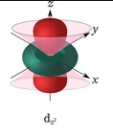
A d-orbital has four flaps and two nodal planes. Then $d{z^2}$ has three-dimensional construction, which has two projections along the z-axis and rings of high thickness in the xy-plane.
Therefore, the nodal plane is two in $d{z^2}$ .
To finding nodal planes by using the following expression,
$\dfrac{{Radial{\text{ nodes}}}}{{Spherical{\text{ nodes}}}} = n - l - 1$
Where,
$l$ is the azimuthal quantum number.
$\dfrac{{Angular{\text{ nodes}}}}{{Nodal{\text{ planes}}}} = 1$ .
Note:
We have to know that, a plane going through the core on which the likelihood of discovering electrons is zero, is known as a nodal plane. The quantity of nodal planes in an orbital is equivalent to azimuthal quantum number.
Complete answer:
We have to see that the thickness of the electron cloud that gives the state of a nuclear orbital demonstrates the probability of discovering electrons in districts around the particle or atom. The denser the cloud is, the higher the probability of discovering an electron. Nodal planes are totally without electron cloud thickness, showing that the probability of discovering electrons in these planes is zero.
A vital idea in quantum mechanics is that electrons have both molecule and wave properties. The nodal planes around a nuclear core are a sign of the wave idea of electrons, as hubs are points of zero playfulness along a standing wave. No adequacy of vibration implies there are no electrons present.
The number and position of nodal planes bring about a considerable lot of the properties of particles and atoms. Particles with few nodal planes are profoundly steady, while those with various nodal planes are unsteady and responsive. The quantity of nodal planes is straightforwardly corresponding with the free energy of a gathering of fortified particles.
A d-orbital has four flaps and two nodal planes. Then $d{z^2}$ has three-dimensional construction, which has two projections along the z-axis and rings of high thickness in the xy-plane.
Therefore, the nodal plane is two in $d{z^2}$ .
To finding nodal planes by using the following expression,
$\dfrac{{Radial{\text{ nodes}}}}{{Spherical{\text{ nodes}}}} = n - l - 1$
Where,
$l$ is the azimuthal quantum number.
$\dfrac{{Angular{\text{ nodes}}}}{{Nodal{\text{ planes}}}} = 1$ .
Note:
We have to know that, a plane going through the core on which the likelihood of discovering electrons is zero, is known as a nodal plane. The quantity of nodal planes in an orbital is equivalent to azimuthal quantum number.
Recently Updated Pages
If x a + bt + ct2 where x is in meters and t is in class 11 physics CBSE

A car covers the first half distance between two places class 11 physics CBSE
The resultant of two vectors overrightarrow P and overrightarrow class 11 physics CBSE
Find the value of cos 135 class 11 maths CBSE
A mass M is held in place by an applied force F and class 11 physics CBSE
A solution of glucose in water is labelled as 10 dfracwv class 11 chemistry CBSE
Trending doubts
One Metric ton is equal to kg A 10000 B 1000 C 100 class 11 physics CBSE
Find the value of the expression given below sin 30circ class 11 maths CBSE
What do you mean by retardation What is its SI uni class 11 physics CBSE
Draw a diagram of nephron and explain its structur class 11 biology CBSE
10 examples of friction in our daily life
Difference between physical and chemical change class 11 chemistry CBSE