




What are the main parts of the ear?
Answer
 Verified
590.4k+ views
Hint: Ear is one of the important sensory organs which is associated with hearing. It is also important for maintaining the pressure of the body with respect to the surrounding. The ear comprises three main parts- the outer ear, middle ear and the inner ear.
Complete answer:
The ear converts the sound waves into electrochemical impulses. It also equalises pressure of the body with the outside. The ear contains three essential parts-
a) External ear: The outer ear is the present outside the body. It acts as a funnel which receives the sound waves and transmits it to the middle ear. It comprises an external pinna, auditory canal which is lined with hairs which prevents the dust from entering and tympanum which is also called the eardrum which contains stretched membrane which conducts sound waves through vibrations.
b) Middle ear: It conducts sound waves from the external ear to the inner ear. It comprises the Eustachian tubes which connect the middle ear with the nasopharynx. It is responsible for equalising pressure. The bones and muscles- There are three bones called the malleus, incus and stapes which connect the middle ear with the inner ear. The function of these bones is to amplify the sound vibrations.
c) Inner ear: It is the part of the ear which is connected with the auditory nerves and the sound processing takes place. It is made up of vestibule-attached with the nerve fibres, semicircular canal- They are three in number, maintaining the balance when the head rotates and a cochlea-primary sensory organ of hearing which contains fluid filled canals.
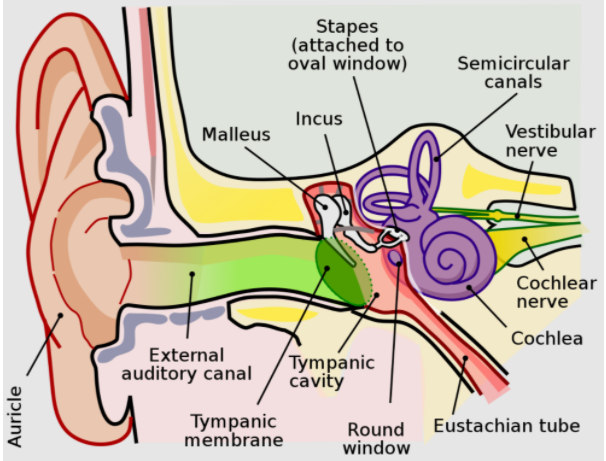
Note: A pair of ears is present in all vertebrates including humans. The sound impulses are sent to the brain through cranial nerve VII which is responsible for auditory function. There are two muscles present in the middle ear which responds to the flexibility without conscious control.
Complete answer:
The ear converts the sound waves into electrochemical impulses. It also equalises pressure of the body with the outside. The ear contains three essential parts-
a) External ear: The outer ear is the present outside the body. It acts as a funnel which receives the sound waves and transmits it to the middle ear. It comprises an external pinna, auditory canal which is lined with hairs which prevents the dust from entering and tympanum which is also called the eardrum which contains stretched membrane which conducts sound waves through vibrations.
b) Middle ear: It conducts sound waves from the external ear to the inner ear. It comprises the Eustachian tubes which connect the middle ear with the nasopharynx. It is responsible for equalising pressure. The bones and muscles- There are three bones called the malleus, incus and stapes which connect the middle ear with the inner ear. The function of these bones is to amplify the sound vibrations.
c) Inner ear: It is the part of the ear which is connected with the auditory nerves and the sound processing takes place. It is made up of vestibule-attached with the nerve fibres, semicircular canal- They are three in number, maintaining the balance when the head rotates and a cochlea-primary sensory organ of hearing which contains fluid filled canals.
Note: A pair of ears is present in all vertebrates including humans. The sound impulses are sent to the brain through cranial nerve VII which is responsible for auditory function. There are two muscles present in the middle ear which responds to the flexibility without conscious control.
Recently Updated Pages
Master Class 11 Social Science: Engaging Questions & Answers for Success

Master Class 11 English: Engaging Questions & Answers for Success
Master Class 11 Accountancy: Engaging Questions & Answers for Success
Master Class 11 Physics: Engaging Questions & Answers for Success
Master Class 11 Computer Science: Engaging Questions & Answers for Success
Master Class 11 Business Studies: Engaging Questions & Answers for Success
Trending doubts
One Metric ton is equal to kg A 10000 B 1000 C 100 class 11 physics CBSE
Find the value of the expression given below sin 30circ class 11 maths CBSE
Draw a diagram of nephron and explain its structur class 11 biology CBSE
10 examples of friction in our daily life
Proton was discovered by A Thomson B Rutherford C Chadwick class 11 chemistry CBSE
The teeth used for biting and cutting food are called class 11 biology CBSE