




What are the main constituents of blood?
Answer
 Verified
596.4k+ views
Hint: In humans and other species, blood is a body fluid that provides the cells with essential substances such as nutrients and oxygen and carries metabolic waste products away from those same cells. It is composed of blood cells suspended in the blood plasma invertebrates.
Complete answer: The main constituents of the blood are as follows:
a) Plasma - It is the liquid blood part that can be separated by spinning a tube containing blood in a centrifuge at a high speed. At the bottom of the channel, the denser cells and platelets settle, forming red and white layers, while the plasma stays at the top, forming a yellow layer.
b) Red blood cells - They are specialized cells that circulate throughout the body and provide oxygen to the tissues. They are also called erythrocytes. Red blood cells in humans are small and biconcave, and, when matures, it does not contain mitochondria or nuclei.
c) Platelets - These are cell fragments that are involved in blood clotting and are also known as thrombocytes. When large cells called megakaryocytes split into bits, they are formed, each making numerous platelets as it separates. The platelets are tiny and approximately disc-shaped.
d) White blood cells - WBCs, also called leukocytes, are much less abundant than red blood cells and make up less than 1 percent of the blood. Its function is also very different from that of red blood cells: they are mainly involved in immune responses, detecting invaders like bacteria and viruses and neutralizing them.
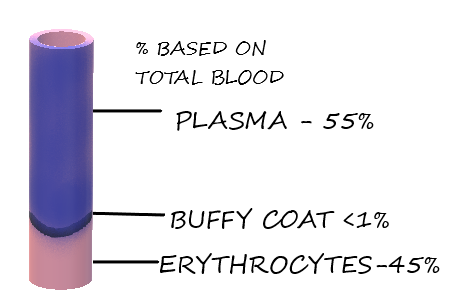
Note: Blood corpuscles and blood plasma are primary blood elements. Soluble proteins consist of blood corpuscles composed of RBCs, WBCs, platelets, and plasma. Plasma is the main blood component which consists mainly of water, which consists of proteins, ions, nutrients, and wastes.
Red blood cells must hold oxygen and carbon dioxide.
The blame for blood clotting is platelets.
White blood cells are part of the immune system and have an immune response function.
Complete answer: The main constituents of the blood are as follows:
a) Plasma - It is the liquid blood part that can be separated by spinning a tube containing blood in a centrifuge at a high speed. At the bottom of the channel, the denser cells and platelets settle, forming red and white layers, while the plasma stays at the top, forming a yellow layer.
b) Red blood cells - They are specialized cells that circulate throughout the body and provide oxygen to the tissues. They are also called erythrocytes. Red blood cells in humans are small and biconcave, and, when matures, it does not contain mitochondria or nuclei.
c) Platelets - These are cell fragments that are involved in blood clotting and are also known as thrombocytes. When large cells called megakaryocytes split into bits, they are formed, each making numerous platelets as it separates. The platelets are tiny and approximately disc-shaped.
d) White blood cells - WBCs, also called leukocytes, are much less abundant than red blood cells and make up less than 1 percent of the blood. Its function is also very different from that of red blood cells: they are mainly involved in immune responses, detecting invaders like bacteria and viruses and neutralizing them.
Note: Blood corpuscles and blood plasma are primary blood elements. Soluble proteins consist of blood corpuscles composed of RBCs, WBCs, platelets, and plasma. Plasma is the main blood component which consists mainly of water, which consists of proteins, ions, nutrients, and wastes.
Red blood cells must hold oxygen and carbon dioxide.
The blame for blood clotting is platelets.
White blood cells are part of the immune system and have an immune response function.
Recently Updated Pages
Master Class 12 Economics: Engaging Questions & Answers for Success

Master Class 12 English: Engaging Questions & Answers for Success
Master Class 12 Social Science: Engaging Questions & Answers for Success
Master Class 12 Maths: Engaging Questions & Answers for Success
Master Class 12 Physics: Engaging Questions & Answers for Success
Master Class 9 General Knowledge: Engaging Questions & Answers for Success
Trending doubts
One Metric ton is equal to kg A 10000 B 1000 C 100 class 11 physics CBSE
Difference Between Prokaryotic Cells and Eukaryotic Cells
Two of the body parts which do not appear in MRI are class 11 biology CBSE
1 ton equals to A 100 kg B 1000 kg C 10 kg D 10000 class 11 physics CBSE
Draw a diagram of nephron and explain its structur class 11 biology CBSE
10 examples of friction in our daily life