




What are the bond angles of $ P{F_3}C{l_2} $ ?
Answer
 Verified
587.7k+ views
Hint :The bond angle generally depends on the number of lone electron pairs, size and electronegativity of the central atom and also the size of atoms surrounding it. Note that the molecule $ P{F_3}C{l_2} $ has a trigonal bipyramidal geometry.
Complete Step By Step Answer:
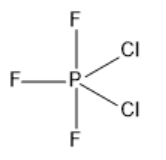
Phosphorus atoms have fifteen electrons with a total of five valence electrons. Three of these electrons are involved in bond formation with fluorine atoms and two electrons are involved in the bond formation with chlorine atoms. So, the hybridization of $ P{F_3}C{l_2} $ is $ s{p^3}d $ . So, the geometry of the molecule $ P{F_3}C{l_2} $ is trigonal bipyramidal with asymmetric charge distribution on the central atom. The fluorine atom is more electronegative and it occupies the axial position. Chlorine being less electronegative will occupy the equatorial position. In the $ P{F_3}C{l_2} $ molecule, the two chlorine atoms take up the planar position. The dipole moments of the two apex fluorine atoms cancel each other. Now, there will be a dipole moment in the triangular plane. The two $ P - Cl $ dipole moments are not cancelled out by one $ P - F $ dipole moment. This will leave a net dipole moment in the plane, which makes $ P{F_3}C{l_2} $ a polar molecule. For a $ E{X_5} $ structure, there will be $ 3 \times \angle X - E - X = {120^ \circ } $ for the equatorial $ X $ ligands and there will be $ 1 \times \angle X - E - X = {180^ \circ } $ . The structure of the molecule $ P{F_3}C{l_2} $ is given below.
Note :
Remember that the bond angle of a molecule depends mainly on the number of lone pairs and the electronegativity of the central atom. Note that more electronegative atoms occupy the axial position in a molecule which has trigonal bipyramidal geometry.
Complete Step By Step Answer:
Phosphorus atoms have fifteen electrons with a total of five valence electrons. Three of these electrons are involved in bond formation with fluorine atoms and two electrons are involved in the bond formation with chlorine atoms. So, the hybridization of $ P{F_3}C{l_2} $ is $ s{p^3}d $ . So, the geometry of the molecule $ P{F_3}C{l_2} $ is trigonal bipyramidal with asymmetric charge distribution on the central atom. The fluorine atom is more electronegative and it occupies the axial position. Chlorine being less electronegative will occupy the equatorial position. In the $ P{F_3}C{l_2} $ molecule, the two chlorine atoms take up the planar position. The dipole moments of the two apex fluorine atoms cancel each other. Now, there will be a dipole moment in the triangular plane. The two $ P - Cl $ dipole moments are not cancelled out by one $ P - F $ dipole moment. This will leave a net dipole moment in the plane, which makes $ P{F_3}C{l_2} $ a polar molecule. For a $ E{X_5} $ structure, there will be $ 3 \times \angle X - E - X = {120^ \circ } $ for the equatorial $ X $ ligands and there will be $ 1 \times \angle X - E - X = {180^ \circ } $ . The structure of the molecule $ P{F_3}C{l_2} $ is given below.
Note :
Remember that the bond angle of a molecule depends mainly on the number of lone pairs and the electronegativity of the central atom. Note that more electronegative atoms occupy the axial position in a molecule which has trigonal bipyramidal geometry.
Recently Updated Pages
Which will be the least stable resonating structure class 11 chemistry CBSE

How many 5 digit telephone numbers can be construc-class-11-maths-CBSE
How do you find the angle of the resultant vector class 11 physics CBSE
Draw labelled diagram of the following i Gram seed class 11 biology CBSE
1 Quintal is equal to a 110 kg b 10 kg c 100kg d 1000 class 11 physics CBSE
What is the need and importance of classification class 11 biology CBSE
Trending doubts
Find the value of the expression given below sin 30circ class 11 maths CBSE
One Metric ton is equal to kg A 10000 B 1000 C 100 class 11 physics CBSE
10 examples of friction in our daily life
Draw a diagram of a plant cell and label at least eight class 11 biology CBSE
Difference between physical and chemical change class 11 chemistry CBSE
Proton was discovered by A Thomson B Rutherford C Chadwick class 11 chemistry CBSE