




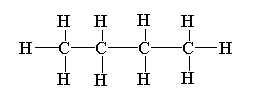
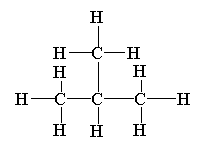
What are structural isomers? List any four characteristics of isomers. Draw the possible structures of butane.
Answer
 Verified
611.4k+ views
Hint: In structural isomers the number of atoms present in the isomer of the chemical compound are the same but their arrangement is different in different isomers which influence their characteristics.
Complete step by step answer:
The isomers are defined as the molecules which have the same molecular formulas but different arrangements of atoms and groups are seen. Isomers are divided into conformational isomers, structural isomers, stereoisomers, geometric isomers, optical isomers.
The organic compounds which have similar molecular formula but differ in their structural arrangement are known as structural isomers.
Characteristics of isomers are shown below.
-The isomers of a chemical compound contain the same molecular formula but their structural arrangement are different.
-Even though the molecular formula of all the isomers of the chemical compound is the same but as the atoms and molecules are arranged differently in all isomers, therefore the chemical and physical properties of the all isomers differ from each other.
-In isomerism, the isomers of the chemical compound contain the same number of atoms.
-The isomerism takes place in only those compounds where four or more than four carbon atoms are present.
The given compound is butane. The molecular formula of butane is \[C{H_3}C{H_2}C{H_2}C{H_3}\]
In butane four carbon atoms are present which can either arrange themselves in a straight chain consisting of four carbon atoms or in a chain of three carbon atoms with a side group attached to one carbon atom. The two isomers of butane are n-butane and 2-methylpropane.
The structure of n-butane is shown below.
The structure of 2-methylpropane is shown below.
Note:
One of the isomers of butane that is 2-methyl propane is also known as isobutane which is a simplest alkane containing tertiary carbon atoms.
Complete step by step answer:
The isomers are defined as the molecules which have the same molecular formulas but different arrangements of atoms and groups are seen. Isomers are divided into conformational isomers, structural isomers, stereoisomers, geometric isomers, optical isomers.
The organic compounds which have similar molecular formula but differ in their structural arrangement are known as structural isomers.
Characteristics of isomers are shown below.
-The isomers of a chemical compound contain the same molecular formula but their structural arrangement are different.
-Even though the molecular formula of all the isomers of the chemical compound is the same but as the atoms and molecules are arranged differently in all isomers, therefore the chemical and physical properties of the all isomers differ from each other.
-In isomerism, the isomers of the chemical compound contain the same number of atoms.
-The isomerism takes place in only those compounds where four or more than four carbon atoms are present.
The given compound is butane. The molecular formula of butane is \[C{H_3}C{H_2}C{H_2}C{H_3}\]
In butane four carbon atoms are present which can either arrange themselves in a straight chain consisting of four carbon atoms or in a chain of three carbon atoms with a side group attached to one carbon atom. The two isomers of butane are n-butane and 2-methylpropane.
The structure of n-butane is shown below.
The structure of 2-methylpropane is shown below.
Note:
One of the isomers of butane that is 2-methyl propane is also known as isobutane which is a simplest alkane containing tertiary carbon atoms.
Recently Updated Pages
Master Class 5 English: Engaging Questions & Answers for Success

Master Class 5 Maths: Engaging Questions & Answers for Success
Master Class 5 Social Science: Engaging Questions & Answers for Success
Master Class 5 Science: Engaging Questions & Answers for Success
Class 5 Question and Answer - Your Ultimate Solutions Guide
Master Class 9 General Knowledge: Engaging Questions & Answers for Success
Trending doubts
One Metric ton is equal to kg A 10000 B 1000 C 100 class 11 physics CBSE
What is cell theory Who formulated it class 11 biology CBSE
Phyllotaxy is the arrangement of ALeaflets BLeaves class 11 biology CBSE
Difference Between Prokaryotic Cells and Eukaryotic Cells
The symbiotic association of fungi and algae is called class 11 biology CBSE
Cell theory was formulated by A Schleiden and Schwann class 11 biology CBSE