




Are red blood cells called erythrocytes? What are white blood cells called?
Answer
 Verified
518.4k+ views
Hint: Blood is basically a connective tissue which consists of a fluid, plasma, and cell. The blood is mobile in nature as it continues to move all over the body. There are basically three types of cells which are found in the blood: Red blood cells (RBC), white blood cells (WBC) and platelets.
Complete solution:
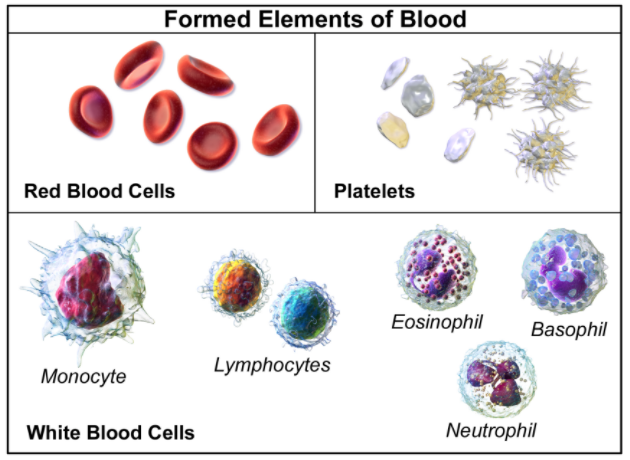
Red blood cells are also well known as erythrocytes. They are the most abundant cells present in the human body. RBCs are not made up of cell organelles like nucleus, mitochondria, ribosomes, centrioles and endoplasmic reticulum. Hence, the complete cytoplasm is filled with haemoglobin. Due to the cell organelles being absent, the consumption of oxygen is also low. Anaerobic respiration takes place in the RBCs. We know that haemoglobin is the oxygen carrying pigment and thus, we can say that RBCs help in the transportation of oxygen.
White blood cells, which are well known as leukocytes, are colourless because they have a lack of haemoglobin. They are made up of cell organelles and they can also change their shape. Changing the shape helps them to squeeze the blood capillaries into the tissues which are present in the body. This process is called diapedesis. The WBCs act as soldiers and scavengers as they fight the foreign bodies that may enter the body. Thus, we can say that they protect the body from various diseases.
Blood platelets are also called thrombocytes. They are very flat fragments of the cell and they do not have nucleus. In case of any kind of injury to the body, the blood platelets release some chemicals which are known as the platelet factors. These factors help in the clotting of blood, which is also known as blood coagulation.
Thus, we reach to the conclusion that erythrocyte is the term which is used for the RBCs (red blood cells) and WBCs (white blood cells) are also known as leukocytes.
Note:
The quantity of these three types of corpuscles may vary within a certain range in the blood of males and females. The increase or decrease in these blood cells beyond a particular limit can lead to various diseases in the human body.
Complete solution:
Red blood cells are also well known as erythrocytes. They are the most abundant cells present in the human body. RBCs are not made up of cell organelles like nucleus, mitochondria, ribosomes, centrioles and endoplasmic reticulum. Hence, the complete cytoplasm is filled with haemoglobin. Due to the cell organelles being absent, the consumption of oxygen is also low. Anaerobic respiration takes place in the RBCs. We know that haemoglobin is the oxygen carrying pigment and thus, we can say that RBCs help in the transportation of oxygen.
White blood cells, which are well known as leukocytes, are colourless because they have a lack of haemoglobin. They are made up of cell organelles and they can also change their shape. Changing the shape helps them to squeeze the blood capillaries into the tissues which are present in the body. This process is called diapedesis. The WBCs act as soldiers and scavengers as they fight the foreign bodies that may enter the body. Thus, we can say that they protect the body from various diseases.
Blood platelets are also called thrombocytes. They are very flat fragments of the cell and they do not have nucleus. In case of any kind of injury to the body, the blood platelets release some chemicals which are known as the platelet factors. These factors help in the clotting of blood, which is also known as blood coagulation.
Thus, we reach to the conclusion that erythrocyte is the term which is used for the RBCs (red blood cells) and WBCs (white blood cells) are also known as leukocytes.
Note:
The quantity of these three types of corpuscles may vary within a certain range in the blood of males and females. The increase or decrease in these blood cells beyond a particular limit can lead to various diseases in the human body.
Recently Updated Pages
Master Class 11 English: Engaging Questions & Answers for Success

Master Class 11 Social Science: Engaging Questions & Answers for Success
Master Class 11 Maths: Engaging Questions & Answers for Success
Master Class 11 Biology: Engaging Questions & Answers for Success
Master Class 11 Physics: Engaging Questions & Answers for Success
Master Class 11 Chemistry: Engaging Questions & Answers for Success
Trending doubts
One Metric ton is equal to kg A 10000 B 1000 C 100 class 11 physics CBSE
Difference Between Prokaryotic Cells and Eukaryotic Cells
1 ton equals to A 100 kg B 1000 kg C 10 kg D 10000 class 11 physics CBSE
Find the value of the expression given below sin 30circ class 11 maths CBSE
Two of the body parts which do not appear in MRI are class 11 biology CBSE
What are hard magnetic materials class 11 physics CBSE