




Why are Ferns called Vascular Cryptogams?
Answer
 Verified
545.1k+ views
Hint: Pteridophytes are included under the division Pteridophyta in the Kingdom Plantae. They are the true land plants that possess vascular tissues for conduction of food, water and minerals. The Pteridophytes usually grow in cool and shady places. However, some can thrive in sandy conditions. Horsetails and Ferns are included under Pteridophytes.
Complete answer:
Ferns are included under the class Polypodiopsida. Ferns are the vascular plants in which vascular tissues (Xylem and Phloem) are present. They evolved from bryophytes. In algae and bryophytes, vascular tissues are absent. Hence, they are the first vascular land plants. The ferns are more common in tropical areas. They reproduce by formation of spores. Spores are formed in sporangia which are present on leaf-like structures called sporophylls. The ferns produced similar kinds of spores and hence called Homosporous plants.
Sporophytic phase is the dominant phase in the life cycle of Ferns. The sporophytes constitute the main plant body of ferns which consists of true roots, stems and leaves. The gametophyte is a short lived and simple prothallus. In ferns, the leaves are large and called Macrophylls. They are green and have a photosynthetic structure. In the case of ferns, the leaves are called fronds.
The plants in which seeds are not formed are called cryptogams. Ferns are also called vascular cryptogams because their mode of reproduction is conspicuous. There is no formation of flowers and seeds in pteridophytes. They are non-seed bearing plants. Hence, ferns are also called vascular cryptogams.
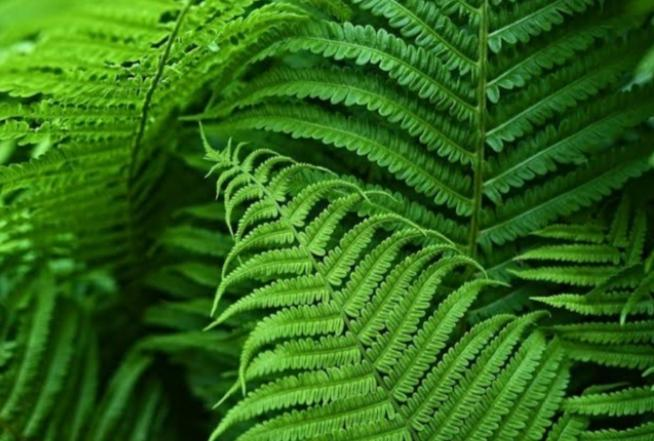
Image showing Fern plant
Note:
The Pteridophytes are economically very important. They have ornamental value and hence, are used for decorative purposes, grown in gardens and houses. Azolla is an aquatic Pteridophyte which is used as a biofertilizer. They are used as food and medicine. They act as soil binders at hilly areas. Some of them act as bioindicators which indicate environmental health and hence, are used for research purposes.
Complete answer:
Ferns are included under the class Polypodiopsida. Ferns are the vascular plants in which vascular tissues (Xylem and Phloem) are present. They evolved from bryophytes. In algae and bryophytes, vascular tissues are absent. Hence, they are the first vascular land plants. The ferns are more common in tropical areas. They reproduce by formation of spores. Spores are formed in sporangia which are present on leaf-like structures called sporophylls. The ferns produced similar kinds of spores and hence called Homosporous plants.
Sporophytic phase is the dominant phase in the life cycle of Ferns. The sporophytes constitute the main plant body of ferns which consists of true roots, stems and leaves. The gametophyte is a short lived and simple prothallus. In ferns, the leaves are large and called Macrophylls. They are green and have a photosynthetic structure. In the case of ferns, the leaves are called fronds.
The plants in which seeds are not formed are called cryptogams. Ferns are also called vascular cryptogams because their mode of reproduction is conspicuous. There is no formation of flowers and seeds in pteridophytes. They are non-seed bearing plants. Hence, ferns are also called vascular cryptogams.
Image showing Fern plant
Note:
The Pteridophytes are economically very important. They have ornamental value and hence, are used for decorative purposes, grown in gardens and houses. Azolla is an aquatic Pteridophyte which is used as a biofertilizer. They are used as food and medicine. They act as soil binders at hilly areas. Some of them act as bioindicators which indicate environmental health and hence, are used for research purposes.
Recently Updated Pages
Master Class 5 English: Engaging Questions & Answers for Success

Master Class 5 Maths: Engaging Questions & Answers for Success
Master Class 5 Social Science: Engaging Questions & Answers for Success
Master Class 5 Science: Engaging Questions & Answers for Success
Class 5 Question and Answer - Your Ultimate Solutions Guide
Master Class 9 General Knowledge: Engaging Questions & Answers for Success
Trending doubts
One Metric ton is equal to kg A 10000 B 1000 C 100 class 11 physics CBSE
What is cell theory Who formulated it class 11 biology CBSE
Phyllotaxy is the arrangement of ALeaflets BLeaves class 11 biology CBSE
Difference Between Prokaryotic Cells and Eukaryotic Cells
The symbiotic association of fungi and algae is called class 11 biology CBSE
Cell theory was formulated by A Schleiden and Schwann class 11 biology CBSE