




Why are amines soluble in nature?
Answer
 Verified
555.6k+ views
Hint: Derivatives of ammonia which are formed by the removal of hydrogen atoms of ammonia are known as amines $ \left( {RN{H_2}} \right) $ . Presence of nitrogen atom in the molecule imparts the electronegativity to it and therefore amines participate in hydrogen bonding.
Complete answer:
Amines are aliphatic and aromatic in nature depending upon the substituent added to the nitrogen atom. Nitrogen atom has five electrons in its outermost valence shells out of which three electrons of nitrogen are shared with other atoms during the bond formation and the rest two electrons present over the nitrogen as a lone pair. Due to higher availability of electrons into nitrogen atoms they readily react with water molecules to form the hydrogen bonding. Strength of hydrogen bonding depends on the availability of electrons over nitrogen atoms. Due to this reason, as the molecular mass of the amine increases the proportion of hydrophobic portion increases due to increase in the hydrophobic alkyl group.
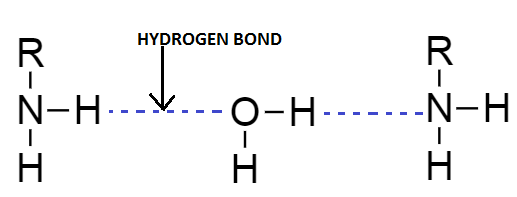
With increase in the number of carbon atoms, solubility of aliphatic amines decreases gradually. The higher member of amine, more than $ 6 $ carbon atom, is practically insoluble in water. Electronegativity of the nitrogen atom is lower than electronegativity of oxygen atom therefore with increase in size of alkyl group electronegativity of amine decreases and results in formation of very weak hydrogen bonding.
Starting members of aliphatic amines show good solubility in water as a solvent.
$ \Rightarrow $ Due to formation of hydrogen bonding amines are soluble in water.
Note:
Aromatic amines also contain the lone pair of electrons over the nitrogen atom but still they are practically insoluble in water due to presence of large hydrophobic structure of benzene ring which impart high hydrophobic character to the molecule. Aromatic amines show good solubility in the organic solvent like ether, benzene or ether.
Complete answer:
Amines are aliphatic and aromatic in nature depending upon the substituent added to the nitrogen atom. Nitrogen atom has five electrons in its outermost valence shells out of which three electrons of nitrogen are shared with other atoms during the bond formation and the rest two electrons present over the nitrogen as a lone pair. Due to higher availability of electrons into nitrogen atoms they readily react with water molecules to form the hydrogen bonding. Strength of hydrogen bonding depends on the availability of electrons over nitrogen atoms. Due to this reason, as the molecular mass of the amine increases the proportion of hydrophobic portion increases due to increase in the hydrophobic alkyl group.
With increase in the number of carbon atoms, solubility of aliphatic amines decreases gradually. The higher member of amine, more than $ 6 $ carbon atom, is practically insoluble in water. Electronegativity of the nitrogen atom is lower than electronegativity of oxygen atom therefore with increase in size of alkyl group electronegativity of amine decreases and results in formation of very weak hydrogen bonding.
Starting members of aliphatic amines show good solubility in water as a solvent.
$ \Rightarrow $ Due to formation of hydrogen bonding amines are soluble in water.
Note:
Aromatic amines also contain the lone pair of electrons over the nitrogen atom but still they are practically insoluble in water due to presence of large hydrophobic structure of benzene ring which impart high hydrophobic character to the molecule. Aromatic amines show good solubility in the organic solvent like ether, benzene or ether.
Recently Updated Pages
Explain the structure of megasporangium class 12 biology CBSE

Why is chloroform kept in dark coloured bottles class 12 chemistry CBSE
Derive the balancing condition of a Wheatstone bri class 12 physics CBSE
Draw VI characteristics of a pn junction diode Explain class 12 physics CBSE
Is it possible to carry pride in ones language too class 12 english CBSE
In a population at Hardy Weinberg equilibrium the allele class 12 biology CBSE
Trending doubts
Draw a labelled sketch of the human eye class 12 physics CBSE
Which are the Top 10 Largest Countries of the World?
Draw ray diagrams each showing i myopic eye and ii class 12 physics CBSE
Which is the correct genotypic ratio of mendel dihybrid class 12 biology CBSE
Differentiate between homogeneous and heterogeneous class 12 chemistry CBSE
Give 10 examples of unisexual and bisexual flowers