




What is the approximate wavelength of blue light?
$\begin{align}
& A.800A{}^\circ \\
& B.1600A{}^\circ \\
& C.3200A{}^\circ \\
& D.4800A{}^\circ \\
\end{align}$
Answer
 Verified
576.6k+ views
Hint: The visible white light we see is a spectrum of seven magnificent colours. The seven colours, namely Violet, Indigo, Blue, Green, Yellow, Orange, and Red. The visible light is a part of the electromagnetic spectrum. The electromagnetic spectrum consists of a range of frequency ranging from a few Hertz to ${{10}^{25}}$ Hertz.
Complete step-by-step solution:
The human eye can view lights only of a certain wavelength, one of which being the visible light part of the electromagnetic spectrum whose wavelength ranges between \[380\times {{10}^{-9}}m\]to\[750\times {{10}^{-9}}m\].
We will see the wavelength ranges of different colours of the electromagnetic spectrum:
1) The wavelength of violet light ranges from \[380\times {{10}^{-9}}m\] to \[450\times {{10}^{-9}}m\].
2) The wavelength of blue light ranges from \[450\times {{10}^{-9}}m\] to \[495\times {{10}^{-9}}m\].
3) The wavelength of green light is \[495\times {{10}^{-9}}m\] to \[570\times {{10}^{-9}}m\].
4) The wavelength of yellow is \[570\times {{10}^{-9}}m\] to \[590\times {{10}^{-9}}m\].
5) The wavelength of orange light is \[590\times {{10}^{-9}}m\] to \[620\times {{10}^{-9}}m\].
6) The wavelength of red light is \[620\times {{10}^{-9}}m\] to \[750\times {{10}^{-9}}m\].
When we look at the above options, blue light has wavelength ranging from \[4500{{A}^{0}}-4950{{A}^{0}}\]
Hence, option D is the correct answer.
Note: The electromagnetic spectrum all together is a band consisting of Gamma radiation, X-ray radiation, Ultraviolet radiation, visible light, infrared radiation, Microwave radiation, Radio waves.
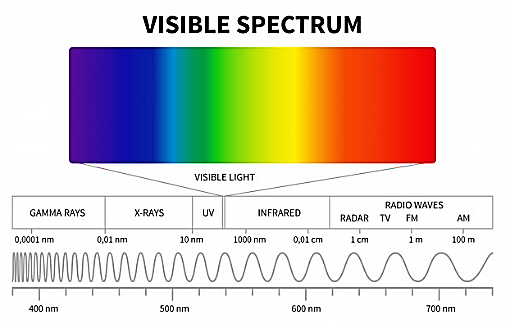
In the electromagnetic wave, a lower wavelength or higher frequency wave will have more energy. Therefore, gamma rays have the most energy and radio waves having the least energy. Electromagnetic waves interact with matter via their electric and magnetic fields which set in oscillation charges present in all matter. The detailed interaction and so the mechanism of absorption, scattering, etc., depend on the wavelength of the electromagnetic wave, and the nature of the atoms and molecules in the medium.
Complete step-by-step solution:
The human eye can view lights only of a certain wavelength, one of which being the visible light part of the electromagnetic spectrum whose wavelength ranges between \[380\times {{10}^{-9}}m\]to\[750\times {{10}^{-9}}m\].
We will see the wavelength ranges of different colours of the electromagnetic spectrum:
1) The wavelength of violet light ranges from \[380\times {{10}^{-9}}m\] to \[450\times {{10}^{-9}}m\].
2) The wavelength of blue light ranges from \[450\times {{10}^{-9}}m\] to \[495\times {{10}^{-9}}m\].
3) The wavelength of green light is \[495\times {{10}^{-9}}m\] to \[570\times {{10}^{-9}}m\].
4) The wavelength of yellow is \[570\times {{10}^{-9}}m\] to \[590\times {{10}^{-9}}m\].
5) The wavelength of orange light is \[590\times {{10}^{-9}}m\] to \[620\times {{10}^{-9}}m\].
6) The wavelength of red light is \[620\times {{10}^{-9}}m\] to \[750\times {{10}^{-9}}m\].
When we look at the above options, blue light has wavelength ranging from \[4500{{A}^{0}}-4950{{A}^{0}}\]
Hence, option D is the correct answer.
Note: The electromagnetic spectrum all together is a band consisting of Gamma radiation, X-ray radiation, Ultraviolet radiation, visible light, infrared radiation, Microwave radiation, Radio waves.
In the electromagnetic wave, a lower wavelength or higher frequency wave will have more energy. Therefore, gamma rays have the most energy and radio waves having the least energy. Electromagnetic waves interact with matter via their electric and magnetic fields which set in oscillation charges present in all matter. The detailed interaction and so the mechanism of absorption, scattering, etc., depend on the wavelength of the electromagnetic wave, and the nature of the atoms and molecules in the medium.
Recently Updated Pages
Master Class 12 Business Studies: Engaging Questions & Answers for Success

Master Class 12 Chemistry: Engaging Questions & Answers for Success
Master Class 12 Biology: Engaging Questions & Answers for Success
Class 12 Question and Answer - Your Ultimate Solutions Guide
Master Class 11 Social Science: Engaging Questions & Answers for Success
Master Class 11 Chemistry: Engaging Questions & Answers for Success
Trending doubts
Which are the Top 10 Largest Countries of the World?
Draw a labelled sketch of the human eye class 12 physics CBSE
Name the crygenes that control cotton bollworm and class 12 biology CBSE
Differentiate between homogeneous and heterogeneous class 12 chemistry CBSE
Ribosomal RNA is actively synthesised in A Nucleoplasm class 12 biology CBSE
How many molecules of ATP and NADPH are required information class 12 biology CBSE