




When any number is divided by $1$, the quotient is $?$
A: $1$
B: $0$
C: $2$
D: Number itself
Answer
 Verified
570.9k+ views
Hint:
Whenever we need to find the quotient, we need to know the division formula that is $Dividend \div Divisor = Quotient$, So by using this formula we can find the quotient of any number.
Complete step by step solution:
We can find the quotient by performing the division operation on a number. In order to perform division operation we should know the formula for division which is given as $Dividend \div Divisor = Quotient$. This can also be written as
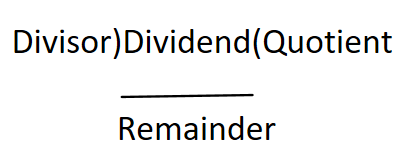
Here, Divisor is a number by which another number is to be divided.
Dividend is the number which is divided by the divisor.
Quotient is a number which obtain or get after the division operation.
Remainder is a number which is left over.
For example: $30 \div 6 = 5$ In this example $30$ is dividend, $6$is divisor, $5$is quotient and $0$ is remainder.
Now, to check the quotient we obtain when the number is divided by 1, we take some examples and find the quotient,
Example 1: let the number or dividend be $2$
On substituting the number in the division formula we get,$2 \div 1 = 2$.
Here the quotient is $2$ that is the number itself.
Example 2: let the number be 58
On substituting the number in division formula we get,
$58 \div 1 = 58$
In this case also the quotient is the number itself.
Hence from the above discussion we can say that the quotient, whenever the number is divided by $1$ is the number itself.
Note:
In quotient we not only have natural numbers, we can also have fractions while finding the quotient. For example if we take $2 \div 6$then we will be having $0.333$ or $\dfrac{1}{3}$ as a quotient. So whenever performing division operations don’t be like we should get quotients in natural numbers only.
Whenever we need to find the quotient, we need to know the division formula that is $Dividend \div Divisor = Quotient$, So by using this formula we can find the quotient of any number.
Complete step by step solution:
We can find the quotient by performing the division operation on a number. In order to perform division operation we should know the formula for division which is given as $Dividend \div Divisor = Quotient$. This can also be written as
Here, Divisor is a number by which another number is to be divided.
Dividend is the number which is divided by the divisor.
Quotient is a number which obtain or get after the division operation.
Remainder is a number which is left over.
For example: $30 \div 6 = 5$ In this example $30$ is dividend, $6$is divisor, $5$is quotient and $0$ is remainder.
Now, to check the quotient we obtain when the number is divided by 1, we take some examples and find the quotient,
Example 1: let the number or dividend be $2$
On substituting the number in the division formula we get,$2 \div 1 = 2$.
Here the quotient is $2$ that is the number itself.
Example 2: let the number be 58
On substituting the number in division formula we get,
$58 \div 1 = 58$
In this case also the quotient is the number itself.
Hence from the above discussion we can say that the quotient, whenever the number is divided by $1$ is the number itself.
Note:
In quotient we not only have natural numbers, we can also have fractions while finding the quotient. For example if we take $2 \div 6$then we will be having $0.333$ or $\dfrac{1}{3}$ as a quotient. So whenever performing division operations don’t be like we should get quotients in natural numbers only.

Recently Updated Pages
Master Class 6 Maths: Engaging Questions & Answers for Success

Master Class 6 English: Engaging Questions & Answers for Success
Master Class 6 Science: Engaging Questions & Answers for Success
Class 6 Question and Answer - Your Ultimate Solutions Guide
Master Class 6 Social Science: Engaging Questions & Answers for Success
Master Class 9 General Knowledge: Engaging Questions & Answers for Success
Trending doubts
Give 10 examples for herbs , shrubs , climbers , creepers
How many millions make a billion class 6 maths CBSE
What is the capital city of Australia? A) Sydney B) Melbourne C) Brisbane D) Canberra
What is the shape of Earth A Circle B Square C Sphere class 6 social science CBSE
The planet nearest to earth is A Mercury B Venus C class 6 social science CBSE
What are the main physical divisions of India class 6 social science CBSE