




Antedon belongs to which of the following class
A. Asteroidea
B. Ophiuroidea
C. Crinoidea
D. Echinoidea
Answer
 Verified
609.6k+ views
Hint: Members of Crinoidea (ancestor of echinoderms) are feather stars. Antedon is a feather star belonging to the phylum Echinodermata but the water vascular-system is not strong.
Step by step answer:
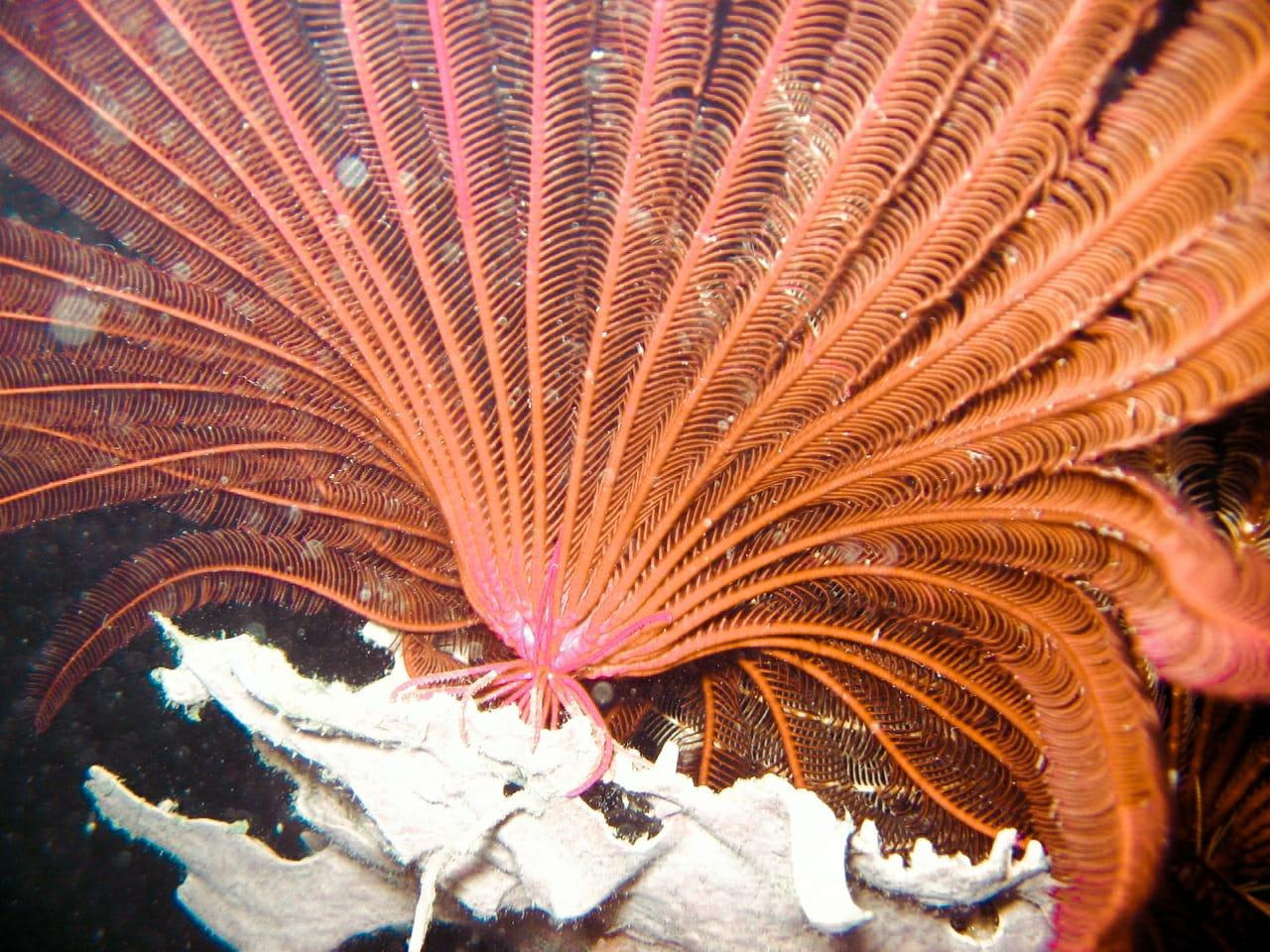
Antedon also known as ‘sea lily’ and ‘feather star’ is found in the class Crinoidea of phylum Echinodermata. They have five pairs of feathery arms arising from a central concave disc. It bears five arms and each arm is further bifurcated, bearing a row of a lateral extension known as Pinnules. The presence of pinnules gives Antedon a feathery appearance. The mouth is situated orally and the anus is found on the aboral surface. The tube feet are present in the ambulacral groove. The class Crinoidea is the ancestor group of all other echinoderm classes. The relationships among extant orders are still obscure, but some attempts have been made to elucidate them. Among the orders, Millericrinida and Isocrinida are the most ancient. The comatulids diverged from a group of Isocrinida, and the bourguet crinoids, due to the retention of the larval stem, diverged from the comatulids. Crinoids frequently live on the hard substratum. Some live in areas of high current flow, usually using the vertical filtration fan posture. Others avoid high streams and use the radial feeding posture. Nevertheless, the crinoid community is probably determined by substratum complexity, independent of water flow. A highly complex substratum may trigger a high diversity crinoid community, and a homogenous substratum carries a low diversity crinoid community. Feather stars usually live in clumps, preferring to attach to crevices, lateral surfaces, or in other places in which they can hide their central mass. This behavior prevents and avoids injuries to vital body parts caused by predators, and also optimizes filtration by enhancing the baffle effect, which improves the chance of food particles touching the feeding structure.
Therefore, the correct answer is C
Note: Almost all crinoids develop by lecithotrophic larvae (short-lived, nonfeeding, planktonic larvae called doliolaria larva) followed by a benthic, nonfeeding, stalked stage that metamorphoses to a benthic stalked juvenile. Most crinoids have only doliolaria larva, which are ovoid with four or five transverse bands of cilia and a tuft of apical cilia. Only one species is known to have internally brooded vitellaria larvae, which lack the ciliated bands.
Step by step answer:
Antedon also known as ‘sea lily’ and ‘feather star’ is found in the class Crinoidea of phylum Echinodermata. They have five pairs of feathery arms arising from a central concave disc. It bears five arms and each arm is further bifurcated, bearing a row of a lateral extension known as Pinnules. The presence of pinnules gives Antedon a feathery appearance. The mouth is situated orally and the anus is found on the aboral surface. The tube feet are present in the ambulacral groove. The class Crinoidea is the ancestor group of all other echinoderm classes. The relationships among extant orders are still obscure, but some attempts have been made to elucidate them. Among the orders, Millericrinida and Isocrinida are the most ancient. The comatulids diverged from a group of Isocrinida, and the bourguet crinoids, due to the retention of the larval stem, diverged from the comatulids. Crinoids frequently live on the hard substratum. Some live in areas of high current flow, usually using the vertical filtration fan posture. Others avoid high streams and use the radial feeding posture. Nevertheless, the crinoid community is probably determined by substratum complexity, independent of water flow. A highly complex substratum may trigger a high diversity crinoid community, and a homogenous substratum carries a low diversity crinoid community. Feather stars usually live in clumps, preferring to attach to crevices, lateral surfaces, or in other places in which they can hide their central mass. This behavior prevents and avoids injuries to vital body parts caused by predators, and also optimizes filtration by enhancing the baffle effect, which improves the chance of food particles touching the feeding structure.
Therefore, the correct answer is C
Note: Almost all crinoids develop by lecithotrophic larvae (short-lived, nonfeeding, planktonic larvae called doliolaria larva) followed by a benthic, nonfeeding, stalked stage that metamorphoses to a benthic stalked juvenile. Most crinoids have only doliolaria larva, which are ovoid with four or five transverse bands of cilia and a tuft of apical cilia. Only one species is known to have internally brooded vitellaria larvae, which lack the ciliated bands.
Recently Updated Pages
Master Class 11 Social Science: Engaging Questions & Answers for Success

Master Class 11 English: Engaging Questions & Answers for Success
Master Class 11 Maths: Engaging Questions & Answers for Success
Master Class 11 Chemistry: Engaging Questions & Answers for Success
Master Class 11 Biology: Engaging Questions & Answers for Success
Master Class 11 Physics: Engaging Questions & Answers for Success
Trending doubts
One Metric ton is equal to kg A 10000 B 1000 C 100 class 11 physics CBSE
Difference Between Prokaryotic Cells and Eukaryotic Cells
How many of the following diseases can be studied with class 11 biology CBSE
Two of the body parts which do not appear in MRI are class 11 biology CBSE
Which of the following enzymes is used for carboxylation class 11 biology CBSE
Explain zero factorial class 11 maths CBSE