




Aniline reacts with phosgene and excess of $ K\;OH $ to form :
(A)
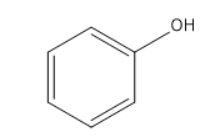
(B)
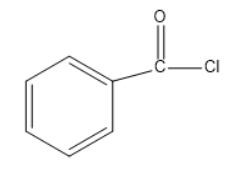
(C)
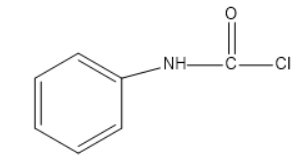
(D)
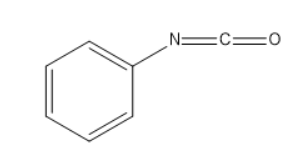
Answer
 Verified
577.8k+ views
Hint :Try to solve this question by drawing the structure of phosgene and aniline in the presence of $ K\;OH $ taking into consideration the dipole moment, effect of presence of lone pair, polarity of bonds etc. This way you’ll be able to decipher the mechanism of the above reaction.
Complete Step By Step Answer:
Before the mechanism of the above reaction let us first familiarise ourselves with the structure of the compounds given in the question.
Aniline-
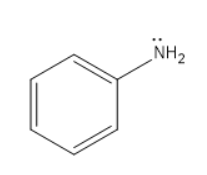
Aniline is the organic compound which consists of a phenyl group attached to an amino group. The amino group contains a lone pair which will participate in the above said chemical reaction.
Phosgene-
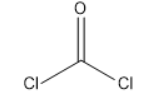
Mechanism:
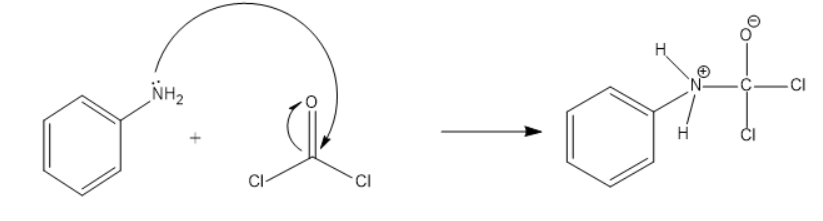
The lone pair on amine attacks the C of the phosgene and due to oxygen’s electronegativity the polarity moves towards the oxygen. The above product is formed. This negative charge on the oxygen will back off and will form a double bond which results in the release of Cl. This is shown below:
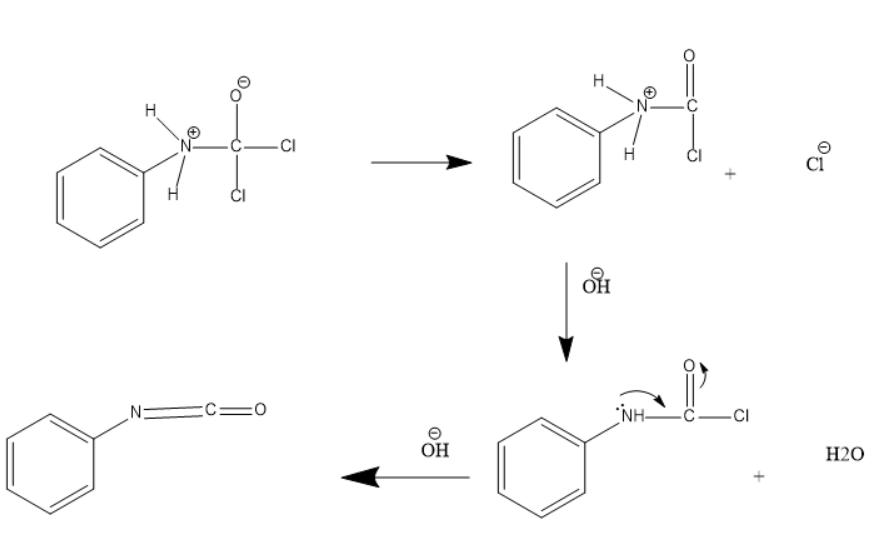
Then the $ ClO{H^{-}} $ from potassium hydroxide attacks the above intermediate product which further results in release of water. On further reaction of the $ O{H^{-} $ ion which results in the formation of phenyl isocyanate.
The intermediate formed in the above reactions are unstable and therefore undergo rearrangement to achieve a stable structure.
Therefore our answer is D.
Note :
Option a and b does occur in the above reaction but only as the intermediate not the final product. Also $ K\;OH $ can be written as $ {K^ + }O{H^{^ - }} $ . The $ O{H^{^ - }} $ in the above mechanism comes when the polarity of the potassium hydroxide is depicted individually.
Complete Step By Step Answer:
Before the mechanism of the above reaction let us first familiarise ourselves with the structure of the compounds given in the question.
Aniline-
Aniline is the organic compound which consists of a phenyl group attached to an amino group. The amino group contains a lone pair which will participate in the above said chemical reaction.
Phosgene-
Mechanism:
The lone pair on amine attacks the C of the phosgene and due to oxygen’s electronegativity the polarity moves towards the oxygen. The above product is formed. This negative charge on the oxygen will back off and will form a double bond which results in the release of Cl. This is shown below:
Then the $ ClO{H^{-}} $ from potassium hydroxide attacks the above intermediate product which further results in release of water. On further reaction of the $ O{H^{-} $ ion which results in the formation of phenyl isocyanate.
The intermediate formed in the above reactions are unstable and therefore undergo rearrangement to achieve a stable structure.
Therefore our answer is D.
Note :
Option a and b does occur in the above reaction but only as the intermediate not the final product. Also $ K\;OH $ can be written as $ {K^ + }O{H^{^ - }} $ . The $ O{H^{^ - }} $ in the above mechanism comes when the polarity of the potassium hydroxide is depicted individually.
Recently Updated Pages
If x a + bt + ct2 where x is in meters and t is in class 11 physics CBSE

A car covers the first half distance between two places class 11 physics CBSE
The resultant of two vectors overrightarrow P and overrightarrow class 11 physics CBSE
Find the value of cos 135 class 11 maths CBSE
A mass M is held in place by an applied force F and class 11 physics CBSE
A solution of glucose in water is labelled as 10 dfracwv class 11 chemistry CBSE
Trending doubts
Find the value of the expression given below sin 30circ class 11 maths CBSE
One Metric ton is equal to kg A 10000 B 1000 C 100 class 11 physics CBSE
Draw a diagram of nephron and explain its structur class 11 biology CBSE
10 examples of friction in our daily life
Proton was discovered by A Thomson B Rutherford C Chadwick class 11 chemistry CBSE
Bond order ofO2 O2+ O2 and O22 is in order A O2 langle class 11 chemistry CBSE