



Aniline is soluble in which of the following organic reagents?
a.) Benzene
b.) Ether
c.) Alcohol
d.) All of the above
Answer
 Verified
641.1k+ views
Hint: Try to analyze the physical properties of the aniline. Solubility is also a physical property which says how ease a compound can dissolve or mix in another compound. Also discuss the nature of the groups that are attached to the benzene ring in the aniline molecule.
Complete Solution :
The molecular formula of the aniline is ${{C}_{6}}{{H}_{5}}-N{{H}_{2}}$ which is having a typical structure as shown below
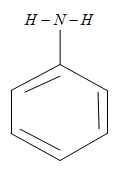
The polarity of this molecule is very low and also the intermolecular hydrogen bonding in itself is not that much strong so that it can form a hydrogen bonding with itself which makes it not to dissolve in any organic molecule. These properties make the aniline to solve in the organic molecules and it can also form the hydrogen bonding with the molecules of the other molecules other than the aniline. And hence aniline can dissolve in organic reagents like benzene, ether, alcohol. That means aniline can soluble in all the organic reagents given above.
So, the correct answer is “Option D”.
Note: In non polar solvents like \[C{{S}_{2}}\] the aniline will exhibit high resonance and due to this it becomes ready to undergo reduction. Due to this effect the ortho and the Para positions are substituted by reducing the $N{{H}_{2}}$ group that is attached in the aniline and the process is called as the mono-substitution.
Complete Solution :
The molecular formula of the aniline is ${{C}_{6}}{{H}_{5}}-N{{H}_{2}}$ which is having a typical structure as shown below
The polarity of this molecule is very low and also the intermolecular hydrogen bonding in itself is not that much strong so that it can form a hydrogen bonding with itself which makes it not to dissolve in any organic molecule. These properties make the aniline to solve in the organic molecules and it can also form the hydrogen bonding with the molecules of the other molecules other than the aniline. And hence aniline can dissolve in organic reagents like benzene, ether, alcohol. That means aniline can soluble in all the organic reagents given above.
So, the correct answer is “Option D”.
Note: In non polar solvents like \[C{{S}_{2}}\] the aniline will exhibit high resonance and due to this it becomes ready to undergo reduction. Due to this effect the ortho and the Para positions are substituted by reducing the $N{{H}_{2}}$ group that is attached in the aniline and the process is called as the mono-substitution.
Recently Updated Pages
Which of the following graphs shows the variation of class 12 physics CBSE

Draw a labelled diagram of the human male reproductive class 12 biology CBSE
Describe the experiment to compare the emf of two cells class 12 physics CBSE
What is standard hydrogen electrode
What is conventional current and electric current class 12 physics CBSE
2Bromopentane is treated with an alcoholic KOH solution class 12 chemistry CBSE
Trending doubts
Draw a labelled sketch of the human eye class 12 physics CBSE
Which are the Top 10 Largest Countries of the World?
A member of Simon commission later became Prime Minister class 12 social science CBSE
Differentiate between homogeneous and heterogeneous class 12 chemistry CBSE
Draw ray diagrams each showing i myopic eye and ii class 12 physics CBSE
Which is the correct genotypic ratio of mendel dihybrid class 12 biology CBSE