




What is the angle of incidence of a ray which is normal to the interface or boundary separating two media?
$\begin{align}
& a){{0}^{0}} \\
& b){{90}^{0}} \\
& c){{180}^{0}} \\
& d){{45}^{0}} \\
\end{align}$
Answer
 Verified
638.4k+ views
Hint: The angle of incidence of any incident ray is the angle made by the ray with the normal of the surface on which the ray is incident. In the above question, it is given that the incident ray is travelling perpendicular to the interface or is in the same path as the normal of the surface.
Complete step-by-step answer:
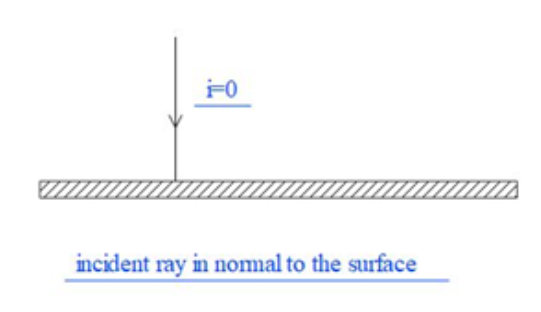
The angle between the incident tray and the normal to the surface is known as incident angle. It is given that the incident ray is travelling normal to the interface or the boundary separating the two media. If the incident ray is on the same path as the normal to the surface, the angle of incidence will be zero.
Therefore, the angle of incidence when light incident ray is along the normal to interface or boundary separating the two media is $i=0$ where $i$ is the angle of incidence. Option a.
Additional information:
When we deal with light rays that are nearly parallel to the surface, it is useful and recommended to consider the angle between the incident ray and the surface rather than the angle between incident ray and the surface normal. In simple terms, it is (${{90}^{0}}-$angle of incidence). This angle is only called glancing angle or grazing angle. Glancing angle is the angle formed by incident ray or the reflected ray and the plane surface.
Note: Usually, the angle of incidence is calculated as the angle between the incident ray and surface normal. But, most of them mistake it with the surface but not surface normal. If the angle is calculated with the surface, it is called as glancing angle and not incident angle.
Complete step-by-step answer:
The angle between the incident tray and the normal to the surface is known as incident angle. It is given that the incident ray is travelling normal to the interface or the boundary separating the two media. If the incident ray is on the same path as the normal to the surface, the angle of incidence will be zero.
Therefore, the angle of incidence when light incident ray is along the normal to interface or boundary separating the two media is $i=0$ where $i$ is the angle of incidence. Option a.
Additional information:
When we deal with light rays that are nearly parallel to the surface, it is useful and recommended to consider the angle between the incident ray and the surface rather than the angle between incident ray and the surface normal. In simple terms, it is (${{90}^{0}}-$angle of incidence). This angle is only called glancing angle or grazing angle. Glancing angle is the angle formed by incident ray or the reflected ray and the plane surface.
Note: Usually, the angle of incidence is calculated as the angle between the incident ray and surface normal. But, most of them mistake it with the surface but not surface normal. If the angle is calculated with the surface, it is called as glancing angle and not incident angle.
Recently Updated Pages
Basicity of sulphurous acid and sulphuric acid are

Master Class 10 Computer Science: Engaging Questions & Answers for Success
Master Class 10 Social Science: Engaging Questions & Answers for Success
Master Class 10 Science: Engaging Questions & Answers for Success
Class 10 Question and Answer - Your Ultimate Solutions Guide
Master Class 10 Maths: Engaging Questions & Answers for Success
Trending doubts
What is the Total Duration of Football Match?
Explain the Treaty of Vienna of 1815 class 10 social science CBSE
In football, which nation is called "La Roja"?
Why is there a time difference of about 5 hours between class 10 social science CBSE
10 examples of evaporation in daily life with explanations
What is the full form of POSCO class 10 social science CBSE