




Angle inscribed in a minor segment is
(A). acute
(B). obtuse
(C). right
(D). straight
Answer
 Verified
678.6k+ views
Hint: To solve this question, we will draw a circle and chords in it (other than diameter) and join the intersection points of the chord and the circumference of the circle to the other points of circumference.
Complete step-by-step solution -
To solve this question, we must first know what is a segment of a circle. A chord of a circle divides the circle into two regions, which are called the segments of the circle. The minor segment is the region bounded by the chord and the minor arc intercepted by chord.
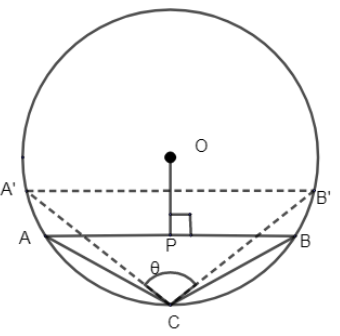
In the above figure, \[\theta \] is the angle inscribed in a minor segment. AB is any chord except the diameter of the circle. Here, we have drawn a perpendicular OP on the chord AB. We can clearly see that the \[\theta \] is less than \[{{180}^{\circ }}\] (because \[\theta \] will be \[{{180}^{\circ }}\] only in the case of straight line) and greater than \[{{90}^{\circ }}\]. Now we will move the chord AB perpendicular to OP such that the length of AB increases. Now new points are A' and B’. We will notice that the new angle formed is less than \[\theta \] but still greater than \[{{90}^{\circ }}\]. Now we will check the options one by one.
Option (a): The angle will not be acute because acute angles are less than \[{{90}^{\circ }}\] but in our case the angle is greater than \[{{90}^{\circ }}\].
Option (b): The angle will be obtuse because obtuse angles are greater than \[{{90}^{\circ }}\] and less than \[{{180}^{\circ }}\].
Option (c): The angle will be greater than \[{{90}^{\circ }}\] not exactly \[{{90}^{\circ }}\].
Option (d): The angle can be \[{{180}^{\circ }}\] only when ACB is a straight line.
Hence, option (b) is correct.
Note: The angle will be \[{{90}^{\circ }}\] only in the limiting case when the chord becomes diameter of the circle but in that case, both the segments will be equal and we will not get any minor or major segment.
Complete step-by-step solution -
To solve this question, we must first know what is a segment of a circle. A chord of a circle divides the circle into two regions, which are called the segments of the circle. The minor segment is the region bounded by the chord and the minor arc intercepted by chord.
In the above figure, \[\theta \] is the angle inscribed in a minor segment. AB is any chord except the diameter of the circle. Here, we have drawn a perpendicular OP on the chord AB. We can clearly see that the \[\theta \] is less than \[{{180}^{\circ }}\] (because \[\theta \] will be \[{{180}^{\circ }}\] only in the case of straight line) and greater than \[{{90}^{\circ }}\]. Now we will move the chord AB perpendicular to OP such that the length of AB increases. Now new points are A' and B’. We will notice that the new angle formed is less than \[\theta \] but still greater than \[{{90}^{\circ }}\]. Now we will check the options one by one.
Option (a): The angle will not be acute because acute angles are less than \[{{90}^{\circ }}\] but in our case the angle is greater than \[{{90}^{\circ }}\].
Option (b): The angle will be obtuse because obtuse angles are greater than \[{{90}^{\circ }}\] and less than \[{{180}^{\circ }}\].
Option (c): The angle will be greater than \[{{90}^{\circ }}\] not exactly \[{{90}^{\circ }}\].
Option (d): The angle can be \[{{180}^{\circ }}\] only when ACB is a straight line.
Hence, option (b) is correct.
Note: The angle will be \[{{90}^{\circ }}\] only in the limiting case when the chord becomes diameter of the circle but in that case, both the segments will be equal and we will not get any minor or major segment.
Recently Updated Pages
Master Class 10 Computer Science: Engaging Questions & Answers for Success

Differentiate between voluntary action and reflex class 10 biology CBSE
The uses of bleaching powder are A It is used bleaching class 10 chemistry CBSE
Fill in the blanks with abstract nouns of the words class 10 english CBSE
How many threedigit numbers are there class 10 maths CBSE
What is a reflex arc class 10 biology CBSE
Trending doubts
Explain the Treaty of Vienna of 1815 class 10 social science CBSE
10 examples of evaporation in daily life with explanations
What is the full form of POSCO class 10 social science CBSE
Make a sketch of the human nerve cell What function class 10 biology CBSE
GST is a direct or indirect tax?
The sum of all even numbers between 21 and 51 is a class 10 maths CBSE