




An urn contains 10 balls colored either black or red. When selecting two balls at random from the urn, the probability that each color is selected is \[\dfrac{8}{15}\]. Assuming that the urn contains more black than red balls, the probability that at least one black ball is selected when selecting two balls, is
(a) \[\dfrac{18}{45}\]
(b) \[\dfrac{30}{45}\]
(c) \[\dfrac{39}{45}\]
(d) \[\dfrac{41}{45}\]
Answer
 Verified
592.5k+ views
Hint: First we need to consider the number of black balls and red balls as variables \[x,y\] respectively such that \[x+y=10\]. Then by using the probability of selecting balls of each color when two balls are taken at random as \[\dfrac{8}{15}\] we have to find \[x,y\]. Then we can easily solve for the probability of getting at least one black ball.
Complete step-by-step solution
We are given that there are 10 balls in the urn
Let us assume that number of black balls = \[x\]
Let us assume that number of red balls = \[y\]
As there are a total of 10 balls we can write \[x+y=10\]
Also, we are given that the probability that each ball of each color is selected is\[P=\dfrac{8}{15}\] when two balls are taken at a time.
Let us count how many chances we get to draw two balls of each color
Let us assume that there are two boxes, we need to place the drawn balls in those boxes.
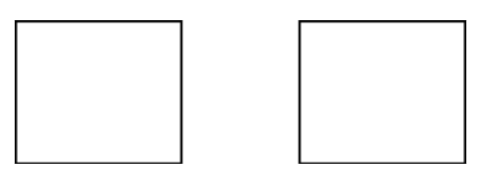
Here, we need to place one black ball in one box.
So, the number of ways of drawing one black ball from \[x\] balls is \[{}^{x}{{C}_{1}}=x\].
Now in another box, we need to place one red ball.
So, the number of ways of drawing one red ball from \[y\] balls is \[{}^{y}{{C}_{1}}=y\].
In this way, we can say that the total number of chances drawing two balls of each color is \[x.y\] ways.
We know that there are 10 balls in total. So, the total number of ways of drawing two balls is \[{}^{10}{{C}_{2}}\].
We know that the formula of probability is
\[P=\dfrac{\text{number of chances of happening the event}}{\text{total number of chances}}\]
By substituting the values of number of chances of happening the event as \[x.y\] and total number of chances as \[{}^{10}{{C}_{2}}\] we will get
\[\Rightarrow P=\dfrac{x.y}{{}^{10}{{C}_{2}}}\]…………………equation (i)
We know that \[{}^{n}{{C}_{r}}=\dfrac{n\text{!}}{r!\left( n-r \right)!}\], by taking the values of \[n,r\] we will get
\[\begin{align}
& \Rightarrow {}^{10}{{C}_{2}}=\dfrac{10\text{!}}{2!.8!} \\
& \Rightarrow {}^{10}{{C}_{2}}=\dfrac{10\times 9}{2} \\
& \Rightarrow {}^{10}{{C}_{2}}=45 \\
\end{align}\]
Now substituting this value in the equation (i) we will get
\[\begin{align}
& \Rightarrow \dfrac{8}{15}=\dfrac{x.y}{45} \\
& \Rightarrow x.y=8\times 3 \\
& \Rightarrow x.y=6\times 4 \\
\end{align}\]
We know that \[x+y=10\] and \[x\] is greater than \[y\] we can take
\[x=6,y=4\]
Now let us calculate the number of chances it will have if at least one black ball of two balls is taken
In this case we have two cases
Case (i): one black and one red
Number of chances of this type equals to \[x.y=6\times 4=24\].
Case (ii): two balls are black
The number of chances of this type equals to
\[{}^{6}{{C}_{2}}=\dfrac{6\times 5}{2}=15\]
So, the total number of changes in the two cases is
\[total=24+15=39\]
The total number of chances in drawing two balls is \[{}^{10}{{C}_{2}}=45\]
Now, let us calculate the probability of drawing at least one black ball as
\[\begin{align}
&\Rightarrow P=\dfrac{\text{number of chances of happening the event}}{\text{total number of chances}} \\
&\Rightarrow P=\dfrac{39}{45} \\
\end{align}\]
Therefore, option (c) is correct.
Note: Some students will make mistakes in taking the number of chances of happening in the event of getting at least one black ball. Some students may miss case (ii) which is important. They miss
Case (ii): two balls are black
The number of chances of this type equals to
\[{}^{6}{{C}_{2}}=\dfrac{6\times 5}{2}=15\]. This needs to be taken care of.
Complete step-by-step solution
We are given that there are 10 balls in the urn
Let us assume that number of black balls = \[x\]
Let us assume that number of red balls = \[y\]
As there are a total of 10 balls we can write \[x+y=10\]
Also, we are given that the probability that each ball of each color is selected is\[P=\dfrac{8}{15}\] when two balls are taken at a time.
Let us count how many chances we get to draw two balls of each color
Let us assume that there are two boxes, we need to place the drawn balls in those boxes.
Here, we need to place one black ball in one box.
So, the number of ways of drawing one black ball from \[x\] balls is \[{}^{x}{{C}_{1}}=x\].
Now in another box, we need to place one red ball.
So, the number of ways of drawing one red ball from \[y\] balls is \[{}^{y}{{C}_{1}}=y\].
In this way, we can say that the total number of chances drawing two balls of each color is \[x.y\] ways.
We know that there are 10 balls in total. So, the total number of ways of drawing two balls is \[{}^{10}{{C}_{2}}\].
We know that the formula of probability is
\[P=\dfrac{\text{number of chances of happening the event}}{\text{total number of chances}}\]
By substituting the values of number of chances of happening the event as \[x.y\] and total number of chances as \[{}^{10}{{C}_{2}}\] we will get
\[\Rightarrow P=\dfrac{x.y}{{}^{10}{{C}_{2}}}\]…………………equation (i)
We know that \[{}^{n}{{C}_{r}}=\dfrac{n\text{!}}{r!\left( n-r \right)!}\], by taking the values of \[n,r\] we will get
\[\begin{align}
& \Rightarrow {}^{10}{{C}_{2}}=\dfrac{10\text{!}}{2!.8!} \\
& \Rightarrow {}^{10}{{C}_{2}}=\dfrac{10\times 9}{2} \\
& \Rightarrow {}^{10}{{C}_{2}}=45 \\
\end{align}\]
Now substituting this value in the equation (i) we will get
\[\begin{align}
& \Rightarrow \dfrac{8}{15}=\dfrac{x.y}{45} \\
& \Rightarrow x.y=8\times 3 \\
& \Rightarrow x.y=6\times 4 \\
\end{align}\]
We know that \[x+y=10\] and \[x\] is greater than \[y\] we can take
\[x=6,y=4\]
Now let us calculate the number of chances it will have if at least one black ball of two balls is taken
In this case we have two cases
Case (i): one black and one red
Number of chances of this type equals to \[x.y=6\times 4=24\].
Case (ii): two balls are black
The number of chances of this type equals to
\[{}^{6}{{C}_{2}}=\dfrac{6\times 5}{2}=15\]
So, the total number of changes in the two cases is
\[total=24+15=39\]
The total number of chances in drawing two balls is \[{}^{10}{{C}_{2}}=45\]
Now, let us calculate the probability of drawing at least one black ball as
\[\begin{align}
&\Rightarrow P=\dfrac{\text{number of chances of happening the event}}{\text{total number of chances}} \\
&\Rightarrow P=\dfrac{39}{45} \\
\end{align}\]
Therefore, option (c) is correct.
Note: Some students will make mistakes in taking the number of chances of happening in the event of getting at least one black ball. Some students may miss case (ii) which is important. They miss
Case (ii): two balls are black
The number of chances of this type equals to
\[{}^{6}{{C}_{2}}=\dfrac{6\times 5}{2}=15\]. This needs to be taken care of.
Recently Updated Pages
Basicity of sulphurous acid and sulphuric acid are

Master Class 10 English: Engaging Questions & Answers for Success
Master Class 10 Social Science: Engaging Questions & Answers for Success
Master Class 10 Computer Science: Engaging Questions & Answers for Success
Class 10 Question and Answer - Your Ultimate Solutions Guide
Master Class 10 General Knowledge: Engaging Questions & Answers for Success
Trending doubts
Who is known as the "Little Master" in Indian cricket history?
Explain the Treaty of Vienna of 1815 class 10 social science CBSE
A boat goes 24 km upstream and 28 km downstream in class 10 maths CBSE
Which are the three major ports of Tamil Nadu A Chennai class 10 social science CBSE
The highest dam in India is A Bhakra dam B Tehri dam class 10 social science CBSE
Describe the process of Unification of Italy class 10 social science CBSE