




An umbrella is made by stitching 10 triangular pieces of cloth of two different colours each piece measuring 20 cm, 50 cm and 50 cm. How much cloth of each colour is required for the umbrella?
Answer
 Verified
630k+ views
Hint: To solve this problem, we need to know the basics of triangles and finding the area of the triangle. In this case, we have a special case of isosceles triangle, thus the area of the isosceles triangle is given by $\dfrac{1}{2}bh$. Here, b is the length of the base of the isosceles triangle and h is the height of the triangle.
Complete step-by-step answer:
Before solving this problem, we should know about the basics of the isosceles triangle and finding its area. We have the area of the isosceles triangle (below figure) is given by $\dfrac{1}{2}(CD)(AB)$. (Since, the formula is $\dfrac{1}{2}bh$)
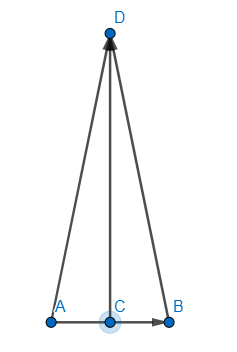
Now, we know that AD=BD= 50 cm and AB = 20 cm (given in the question). We need to find a CD to find the area. We consider the triangle ACD, thus we can use Pythagoras theorem on this triangle to find CD. Thus, we have $C{{D}^{2}}=A{{D}^{2}}-A{{C}^{2}}$. (In an isosceles triangle, the height of the triangle to the base (CD) would bisect the base. Thus, AC=BC = 10 cm. Now, we have,
$C{{D}^{2}}={{50}^{2}}-{{10}^{2}}=2400$
CD = 48.989 cm.
Now, the area is $\dfrac{1}{2}(CD)(AB)$. Thus,
Area = $\dfrac{1}{2}(48.989)(20)$= 489.897 $c{{m}^{2}}$
Now, in the problem, it is given that the umbrella is made of 10 triangular clothes of two different colours, thus the amount of cloth required for each colour is 489.897 $\times $ $\dfrac{10}{2}$= 2449.489 $c{{m}^{2}}$ .
Hence, the amount of cloth required for each colour is 2449.489 $c{{m}^{2}}$.
Note: For a triangle which is not special (special means isosceles, right or equilateral triangle), we calculate the area by using the heron’s formula. This is given by $\sqrt{s(s-a)(s-b)(s-c)}$. Here, s is the length of half the perimeter of the triangle, a, b and c are the side lengths of the triangle.
Complete step-by-step answer:
Before solving this problem, we should know about the basics of the isosceles triangle and finding its area. We have the area of the isosceles triangle (below figure) is given by $\dfrac{1}{2}(CD)(AB)$. (Since, the formula is $\dfrac{1}{2}bh$)
Now, we know that AD=BD= 50 cm and AB = 20 cm (given in the question). We need to find a CD to find the area. We consider the triangle ACD, thus we can use Pythagoras theorem on this triangle to find CD. Thus, we have $C{{D}^{2}}=A{{D}^{2}}-A{{C}^{2}}$. (In an isosceles triangle, the height of the triangle to the base (CD) would bisect the base. Thus, AC=BC = 10 cm. Now, we have,
$C{{D}^{2}}={{50}^{2}}-{{10}^{2}}=2400$
CD = 48.989 cm.
Now, the area is $\dfrac{1}{2}(CD)(AB)$. Thus,
Area = $\dfrac{1}{2}(48.989)(20)$= 489.897 $c{{m}^{2}}$
Now, in the problem, it is given that the umbrella is made of 10 triangular clothes of two different colours, thus the amount of cloth required for each colour is 489.897 $\times $ $\dfrac{10}{2}$= 2449.489 $c{{m}^{2}}$ .
Hence, the amount of cloth required for each colour is 2449.489 $c{{m}^{2}}$.
Note: For a triangle which is not special (special means isosceles, right or equilateral triangle), we calculate the area by using the heron’s formula. This is given by $\sqrt{s(s-a)(s-b)(s-c)}$. Here, s is the length of half the perimeter of the triangle, a, b and c are the side lengths of the triangle.
Recently Updated Pages
Basicity of sulphurous acid and sulphuric acid are

Master Class 10 English: Engaging Questions & Answers for Success
Master Class 10 Social Science: Engaging Questions & Answers for Success
Master Class 10 Computer Science: Engaging Questions & Answers for Success
Class 10 Question and Answer - Your Ultimate Solutions Guide
Master Class 10 General Knowledge: Engaging Questions & Answers for Success
Trending doubts
Which country won the ICC Men's ODI World Cup in 2023?
In cricket, how many legal balls are there in a standard over?
Explain the Treaty of Vienna of 1815 class 10 social science CBSE
What does "powerplay" mean in limited-overs cricket?
What is the full form of PNG A Petrol Natural Gas B class 10 chemistry CBSE
What is the "Powerplay" in T20 cricket?