




An optical device has been given to a student and he determines its focal length by focusing the web of the sun on a screen placed 24 cm from the device on the same side of the sun.
(i)Name the optical device.
(ii) Find its focal length.
Answer
 Verified
614.4k+ views
Hint: The mirrors and lenses which are used to focus onto something are called spherical mirrors and lenses as they are a part of some sphere that is cut. These are collectively called optical devices. Real images can only be produced by a concave mirror and convex lens.
Formula used:
$\dfrac{1}{f} = \dfrac{1}{v} + \dfrac{1}{u}$
Complete step by step answer:
In order to get the answer to the first part of the question, we can use the fact that the screen is placed on the same side of the sun. This can only be the case of a mirror as in a mirror, the rays get reflected and hence the image is formed on the same side of the object. Now, as we have concluded that the device is a mirror, let’s apply mirror formula to find respective focal length:
$\dfrac{1}{f} = \dfrac{1}{v} + \dfrac{1}{u}$
Since the screen is on the same side, v=-24cm and sun is very far, so $u=-\infty$.
$\implies \dfrac1f = \dfrac{1}{-24} + \dfrac{1}{-\infty}$
Or f = -24 cm.
Hence the answer to (ii) part of the question is f = -24 cm.
Now, since the focal length is negative, therefore it’s a concave mirror.
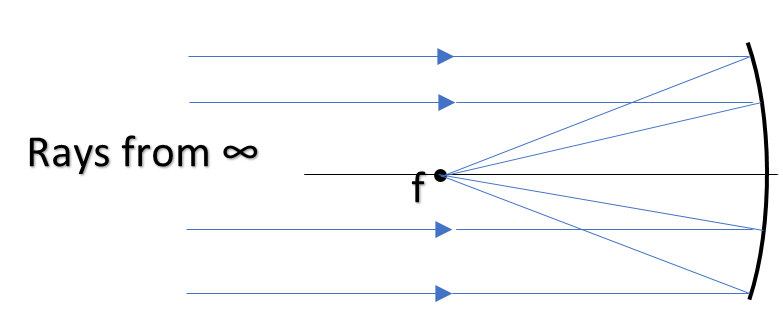
Also, from the figure, we can see that when the rays from infinity fall on a concave mirror, it gets focused on the focus of the mirror.
Additional information:
One might wonder that the distance of the sun is not infinity but a known finite value. Then why do we consider it to be at infinity? It’s because, in optics, we consider that value to be infinity which is very large as compared to the size of optical devices.
Note:
In addition to this, if it were given that the image is formed on the opposite side i.e. the optical device is in the middle of the screen and object, then it would definitely be the case of refraction through spherical lens. And that also, if the optical device is used to focus on the screen, it could only be the case of a convex mirror.
Formula used:
$\dfrac{1}{f} = \dfrac{1}{v} + \dfrac{1}{u}$
Complete step by step answer:
In order to get the answer to the first part of the question, we can use the fact that the screen is placed on the same side of the sun. This can only be the case of a mirror as in a mirror, the rays get reflected and hence the image is formed on the same side of the object. Now, as we have concluded that the device is a mirror, let’s apply mirror formula to find respective focal length:
$\dfrac{1}{f} = \dfrac{1}{v} + \dfrac{1}{u}$
Since the screen is on the same side, v=-24cm and sun is very far, so $u=-\infty$.
$\implies \dfrac1f = \dfrac{1}{-24} + \dfrac{1}{-\infty}$
Or f = -24 cm.
Hence the answer to (ii) part of the question is f = -24 cm.
Now, since the focal length is negative, therefore it’s a concave mirror.
Also, from the figure, we can see that when the rays from infinity fall on a concave mirror, it gets focused on the focus of the mirror.
Additional information:
One might wonder that the distance of the sun is not infinity but a known finite value. Then why do we consider it to be at infinity? It’s because, in optics, we consider that value to be infinity which is very large as compared to the size of optical devices.
Note:
In addition to this, if it were given that the image is formed on the opposite side i.e. the optical device is in the middle of the screen and object, then it would definitely be the case of refraction through spherical lens. And that also, if the optical device is used to focus on the screen, it could only be the case of a convex mirror.
Recently Updated Pages
Master Class 11 English: Engaging Questions & Answers for Success

Master Class 11 Social Science: Engaging Questions & Answers for Success
Master Class 11 Maths: Engaging Questions & Answers for Success
Master Class 11 Chemistry: Engaging Questions & Answers for Success
Master Class 11 Biology: Engaging Questions & Answers for Success
Master Class 11 Physics: Engaging Questions & Answers for Success
Trending doubts
One Metric ton is equal to kg A 10000 B 1000 C 100 class 11 physics CBSE
Difference Between Prokaryotic Cells and Eukaryotic Cells
Find the value of the expression given below sin 30circ class 11 maths CBSE
1 ton equals to A 100 kg B 1000 kg C 10 kg D 10000 class 11 physics CBSE
Two of the body parts which do not appear in MRI are class 11 biology CBSE
Draw a diagram of nephron and explain its structur class 11 biology CBSE