




An optical bench has 1.5m long scale having four equal divisions in each cm. While measuring the focal length of a convex lens, the lens is kept at 75 cm mark of the scale and the object pin is kept at 45 cm mark. The image of the object pin on the other side of the lens overlaps with the image pin that is kept at 135 cm mark. In this experiment, the percentage error in the measurement of the focal length of the lens is.
Answer
 Verified
602.7k+ views
Hint: In order 10 solve the problem, first we calculate the focal length of lens by using following formula
$\dfrac{1}{f} = \dfrac{1}{v} - \dfrac{1}{u}$
Where
u $ = $ distance of object from lens
v $ = $distance of image from lens
f $ = $ focal length of lens
After then differentiate the above equation and calculate the percentage error in the measurement of focal length.
Step by step answer: We can solve the problem with the help of diagrams easily.
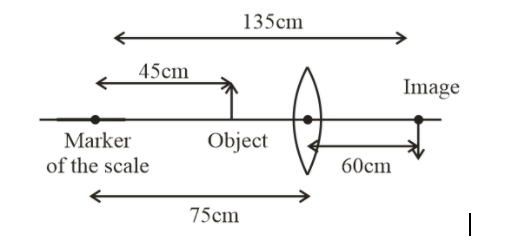
From figure, we can easily see the value of u and v i.e.,
u $ = $ distance of object from lens
$u = - (75 - 45)$
$u = - 30cm$
and
v $ = $ distance of image from lens
$v = 60cm$
We know that the lens formula
$\dfrac{1}{f} = \dfrac{1}{v} - \dfrac{1}{u}$ …..(!)
$\dfrac{1}{f} = \dfrac{1}{{60}} - \dfrac{1}{{( - 30)}}$
$\dfrac{1}{f} = \dfrac{1}{{60}} + \dfrac{1}{{30}}$
$\dfrac{1}{f} = \dfrac{{30 + 60}}{{(60)(30)}} = \dfrac{{90}}{{1800}}$
$\dfrac{1}{f} = \dfrac{1}{{20}}$
$f = 20cm$
Now, on differentiating equation 1
$ - \dfrac{{df}}{{{f^2}}} = - \dfrac{{dv}}{{{v^2}}} - \left( { - \dfrac{{du}}{{{u^2}}}} \right)$
$\dfrac{{df}}{{{f^2}}} = \dfrac{{dv}}{{{v^2}}} - \dfrac{{du}}{{{u^2}}}$
So, the maximum, error in f is
${\left( {\dfrac{{\Delta f}}{{{f^2}}}} \right)_{\max }} = \dfrac{{\Delta v}}{{{v^2}}} + \dfrac{{\Delta u}}{{{u^2}}}$
Here $\Delta v = $ error in measurement of v i.e., $\dfrac{1}{2}$ because there are 4 equal divisions in scale.
So, $\Delta f = {f^2}\left( {\dfrac{{\Delta v}}{{{v^2}}} + \dfrac{{\Delta u}}{{{u^2}}}} \right)$
$\Delta f = \dfrac{{400}}{2}\left[ {\dfrac{1}{{3600}} + \dfrac{1}{{900}}} \right]$
$\Delta f = 200\left[ {\dfrac{{1 + 4}}{{3600}}} \right] = 200 \times \dfrac{5}{{3600}}$
$\Delta f = \dfrac{{10}}{{36}}$
Hence, the $\% $ error in focal length is
$\dfrac{{\Delta f}}{f} \times 100\% = \dfrac{{10}}{{36 \times 20}} \times 100\% $
$ = \dfrac{{100}}{{72}}\% = 1.3888\% $
$\% $ error in $f \approx 1.39\% $
Note: There are some uses of optical bench experiment which are
1.To calculate the focal lengths of lenses.
2.Combine the lenses to demonstrate the principle of a telescope.
$\dfrac{1}{f} = \dfrac{1}{v} - \dfrac{1}{u}$
Where
u $ = $ distance of object from lens
v $ = $distance of image from lens
f $ = $ focal length of lens
After then differentiate the above equation and calculate the percentage error in the measurement of focal length.
Step by step answer: We can solve the problem with the help of diagrams easily.
From figure, we can easily see the value of u and v i.e.,
u $ = $ distance of object from lens
$u = - (75 - 45)$
$u = - 30cm$
and
v $ = $ distance of image from lens
$v = 60cm$
We know that the lens formula
$\dfrac{1}{f} = \dfrac{1}{v} - \dfrac{1}{u}$ …..(!)
$\dfrac{1}{f} = \dfrac{1}{{60}} - \dfrac{1}{{( - 30)}}$
$\dfrac{1}{f} = \dfrac{1}{{60}} + \dfrac{1}{{30}}$
$\dfrac{1}{f} = \dfrac{{30 + 60}}{{(60)(30)}} = \dfrac{{90}}{{1800}}$
$\dfrac{1}{f} = \dfrac{1}{{20}}$
$f = 20cm$
Now, on differentiating equation 1
$ - \dfrac{{df}}{{{f^2}}} = - \dfrac{{dv}}{{{v^2}}} - \left( { - \dfrac{{du}}{{{u^2}}}} \right)$
$\dfrac{{df}}{{{f^2}}} = \dfrac{{dv}}{{{v^2}}} - \dfrac{{du}}{{{u^2}}}$
So, the maximum, error in f is
${\left( {\dfrac{{\Delta f}}{{{f^2}}}} \right)_{\max }} = \dfrac{{\Delta v}}{{{v^2}}} + \dfrac{{\Delta u}}{{{u^2}}}$
Here $\Delta v = $ error in measurement of v i.e., $\dfrac{1}{2}$ because there are 4 equal divisions in scale.
So, $\Delta f = {f^2}\left( {\dfrac{{\Delta v}}{{{v^2}}} + \dfrac{{\Delta u}}{{{u^2}}}} \right)$
$\Delta f = \dfrac{{400}}{2}\left[ {\dfrac{1}{{3600}} + \dfrac{1}{{900}}} \right]$
$\Delta f = 200\left[ {\dfrac{{1 + 4}}{{3600}}} \right] = 200 \times \dfrac{5}{{3600}}$
$\Delta f = \dfrac{{10}}{{36}}$
Hence, the $\% $ error in focal length is
$\dfrac{{\Delta f}}{f} \times 100\% = \dfrac{{10}}{{36 \times 20}} \times 100\% $
$ = \dfrac{{100}}{{72}}\% = 1.3888\% $
$\% $ error in $f \approx 1.39\% $
Note: There are some uses of optical bench experiment which are
1.To calculate the focal lengths of lenses.
2.Combine the lenses to demonstrate the principle of a telescope.
Recently Updated Pages
Master Class 10 Social Science: Engaging Questions & Answers for Success

Master Class 10 Science: Engaging Questions & Answers for Success
Master Class 10 Maths: Engaging Questions & Answers for Success
Master Class 10 General Knowledge: Engaging Questions & Answers for Success
Master Class 10 Computer Science: Engaging Questions & Answers for Success
Class 10 Question and Answer - Your Ultimate Solutions Guide
Trending doubts
What is the full form of PNG A Petrol Natural Gas B class 10 chemistry CBSE
Explain the Treaty of Vienna of 1815 class 10 social science CBSE
In cricket, how many legal balls are there in a standard over?
Why is there a time difference of about 5 hours between class 10 social science CBSE
Who Won 36 Oscar Awards? Record Holder Revealed
What is the median of the first 10 natural numbers class 10 maths CBSE