




An open organ pipe of length L vibrates in its fundamental mode. The pressure variation is maximum
(A) at the two ends
(B) at the middle of the pipe
(C) at distances L/4 inside the ends
(D) at distances L/8 inside the ends
Answer
 Verified
637.8k+ views
Hint: The solution of this question is based on the topic Vibrations of Air Column in Pipes. As we know Musical wind instruments like flute, clarinet etc. longitudinal stationary waves are formed in the pipe Due to the superposition of the Like incident wave and the reflected wave.
Complete Step-by-Step solution:
To produce musical sound by blowing air into the pipe we use organ pipes because organ pipes are musical instruments. Organ pipe are classified into two parts
(a) closed organ pipes, closed at one end
(b) open organ pipe, open at both ends.
(a) Closed organ pipe
In any situation, if the air is blown lightly at the other (open) end of the closed organ pipe, then the air column vibrates (as shown in figure) in the fundamental mode In closed organ pipe. A node is formed at the closed end and an antinode is formed at the open end of a closed organ pipe. In closed organ pipe pressure is maximum at nodes as compared to other points of a closed organ pipe.
(b) Open organ pipe
In an open Organ pipe both of its ends are open so we can say that open organ pipes are those pipes in which both the ends are open. Example of open organ pipe is flute
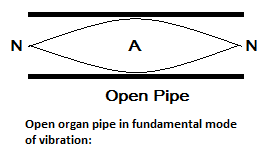
The basic mode (fundamental) of vibration is the frequency at which a standing wave is formed in the pipe and this frequency is the minimum frequency at which a standing wave is formed. And in an open organ pipe, if the fundamental mode of vibration is established, then pressure nodes are found at the open ends because the air molecules at these ends are free to vibrate.
Above analysis shows that the formation of pressure antinodes at the midway between these two nodes i.e. at the center of the pipe and here the pressure variation is extremely large or we say maximum in this case.
Hence option (B) is the correct answer.
Note- The open end(s) of the pipe are always antinodes (have the largest amplitudes). The open pipe has two ends but the closed one only has one, so the wave must bounce off the end of the wall to reach the open end, which causes it to travel twice as long (and sound an octave lower).
Complete Step-by-Step solution:
To produce musical sound by blowing air into the pipe we use organ pipes because organ pipes are musical instruments. Organ pipe are classified into two parts
(a) closed organ pipes, closed at one end
(b) open organ pipe, open at both ends.
(a) Closed organ pipe
In any situation, if the air is blown lightly at the other (open) end of the closed organ pipe, then the air column vibrates (as shown in figure) in the fundamental mode In closed organ pipe. A node is formed at the closed end and an antinode is formed at the open end of a closed organ pipe. In closed organ pipe pressure is maximum at nodes as compared to other points of a closed organ pipe.
(b) Open organ pipe
In an open Organ pipe both of its ends are open so we can say that open organ pipes are those pipes in which both the ends are open. Example of open organ pipe is flute
The basic mode (fundamental) of vibration is the frequency at which a standing wave is formed in the pipe and this frequency is the minimum frequency at which a standing wave is formed. And in an open organ pipe, if the fundamental mode of vibration is established, then pressure nodes are found at the open ends because the air molecules at these ends are free to vibrate.
Above analysis shows that the formation of pressure antinodes at the midway between these two nodes i.e. at the center of the pipe and here the pressure variation is extremely large or we say maximum in this case.
Hence option (B) is the correct answer.
Note- The open end(s) of the pipe are always antinodes (have the largest amplitudes). The open pipe has two ends but the closed one only has one, so the wave must bounce off the end of the wall to reach the open end, which causes it to travel twice as long (and sound an octave lower).
Recently Updated Pages
Master Class 12 Economics: Engaging Questions & Answers for Success

Master Class 12 English: Engaging Questions & Answers for Success
Master Class 12 Social Science: Engaging Questions & Answers for Success
Master Class 12 Maths: Engaging Questions & Answers for Success
Master Class 12 Physics: Engaging Questions & Answers for Success
Master Class 10 English: Engaging Questions & Answers for Success
Trending doubts
Explain the Treaty of Vienna of 1815 class 10 social science CBSE
Who Won 36 Oscar Awards? Record Holder Revealed
Why is it 530 pm in india when it is 1200 afternoon class 10 social science CBSE
Make a sketch of the human nerve cell What function class 10 biology CBSE
What is the full form of POSCO class 10 social science CBSE
Define Potential, Developed, Stock and Reserved resources