




An object is placed at a distance of 30cm from a concave mirror and its real image is formed at a distance of 30cm from the mirror. The focal length of the mirror is:
A. 60cm
B. 45cm
C. 30cm
D. 15cm
Answer
 Verified
624k+ views
Hint: Write the values of object distance and image distance from the given information. Use the proper sign convention. Use the mirror formula to find the focal length of the mirror. Since the mirror is a concave mirror, the focal length must be negative.
Complete answer step by step:
Given that, an object is placed at a distance of 30cm from a concave mirror, therefore, \[u=-30cm\]
Since the image formed is real and it is formed at a distance of 30cm from the mirror, \[v=-30cm\]
Let f be the focal length of the mirror.
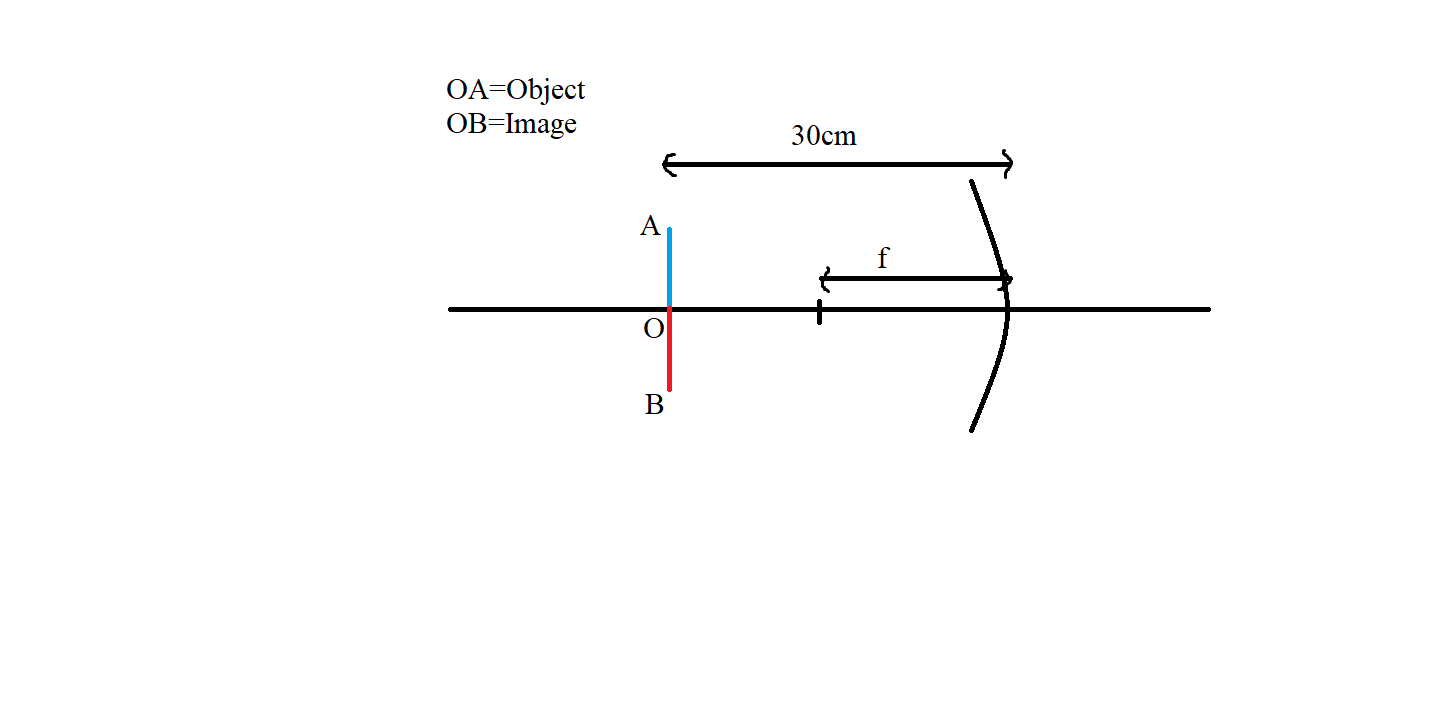
Using mirror formula,
$\dfrac{1}{f}=\dfrac{1}{u}+\dfrac{1}{v}$
Substituting the given value in the above formula, we get,
$\begin{align}
& \dfrac{1}{f}=\dfrac{1}{-30}+\dfrac{1}{-30} \\
& \dfrac{1}{f}=-\dfrac{2}{30} \\
& \dfrac{1}{f}=-\dfrac{1}{15} \\
& \therefore f=-15cm \\
\end{align}$
Thus, the focal length of the given concave mirror is -15cm. The negative sign indicates that the focal point lies on the left side of the image. Taking only absolute value, we find focal length equal to 15cm
Answer D. 15cm
Additional Information:
Sign conventions used for the mirror:
1. An object is always placed to the left of the mirror.
2. All distances are measured from the pole of the mirror.
3. Distances measured in the direction of the incident ray are taken as positive and the distances measured in the direction opposite to that of the incident rays are taken as negative.
4. Distances measured along the y-axis above the principal axis are taken as positive and that measured along the y-axis below the principal axis are taken as negative.
Note: Note that the focal length of a concave mirror is negative and that of a convex mirror is positive. Remember the sign convention used while solving the problems related to mirrors and lenses. Use appropriate sign convention depending on where the object is placed and where the image is formed. If an object or image is placed on the left side of the mirror then the sign must be negative and if the image or object is on the right hand side then the sign must be positive.
Complete answer step by step:
Given that, an object is placed at a distance of 30cm from a concave mirror, therefore, \[u=-30cm\]
Since the image formed is real and it is formed at a distance of 30cm from the mirror, \[v=-30cm\]
Let f be the focal length of the mirror.
Using mirror formula,
$\dfrac{1}{f}=\dfrac{1}{u}+\dfrac{1}{v}$
Substituting the given value in the above formula, we get,
$\begin{align}
& \dfrac{1}{f}=\dfrac{1}{-30}+\dfrac{1}{-30} \\
& \dfrac{1}{f}=-\dfrac{2}{30} \\
& \dfrac{1}{f}=-\dfrac{1}{15} \\
& \therefore f=-15cm \\
\end{align}$
Thus, the focal length of the given concave mirror is -15cm. The negative sign indicates that the focal point lies on the left side of the image. Taking only absolute value, we find focal length equal to 15cm
Answer D. 15cm
Additional Information:
Sign conventions used for the mirror:
1. An object is always placed to the left of the mirror.
2. All distances are measured from the pole of the mirror.
3. Distances measured in the direction of the incident ray are taken as positive and the distances measured in the direction opposite to that of the incident rays are taken as negative.
4. Distances measured along the y-axis above the principal axis are taken as positive and that measured along the y-axis below the principal axis are taken as negative.
Note: Note that the focal length of a concave mirror is negative and that of a convex mirror is positive. Remember the sign convention used while solving the problems related to mirrors and lenses. Use appropriate sign convention depending on where the object is placed and where the image is formed. If an object or image is placed on the left side of the mirror then the sign must be negative and if the image or object is on the right hand side then the sign must be positive.
Recently Updated Pages
Master Class 12 Business Studies: Engaging Questions & Answers for Success

Master Class 12 Biology: Engaging Questions & Answers for Success
Master Class 12 Chemistry: Engaging Questions & Answers for Success
Class 12 Question and Answer - Your Ultimate Solutions Guide
Master Class 11 Social Science: Engaging Questions & Answers for Success
Master Class 11 English: Engaging Questions & Answers for Success
Trending doubts
Which are the Top 10 Largest Countries of the World?
Draw a labelled sketch of the human eye class 12 physics CBSE
Name the crygenes that control cotton bollworm and class 12 biology CBSE
Differentiate between homogeneous and heterogeneous class 12 chemistry CBSE
Ribosomal RNA is actively synthesised in A Nucleoplasm class 12 biology CBSE
How many molecules of ATP and NADPH are required information class 12 biology CBSE