



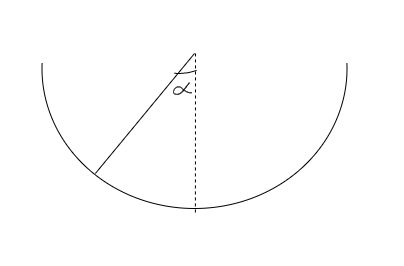
An insect crawls up a hemispherical surface very slowly as shown in figure. The coefficient of friction between the insect and the surface is $\dfrac{1}{3}$. If the line joining the centre of the hemispherical surface to the insect makes an angle $\alpha $with the vertical, the maximum possible value of $\alpha $ is given by-
$
A.{\text{ cot}}\alpha {\text{ = 3}} \\
{\text{B. sec}}\alpha {\text{ = 3}} \\
{\text{C. cosec}}\alpha {\text{ = 3}} \\
{\text{D. none}} \\
$
Answer
 Verified
607.3k+ views
- Hint- Here we will proceed by using the formula of force i.e. mg. and the formula of limiting friction i.e. ${f_l} = \mu N$ as here f is the maximum and limiting friction. Then we will equate both the equations formed to get the required result.
Complete step-by-step solution -
FORMULA USED-
$F = mg$
${f_l} = \mu N$
$\dfrac{1}{{\tan \theta }} = \cot \theta $
Here, given that-
The coefficient of friction between the insect and the surface i.e.$\mu = \dfrac{1}{3}$.
Now as we know that below the point at which insect will definitely have some mass, so force at that point will be mg.
$ \Rightarrow F = mg$
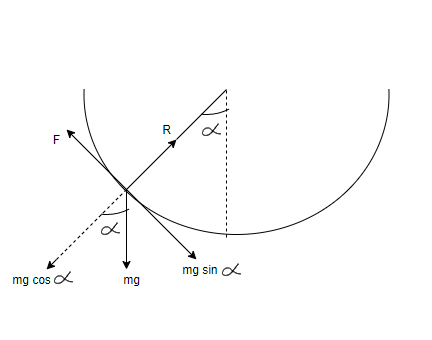
Also given that the the line joining the centre of the hemispherical surface to the insect makes an angle $\alpha $with the vertical, so mg will have two components-
$mg{\text{ sin}}\alpha $ ( which is downwards to mg)
$mg{\text{ cos}}\alpha $( which is upwards to mg, equal and opposite to normal)
As we know that in the diagram, $mg{\text{ sin}}\alpha $will balance static frictional force $f$(which is also maximum and limiting frictional force in this case of insect because after this point insect will start slipping)
Here, we must understand that only two forces are acting on insect,
Normal force
Mg force
So we get- $N = mg{\text{ cos}}\alpha ................\left( 1 \right)$
Now we will calculate limiting frictional force,
$f = mg{\text{ sin}}\alpha ...............\left( 2 \right)$
But we know that the formula of limiting friction i.e.${f_l} = \mu N$.
Where $\mu $ is coefficient of friction.
N is a normal reaction force.
Now using equation 1,
We get-
${f_l} = \mu mg{\text{ cos }}\alpha ........\left( 3 \right)$
In this question,
$f$ is the limiting frictional force$\left( {{f_l}} \right)$
So equating equation 2 and equation 3,
We get-
$mg{\text{ sin}}\alpha {\text{ = }}\mu {\text{ mg cos}}\alpha $
$\Rightarrow \sin \alpha = \mu \cos \alpha $
$\Rightarrow \dfrac{{\sin \alpha }}{{\cos \alpha }} = \mu $
$\Rightarrow \tan \alpha {\text{ = }}\mu $
$\Rightarrow \tan \alpha = \dfrac{1}{3}$ $\left( {\because \mu = \dfrac{1}{3}} \right)$
By cross-multiplying,
We get-
$\dfrac{1}{{\tan \alpha }} = 3$
$\cot \alpha = 3$ $\left( {\dfrac{1}{{\tan \theta }} = \cot \theta } \right)$
Therefore, option A is correct.
Note- While solving this question, we must know that here $f$ (static frictional force) will be the same as limiting frictional force ${f_l}$. Also, here we must understand that there are two forces i.e. normal force, mg force acting on insects. Hence we get our desired result.
Complete step-by-step solution -
FORMULA USED-
$F = mg$
${f_l} = \mu N$
$\dfrac{1}{{\tan \theta }} = \cot \theta $
Here, given that-
The coefficient of friction between the insect and the surface i.e.$\mu = \dfrac{1}{3}$.
Now as we know that below the point at which insect will definitely have some mass, so force at that point will be mg.
$ \Rightarrow F = mg$
Also given that the the line joining the centre of the hemispherical surface to the insect makes an angle $\alpha $with the vertical, so mg will have two components-
$mg{\text{ sin}}\alpha $ ( which is downwards to mg)
$mg{\text{ cos}}\alpha $( which is upwards to mg, equal and opposite to normal)
As we know that in the diagram, $mg{\text{ sin}}\alpha $will balance static frictional force $f$(which is also maximum and limiting frictional force in this case of insect because after this point insect will start slipping)
Here, we must understand that only two forces are acting on insect,
Normal force
Mg force
So we get- $N = mg{\text{ cos}}\alpha ................\left( 1 \right)$
Now we will calculate limiting frictional force,
$f = mg{\text{ sin}}\alpha ...............\left( 2 \right)$
But we know that the formula of limiting friction i.e.${f_l} = \mu N$.
Where $\mu $ is coefficient of friction.
N is a normal reaction force.
Now using equation 1,
We get-
${f_l} = \mu mg{\text{ cos }}\alpha ........\left( 3 \right)$
In this question,
$f$ is the limiting frictional force$\left( {{f_l}} \right)$
So equating equation 2 and equation 3,
We get-
$mg{\text{ sin}}\alpha {\text{ = }}\mu {\text{ mg cos}}\alpha $
$\Rightarrow \sin \alpha = \mu \cos \alpha $
$\Rightarrow \dfrac{{\sin \alpha }}{{\cos \alpha }} = \mu $
$\Rightarrow \tan \alpha {\text{ = }}\mu $
$\Rightarrow \tan \alpha = \dfrac{1}{3}$ $\left( {\because \mu = \dfrac{1}{3}} \right)$
By cross-multiplying,
We get-
$\dfrac{1}{{\tan \alpha }} = 3$
$\cot \alpha = 3$ $\left( {\dfrac{1}{{\tan \theta }} = \cot \theta } \right)$
Therefore, option A is correct.
Note- While solving this question, we must know that here $f$ (static frictional force) will be the same as limiting frictional force ${f_l}$. Also, here we must understand that there are two forces i.e. normal force, mg force acting on insects. Hence we get our desired result.
Recently Updated Pages
Which will be the least stable resonating structure class 11 chemistry CBSE

How many 5 digit telephone numbers can be construc-class-11-maths-CBSE
How do you find the angle of the resultant vector class 11 physics CBSE
Draw labelled diagram of the following i Gram seed class 11 biology CBSE
1 Quintal is equal to a 110 kg b 10 kg c 100kg d 1000 class 11 physics CBSE
What is the need and importance of classification class 11 biology CBSE
Trending doubts
Find the value of the expression given below sin 30circ class 11 maths CBSE
One Metric ton is equal to kg A 10000 B 1000 C 100 class 11 physics CBSE
10 examples of friction in our daily life
Draw a diagram of a plant cell and label at least eight class 11 biology CBSE
Difference between physical and chemical change class 11 chemistry CBSE
Proton was discovered by A Thomson B Rutherford C Chadwick class 11 chemistry CBSE