




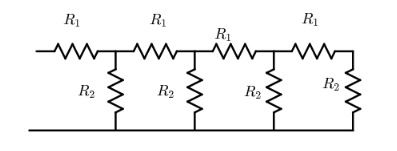
An infinite sequence of resistances is shown in the figure. The resultant resistance between A and B will be, when $ {R_1} = 1\Omega $ and $ {R_2} = 2\Omega $
(A) Infinity
(B) $ 1\Omega $
(C) $ 2\Omega $
(D) $ 1.5\Omega $
Answer
 Verified
568.2k+ views
Hint: The resistance is split in two parts by using symmetry and the resistance of single sections is calculated. It is assumed that the resistance of the rest of the figure is equivalent to a certain value. If we add one more branch, then the resultant resistance would be the same because this is an infinite sequence.
Complete step by step answer:
Let the resultant resistance be $ R $ .
If we add one more branch, then the resultant resistance would be the same because this is an infinite sequence.
Now, we take the first segment from the given figure and evaluate separately. It is assumed that the resistance of the rest of the figure is equivalent to $ R $ .
Now this resistance $ R $ is connected in parallel to the resistance $ {R_2} $ and $ {R_2} $ resistor is in series with the resistor $ {R_1} $ . The figure would then look somewhat like this.
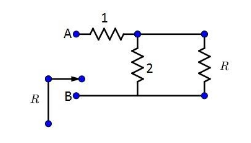
From the figure, it can be seen that, resistor $ {R_1} $ is in series with the resistors $ {R_2} $ and $ R $ .
By laws of resistance addition,
$ {R_1}{R_2} + {R_1} = R $ .
$ \Rightarrow 2R + R + 2 = {R^2} + R $ .
Simplifying this we get, $ {R^2} - R - 2 = 0 $ .
On factorising this equation, we get, $ \left( {R - 2} \right)\left( {R + 1} \right) = 0 $ .
We know that resistance value cannot be negative.
Thus,
$ \left( {R - 2} \right) = 0 $
$ \Rightarrow R = 2\Omega $
Hence, the correct answer is Option C.
Note:
Whenever every resistance in a configuration is multiplied by a factor then the equivalent resistance also gets multiplied by that factor. Here, we split the resistance and also the series goes on to infinity which lets us make the necessary manipulations.
Steps involved have been listed below.
1. Split the resistance in two parts by using symmetry.
2. Calculate the resistance of a single section by using the fact mentioned above.
3. Going back to the original problem .Combine the resistances as they are in parallel.
Complete step by step answer:
Let the resultant resistance be $ R $ .
If we add one more branch, then the resultant resistance would be the same because this is an infinite sequence.
Now, we take the first segment from the given figure and evaluate separately. It is assumed that the resistance of the rest of the figure is equivalent to $ R $ .
Now this resistance $ R $ is connected in parallel to the resistance $ {R_2} $ and $ {R_2} $ resistor is in series with the resistor $ {R_1} $ . The figure would then look somewhat like this.
From the figure, it can be seen that, resistor $ {R_1} $ is in series with the resistors $ {R_2} $ and $ R $ .
By laws of resistance addition,
$ {R_1}{R_2} + {R_1} = R $ .
$ \Rightarrow 2R + R + 2 = {R^2} + R $ .
Simplifying this we get, $ {R^2} - R - 2 = 0 $ .
On factorising this equation, we get, $ \left( {R - 2} \right)\left( {R + 1} \right) = 0 $ .
We know that resistance value cannot be negative.
Thus,
$ \left( {R - 2} \right) = 0 $
$ \Rightarrow R = 2\Omega $
Hence, the correct answer is Option C.
Note:
Whenever every resistance in a configuration is multiplied by a factor then the equivalent resistance also gets multiplied by that factor. Here, we split the resistance and also the series goes on to infinity which lets us make the necessary manipulations.
Steps involved have been listed below.
1. Split the resistance in two parts by using symmetry.
2. Calculate the resistance of a single section by using the fact mentioned above.
3. Going back to the original problem .Combine the resistances as they are in parallel.
Recently Updated Pages
Basicity of sulphurous acid and sulphuric acid are

Master Class 12 English: Engaging Questions & Answers for Success
Master Class 12 Social Science: Engaging Questions & Answers for Success
Master Class 12 Maths: Engaging Questions & Answers for Success
Master Class 12 Economics: Engaging Questions & Answers for Success
Master Class 12 Physics: Engaging Questions & Answers for Success
Trending doubts
Draw a labelled sketch of the human eye class 12 physics CBSE
Which are the Top 10 Largest Countries of the World?
Draw ray diagrams each showing i myopic eye and ii class 12 physics CBSE
Giving reasons state the signs positive or negative class 12 physics CBSE
Explain esterification reaction with the help of a class 12 chemistry CBSE
What is defined as a solenoid Depict a diagram with class 12 physics CBSE