




An ice – cream pot has a right circular cylindrical shape. The radius of its base is 12 cm and height is 7 cm. It is completely filled with ice – cream. Ice – cream is sold in the form of cones whose diameter of base is 4 cm and height is 3.5 cm. How many ice – cream cones were sold.$\left( \pi =\dfrac{22}{7} \right)$
Answer
 Verified
666k+ views
Hint: First of all find the volume of the cylinder in which all the ice – cream is present initially by using the formula $\text{Volume of cylinder}=\pi {{r}^{2}}h$. Now, this ice cream is sold in cone shape cups of diameter 4 cm and height 3.5 cm so find the volume of 1 cone which is found by using the formula $\text{Volume of cone}=\dfrac{1}{3}\pi {{r}^{2}}h$. Now, let us assume that “n” number of cones contain the total ice cream that is in cylindrical ice cream pot so equating the volume of the cylinder with the multiplication of n by volume of 1 cone. Solving this equation will give us the value of n.
Complete step-by-step answer:
We have given the ice cream pot in the form of a cylinder which has a radius as 12 cm and height as 7 cm. In the below diagram, we have shown a cylinder with radius r and height h.
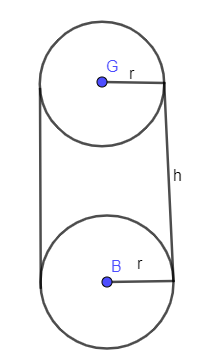
We know that volume of the cylinder is equal to:
$\pi {{r}^{2}}h$
Now, substituting the value of r as 12 cm and h as 7 cm and $\left( \pi =\dfrac{22}{7} \right)$ in the above equation we get,
$\begin{align}
& \pi {{r}^{2}}h \\
& =\dfrac{22}{7}{{\left( 12 \right)}^{2}}\left( 7 \right) \\
\end{align}$
In the above expression, 7 will be cancelled out from the numerator and the denominator.
$\begin{align}
& 22{{\left( 12 \right)}^{2}} \\
& =3168c{{m}^{3}} \\
\end{align}$
Now, let us assume that ice cream is filled in the n number of cone shaped cups.
The diameter of the base of the cone is given as 4 cm and the height of the cone is given as 3.5 cm.
The radius of the cone is found by dividing diameter by 2.
Radius of the cone $=\dfrac{4}{2}=2cm$
In the below diagram, we have shown a cone of radius r and height h:
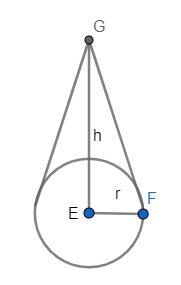
We know that the volume of cone is equal to:
$\dfrac{1}{3}\pi {{r}^{2}}h$
Substituting the value of r as 2 cm and h as 3.5 cm in the above expression we get,
\[\begin{align}
& \Rightarrow \dfrac{1}{3}\left( 22 \right){{\left( 2 \right)}^{2}}\left( 0.5 \right) \\
& \Rightarrow \dfrac{44}{3}c{{m}^{3}} \\
\end{align}\]
Equating the volume of cylinder with the multiplication of n by volume of 1 cone we get,
$3168=n\left( \dfrac{44}{3} \right)$
On cross multiplying the above equation we get,
$3168\left( 3 \right)=44n$
Dividing 44 on both the sides of the above equation we get,
$\begin{align}
& \dfrac{3168\left( 3 \right)}{44}=n \\
& \Rightarrow \dfrac{9504}{44}=n \\
& \Rightarrow 216=n \\
\end{align}$
From the above, we have got 216 numbers of cones to fill the ice cream contained in the cylindrical ice cream pot.
Note: Instead of solving the complete calculations of volume of cone and volume of cylinder we can solve in the following way:
Volume of a cylinder is equal to:
$\begin{align}
& \pi {{r}^{2}}h \\
& =\pi {{\left( 12 \right)}^{2}}\left( 7 \right) \\
\end{align}$
Volume of a cone is equal to:
$\begin{align}
& \dfrac{1}{3}\pi {{r}^{2}}h \\
& =\dfrac{1}{3}\pi {{\left( 2 \right)}^{2}}\left( 3.5 \right) \\
\end{align}$
Equating the volume of cylinder with the multiplication of n by volume of 1 cone we get,
$\pi {{\left( 12 \right)}^{2}}\left( 7 \right)=n\left( \dfrac{1}{3}\pi {{\left( 2 \right)}^{2}}\left( 3.5 \right) \right)$
In the above equation, $\pi $ will be cancelled out on both the sides and as you can see that L.H.S and R.H.S has numbers which are divisible by 7, 2 and that makes the calculation pretty easier as compared to the ones that we did in the above solution.
${{\left( 12 \right)}^{2}}\left( 7 \right)=n\left( \dfrac{1}{3}{{\left( 2 \right)}^{2}}\left( 3.5 \right) \right)$
On cross multiplying the above equation we get,
$\begin{align}
& 3\left( 144 \right)7=n\left( 4 \right)\left( 3.5 \right) \\
& \Rightarrow n=\dfrac{3\left( 144 \right)7}{\left( 4 \right)\left( 3.5 \right)} \\
& \Rightarrow n=\dfrac{3\left( 144 \right)}{4\left( 0.5 \right)} \\
& \Rightarrow n=\dfrac{3\left( 144 \right)}{2} \\
& \Rightarrow n=3\left( 72 \right)=216 \\
\end{align}$
Complete step-by-step answer:
We have given the ice cream pot in the form of a cylinder which has a radius as 12 cm and height as 7 cm. In the below diagram, we have shown a cylinder with radius r and height h.
We know that volume of the cylinder is equal to:
$\pi {{r}^{2}}h$
Now, substituting the value of r as 12 cm and h as 7 cm and $\left( \pi =\dfrac{22}{7} \right)$ in the above equation we get,
$\begin{align}
& \pi {{r}^{2}}h \\
& =\dfrac{22}{7}{{\left( 12 \right)}^{2}}\left( 7 \right) \\
\end{align}$
In the above expression, 7 will be cancelled out from the numerator and the denominator.
$\begin{align}
& 22{{\left( 12 \right)}^{2}} \\
& =3168c{{m}^{3}} \\
\end{align}$
Now, let us assume that ice cream is filled in the n number of cone shaped cups.
The diameter of the base of the cone is given as 4 cm and the height of the cone is given as 3.5 cm.
The radius of the cone is found by dividing diameter by 2.
Radius of the cone $=\dfrac{4}{2}=2cm$
In the below diagram, we have shown a cone of radius r and height h:
We know that the volume of cone is equal to:
$\dfrac{1}{3}\pi {{r}^{2}}h$
Substituting the value of r as 2 cm and h as 3.5 cm in the above expression we get,
\[\begin{align}
& \Rightarrow \dfrac{1}{3}\left( 22 \right){{\left( 2 \right)}^{2}}\left( 0.5 \right) \\
& \Rightarrow \dfrac{44}{3}c{{m}^{3}} \\
\end{align}\]
Equating the volume of cylinder with the multiplication of n by volume of 1 cone we get,
$3168=n\left( \dfrac{44}{3} \right)$
On cross multiplying the above equation we get,
$3168\left( 3 \right)=44n$
Dividing 44 on both the sides of the above equation we get,
$\begin{align}
& \dfrac{3168\left( 3 \right)}{44}=n \\
& \Rightarrow \dfrac{9504}{44}=n \\
& \Rightarrow 216=n \\
\end{align}$
From the above, we have got 216 numbers of cones to fill the ice cream contained in the cylindrical ice cream pot.
Note: Instead of solving the complete calculations of volume of cone and volume of cylinder we can solve in the following way:
Volume of a cylinder is equal to:
$\begin{align}
& \pi {{r}^{2}}h \\
& =\pi {{\left( 12 \right)}^{2}}\left( 7 \right) \\
\end{align}$
Volume of a cone is equal to:
$\begin{align}
& \dfrac{1}{3}\pi {{r}^{2}}h \\
& =\dfrac{1}{3}\pi {{\left( 2 \right)}^{2}}\left( 3.5 \right) \\
\end{align}$
Equating the volume of cylinder with the multiplication of n by volume of 1 cone we get,
$\pi {{\left( 12 \right)}^{2}}\left( 7 \right)=n\left( \dfrac{1}{3}\pi {{\left( 2 \right)}^{2}}\left( 3.5 \right) \right)$
In the above equation, $\pi $ will be cancelled out on both the sides and as you can see that L.H.S and R.H.S has numbers which are divisible by 7, 2 and that makes the calculation pretty easier as compared to the ones that we did in the above solution.
${{\left( 12 \right)}^{2}}\left( 7 \right)=n\left( \dfrac{1}{3}{{\left( 2 \right)}^{2}}\left( 3.5 \right) \right)$
On cross multiplying the above equation we get,
$\begin{align}
& 3\left( 144 \right)7=n\left( 4 \right)\left( 3.5 \right) \\
& \Rightarrow n=\dfrac{3\left( 144 \right)7}{\left( 4 \right)\left( 3.5 \right)} \\
& \Rightarrow n=\dfrac{3\left( 144 \right)}{4\left( 0.5 \right)} \\
& \Rightarrow n=\dfrac{3\left( 144 \right)}{2} \\
& \Rightarrow n=3\left( 72 \right)=216 \\
\end{align}$
Recently Updated Pages
Write structures of the following compounds i 2 Chloro3methylpentane class 11 chemistry CBSE

What is BLO What is the full form of BLO class 8 social science CBSE
Explain the Treaty of Vienna of 1815 class 10 social science CBSE
A Paragraph on Pollution in about 100-150 Words
XIX+XXX A 49 B 51 C 55 D 44 class 5 maths CBSE
If x a + bt + ct2 where x is in meters and t is in class 11 physics CBSE
Trending doubts
One Metric ton is equal to kg A 10000 B 1000 C 100 class 11 physics CBSE
Find the value of the expression given below sin 30circ class 11 maths CBSE
What do you mean by retardation What is its SI uni class 11 physics CBSE
Draw a diagram of nephron and explain its structur class 11 biology CBSE
10 examples of friction in our daily life
Difference between physical and chemical change class 11 chemistry CBSE