



An $fcc$ lattice has a lattice parameter \[a\] equal to $400pm$. Calculate the molar volume (in ML) of the lattice including all the empty space.
A. $10.8$
B. $96.2$
C. $8.6$
D. $9.6$
Answer
 Verified
614.7k+ views
Hint: The ordered structure that has occurred from the intrinsic nature of the constituent particles or atoms to form symmetric patterns of the crystal structure that will repeat along all the dimensions are known as a unit cell. The numerous unit cells together form a crystal lattice. Each lattice point is being occupied by one particle or atom.
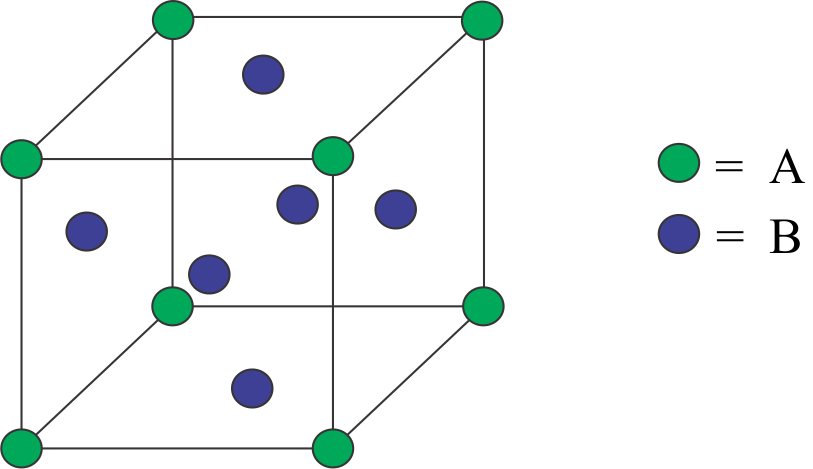
Complete step by step answer: The \[fcc\]unit cell is also known as the face centred cubic unit cell. This unit cell contains atoms at all the corners of the crystal lattice and at the centre of the faces of all the walls of the cube.
The corner atoms are being shared by eight more-unit cells. Thus, the contribution of each corner atom to a one-unit cell $fcc$ structure is $\dfrac{1}{8}$. And since, there are total eight corner atoms, therefore the contribution of all the corner atoms would be $\dfrac{1}{8} \times 8 = 1atom$
Similarly, the face atoms are being mutually shared by two-unit cells thus we can say that the contribution of each face atom would be \[\dfrac{1}{2}\]. Since, there are total six face atom, so the total contribution of face atoms would be $\dfrac{1}{2} \times 6 = 3atoms$
Therefore, we can say that the $fcc$ structure unit cell has $\left( {1 + 3 = 4} \right)4atoms$ in its structure.
Now, if an $fcc$ lattice has a lattice parameter $'a'$ equal to $400pm$, then
Volume of the unit cell = ${400^3}$
$\left[ {volume = {{\left( {side} \right)}^3}} \right]$
$ = 64 \times {10^{ - 24}}c{m^3}$
Volume of ${N_A}$ unit cell = $64 \times {10^{ - 24}} \times 6 \times {10^{23}}$ $\left[ {{N_A} = Avogadra{\text{ }}Number} \right]$
$ = 38.4c{m^3}$
Molar volume =$\dfrac{{38.4}}{4} = 9.6c{m^3}/mol$
Hence, the answer is option (D).
Note: On the basis of arrangements of atoms in space there can be different types of lattice structures. Mainly lattice structure can be fcc, bcc and hcp. In $fcc$ lattice structure, the coordination number is $12$ and the packing efficiency is $74\% $.
Complete step by step answer: The \[fcc\]unit cell is also known as the face centred cubic unit cell. This unit cell contains atoms at all the corners of the crystal lattice and at the centre of the faces of all the walls of the cube.
The corner atoms are being shared by eight more-unit cells. Thus, the contribution of each corner atom to a one-unit cell $fcc$ structure is $\dfrac{1}{8}$. And since, there are total eight corner atoms, therefore the contribution of all the corner atoms would be $\dfrac{1}{8} \times 8 = 1atom$
Similarly, the face atoms are being mutually shared by two-unit cells thus we can say that the contribution of each face atom would be \[\dfrac{1}{2}\]. Since, there are total six face atom, so the total contribution of face atoms would be $\dfrac{1}{2} \times 6 = 3atoms$
Therefore, we can say that the $fcc$ structure unit cell has $\left( {1 + 3 = 4} \right)4atoms$ in its structure.
Now, if an $fcc$ lattice has a lattice parameter $'a'$ equal to $400pm$, then
Volume of the unit cell = ${400^3}$
$\left[ {volume = {{\left( {side} \right)}^3}} \right]$
$ = 64 \times {10^{ - 24}}c{m^3}$
Volume of ${N_A}$ unit cell = $64 \times {10^{ - 24}} \times 6 \times {10^{23}}$ $\left[ {{N_A} = Avogadra{\text{ }}Number} \right]$
$ = 38.4c{m^3}$
Molar volume =$\dfrac{{38.4}}{4} = 9.6c{m^3}/mol$
Hence, the answer is option (D).
Note: On the basis of arrangements of atoms in space there can be different types of lattice structures. Mainly lattice structure can be fcc, bcc and hcp. In $fcc$ lattice structure, the coordination number is $12$ and the packing efficiency is $74\% $.
Recently Updated Pages
Master Class 12 Business Studies: Engaging Questions & Answers for Success

Master Class 12 Chemistry: Engaging Questions & Answers for Success
Master Class 12 Biology: Engaging Questions & Answers for Success
Class 12 Question and Answer - Your Ultimate Solutions Guide
Master Class 11 English: Engaging Questions & Answers for Success
Master Class 11 Social Science: Engaging Questions & Answers for Success
Trending doubts
Which are the Top 10 Largest Countries of the World?
Draw a labelled sketch of the human eye class 12 physics CBSE
The end of compass needle which points towards north class 12 physics CBSE
Differentiate between homogeneous and heterogeneous class 12 chemistry CBSE
Why is the cell called the structural and functional class 12 biology CBSE
When was the first election held in India a 194748 class 12 sst CBSE