




An example of colonial alga is
A. Spirogyra
B. Chlorella
C. Volvox
D. Ulothrix
Answer
 Verified
618k+ views
Hint: Algae (singular form Alga) are a group of organisms that are aquatic in nature and are capable of performing photosynthesis. Algae can be unicellular or multicellular. Organisms that comprise the group called Algae not necessarily related to each other and therefore they form a polyphyletic group. Algae is present in water either in singularly or they form colonies.
Complete step by step answer: Algae are a polyphyletic group of organisms that are capable of carrying out photosynthesis. Algae can be prokaryotic like cyanobacteria or eukaryotic like seaweed.
Volvox is a chlorophyte green alga that belongs to the family Volvocaceae. It is a freshwater species found in colonial forms. Each Volvox colony comprises thousands of cells in two forms – somatic cells and germ cells. The mature somatic cells have flagella. The number of cells in a colony are determined at the time of reproduction. Each colony has ‘eyespots’ that help the colony to move in direction of light.
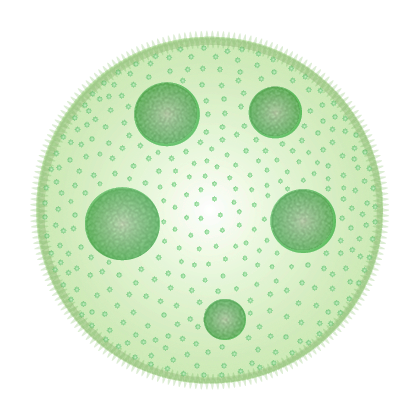
Fig: Volvox
-Spirogyra is a freshwater alga that belongs to the order Zygnematales. The characteristic of these organisms is the spiral arrangement of their chloroplasts. Spirogyra is capable of producing large amounts of oxygen and develops as filamentous masses. However, Spirogyra grows as single filaments and not in colonies.
-Chlorella is a single celled green alga that belongs to the division Chlorophyta. It is known to have chlorophyll and has high photosynthetic efficiency. Chlorella is a good source of food, very high in protein. Under specific conditions, Chlorella is capable of producing polyunsaturated fats. However, Chlorella grows as an individual organism and not in colonies.
-Ulothrix is a green alga belonging to the family Polytrichaceae. These organisms are found in both freshwater and marine water. The body of these plants are filamentous but non branching. These
organisms are attached to a substratum by a specialized cell called holdfast cell. Ulothrix is found as single filaments and is not known to form colonies.
Therefore, from the above discussion it can be concluded that Volvox is a colonial alga. Hence, option (c) is correct.
Note: Algae are a polyphyletic group of organisms that are capable of photosynthesis. They live in colonies like that of Volvox or individually like Spirogyra. Algae are known to use carbon dioxide very efficiently and produce energy rich oils. Thus, they can present themselves as a replacement of fossil fuels. Algae contribute to the environment by producing oxygen through photosynthesis.
Complete step by step answer: Algae are a polyphyletic group of organisms that are capable of carrying out photosynthesis. Algae can be prokaryotic like cyanobacteria or eukaryotic like seaweed.
Volvox is a chlorophyte green alga that belongs to the family Volvocaceae. It is a freshwater species found in colonial forms. Each Volvox colony comprises thousands of cells in two forms – somatic cells and germ cells. The mature somatic cells have flagella. The number of cells in a colony are determined at the time of reproduction. Each colony has ‘eyespots’ that help the colony to move in direction of light.
Fig: Volvox
-Spirogyra is a freshwater alga that belongs to the order Zygnematales. The characteristic of these organisms is the spiral arrangement of their chloroplasts. Spirogyra is capable of producing large amounts of oxygen and develops as filamentous masses. However, Spirogyra grows as single filaments and not in colonies.
-Chlorella is a single celled green alga that belongs to the division Chlorophyta. It is known to have chlorophyll and has high photosynthetic efficiency. Chlorella is a good source of food, very high in protein. Under specific conditions, Chlorella is capable of producing polyunsaturated fats. However, Chlorella grows as an individual organism and not in colonies.
-Ulothrix is a green alga belonging to the family Polytrichaceae. These organisms are found in both freshwater and marine water. The body of these plants are filamentous but non branching. These
organisms are attached to a substratum by a specialized cell called holdfast cell. Ulothrix is found as single filaments and is not known to form colonies.
Therefore, from the above discussion it can be concluded that Volvox is a colonial alga. Hence, option (c) is correct.
Note: Algae are a polyphyletic group of organisms that are capable of photosynthesis. They live in colonies like that of Volvox or individually like Spirogyra. Algae are known to use carbon dioxide very efficiently and produce energy rich oils. Thus, they can present themselves as a replacement of fossil fuels. Algae contribute to the environment by producing oxygen through photosynthesis.
Recently Updated Pages
Master Class 11 English: Engaging Questions & Answers for Success

Master Class 11 Social Science: Engaging Questions & Answers for Success
Master Class 11 Maths: Engaging Questions & Answers for Success
Master Class 11 Chemistry: Engaging Questions & Answers for Success
Master Class 11 Biology: Engaging Questions & Answers for Success
Master Class 11 Physics: Engaging Questions & Answers for Success
Trending doubts
One Metric ton is equal to kg A 10000 B 1000 C 100 class 11 physics CBSE
Difference Between Prokaryotic Cells and Eukaryotic Cells
Find the value of the expression given below sin 30circ class 11 maths CBSE
1 ton equals to A 100 kg B 1000 kg C 10 kg D 10000 class 11 physics CBSE
Two of the body parts which do not appear in MRI are class 11 biology CBSE
What are hard magnetic materials class 11 physics CBSE