




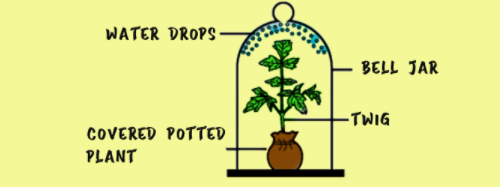
An apparatus as shown was set up to investigate a physiological process in plants. The setup was kept in sunlight for two hours. Droplets of water were then seen inside the bell jar. Answer the question that follows:
a) Name the process being studied.
b) Explain the process named above in (a)
c)why was the pot covered with a plastic sheet?
d)suggest a suitable control for this experiment.
e) mention two ways in which this process is beneficial to plants.
f) list three adaptations in plants to reduce the above-mentioned process.
Answer
 Verified
586.5k+ views
Hint: The plants have a tendency to lose their water content in the form of vapor. This process helps them to cool down and also to lose the excessive water molecules present in them. This process occurs from the leaf surface by the stomata.
Complete answer:
-The above setup shows the transpiration occurring in the plant. It is a physiological process that occurs in plants.
-Transpiration is the process where the water is lost from the leaves of the plants in the form of vapor into the atmosphere. The roots of the plant absorb the water and nutrients from the soil and transport them to other parts of the plant. Some amount of this water is then released into the air by the process of transpiration.
-The pot was covered with a plastic sheet in order to capture the vapors released by the plants for the process of transpiration. If the plastic sheet is absent or there is no lid present then the vapors will go into the atmosphere and the person studying the process of transpiration would not get the desired results.
-The control of this experiment can be done by setting up the whole setup exactly but not putting the plant inside the plastic sheet cover. In such a way one can observe the water droplets that would be formed in the presence of the plant and the absence of water droplets in the absence of the plant in the control setup.
-The transpiration process helps the plant to cool down in the hot summertime. It helps in the cooling of the leaves as the transpired water forms a cool blanket around the leaves of the plant. This process also helps the plant to extract more water from the soil. The compensation of the lost water is done by the roots absorbing more water from the soil. In this way, the movement of water continues in the plant.
-To reduce the loss of water from the transpiration some plants have reduced the size of their leaves and have modified their leaves into spine-like structures. Some plants have sunken stomata so a low rate of transpiration occurs. Some leaves also have hair-like structures present on them which is also an adaptation to reduce the rate of transpiration.
Note: The process of transpiration is the process in which the plant loses its water content from the leaves in the form of vapor into the air. The transpiration process helps the plant to cool down. This process also helps the plant to extract more water from the soil.
Complete answer:
-The above setup shows the transpiration occurring in the plant. It is a physiological process that occurs in plants.
-Transpiration is the process where the water is lost from the leaves of the plants in the form of vapor into the atmosphere. The roots of the plant absorb the water and nutrients from the soil and transport them to other parts of the plant. Some amount of this water is then released into the air by the process of transpiration.
-The pot was covered with a plastic sheet in order to capture the vapors released by the plants for the process of transpiration. If the plastic sheet is absent or there is no lid present then the vapors will go into the atmosphere and the person studying the process of transpiration would not get the desired results.
-The control of this experiment can be done by setting up the whole setup exactly but not putting the plant inside the plastic sheet cover. In such a way one can observe the water droplets that would be formed in the presence of the plant and the absence of water droplets in the absence of the plant in the control setup.
-The transpiration process helps the plant to cool down in the hot summertime. It helps in the cooling of the leaves as the transpired water forms a cool blanket around the leaves of the plant. This process also helps the plant to extract more water from the soil. The compensation of the lost water is done by the roots absorbing more water from the soil. In this way, the movement of water continues in the plant.
-To reduce the loss of water from the transpiration some plants have reduced the size of their leaves and have modified their leaves into spine-like structures. Some plants have sunken stomata so a low rate of transpiration occurs. Some leaves also have hair-like structures present on them which is also an adaptation to reduce the rate of transpiration.
Note: The process of transpiration is the process in which the plant loses its water content from the leaves in the form of vapor into the air. The transpiration process helps the plant to cool down. This process also helps the plant to extract more water from the soil.
Recently Updated Pages
Master Class 11 Social Science: Engaging Questions & Answers for Success

Master Class 11 Physics: Engaging Questions & Answers for Success
Master Class 11 Maths: Engaging Questions & Answers for Success
Master Class 11 Economics: Engaging Questions & Answers for Success
Master Class 11 Computer Science: Engaging Questions & Answers for Success
Master Class 11 Chemistry: Engaging Questions & Answers for Success
Trending doubts
One Metric ton is equal to kg A 10000 B 1000 C 100 class 11 physics CBSE
There are 720 permutations of the digits 1 2 3 4 5 class 11 maths CBSE
1 Quintal is equal to a 110 kg b 10 kg c 100kg d 1000 class 11 physics CBSE
State and prove Bernoullis theorem class 11 physics CBSE
Difference Between Prokaryotic Cells and Eukaryotic Cells
Which among the following are examples of coming together class 11 social science CBSE