




An aeroplane when flying at a height of 2000 m from the ground passes vertically above helicopter at an instant when the angles of the elevation of the two planes from the same point on the ground are ${{60}^{\circ }}$ and ${{30}^{\circ }}$ respectively. Find the vertical distance between the helicopter from the ground.
Answer
 Verified
641.7k+ views
Hint: We will be using the concept of trigonometry to solve the problem we will also be using concept of height and distances to further simplifying the problem
We will first draw a diagram to understand the question
Complete step-by-step answer:
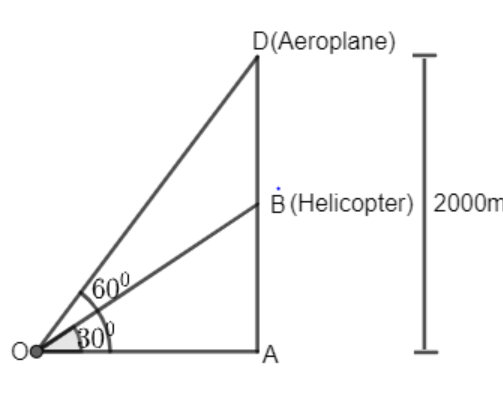
We have given that the elevation of both aeroplane and helicopter is ${{60}^{\circ }}$ and ${{30}^{\circ }}$ respectively
Now we have to find the vertical height of helicopter from ground i.e. AB
We have been given the vertical height of aeroplane from ground i.e. AD = 2000
We will first find the value of base OA through trigonometry in $\Delta OAD$
So, we have $\Delta OAD$ now we will apply,
$\begin{align}
& \tan {{60}^{\circ }}=\dfrac{Perpendicular}{Base} \\
& \Rightarrow \sqrt{3}=\dfrac{AD}{OA} \\
& \Rightarrow \sqrt{3}=\dfrac{2000}{OA} \\
& OA=\dfrac{2000}{\sqrt{3}}m...........(i) \\
\end{align}$
Now we will apply trigonometry in $\Delta OBA$
So, we have
$\begin{align}
& \tan {{30}^{\circ }}=\dfrac{AB}{OA} \\
& \dfrac{1}{\sqrt{3}}\times OA=AB \\
\end{align}$
We will substitute OA from (i)
$\begin{align}
& \dfrac{1}{\sqrt{3}}\times \dfrac{2000}{\sqrt{3}}=AB \\
& \dfrac{2000}{3}m=AB \\
\end{align}$
So, the vertical distance between helicopter and ground is $\dfrac{2000}{3}m$
Note: To solve these types of questions it is important to note that we have first applied trigonometric ratios in upper triangle DOA to find the base OA then we have applied trigonometry ratio in the smaller triangle BOA to find the height of the helicopter. It is also helpful to remember trigonometric relations like,
$\begin{align}
& \tan \theta =\dfrac{P}{B} \\
& \cos \theta =\dfrac{B}{H} \\
& \sin \theta =\dfrac{P}{H} \\
\end{align}$
We will first draw a diagram to understand the question
Complete step-by-step answer:
We have given that the elevation of both aeroplane and helicopter is ${{60}^{\circ }}$ and ${{30}^{\circ }}$ respectively
Now we have to find the vertical height of helicopter from ground i.e. AB
We have been given the vertical height of aeroplane from ground i.e. AD = 2000
We will first find the value of base OA through trigonometry in $\Delta OAD$
So, we have $\Delta OAD$ now we will apply,
$\begin{align}
& \tan {{60}^{\circ }}=\dfrac{Perpendicular}{Base} \\
& \Rightarrow \sqrt{3}=\dfrac{AD}{OA} \\
& \Rightarrow \sqrt{3}=\dfrac{2000}{OA} \\
& OA=\dfrac{2000}{\sqrt{3}}m...........(i) \\
\end{align}$
Now we will apply trigonometry in $\Delta OBA$
So, we have
$\begin{align}
& \tan {{30}^{\circ }}=\dfrac{AB}{OA} \\
& \dfrac{1}{\sqrt{3}}\times OA=AB \\
\end{align}$
We will substitute OA from (i)
$\begin{align}
& \dfrac{1}{\sqrt{3}}\times \dfrac{2000}{\sqrt{3}}=AB \\
& \dfrac{2000}{3}m=AB \\
\end{align}$
So, the vertical distance between helicopter and ground is $\dfrac{2000}{3}m$
Note: To solve these types of questions it is important to note that we have first applied trigonometric ratios in upper triangle DOA to find the base OA then we have applied trigonometry ratio in the smaller triangle BOA to find the height of the helicopter. It is also helpful to remember trigonometric relations like,
$\begin{align}
& \tan \theta =\dfrac{P}{B} \\
& \cos \theta =\dfrac{B}{H} \\
& \sin \theta =\dfrac{P}{H} \\
\end{align}$
Recently Updated Pages
Master Class 11 English: Engaging Questions & Answers for Success

Master Class 11 Social Science: Engaging Questions & Answers for Success
Master Class 11 Maths: Engaging Questions & Answers for Success
Master Class 11 Chemistry: Engaging Questions & Answers for Success
Master Class 11 Biology: Engaging Questions & Answers for Success
Master Class 11 Physics: Engaging Questions & Answers for Success
Trending doubts
One Metric ton is equal to kg A 10000 B 1000 C 100 class 11 physics CBSE
Difference Between Prokaryotic Cells and Eukaryotic Cells
Find the value of the expression given below sin 30circ class 11 maths CBSE
1 ton equals to A 100 kg B 1000 kg C 10 kg D 10000 class 11 physics CBSE
Two of the body parts which do not appear in MRI are class 11 biology CBSE
What are hard magnetic materials class 11 physics CBSE