




An aeroplane is moving in a circular path with a speed $250km/hr$ in a horizontal plane. The change in magnitude of velocity in half the revolution is:
$A)\text{ }500\text{ }km/hr$
$B)\text{ 2}50\text{ }km/hr$
$C)\text{ }125\text{ }km/hr$
D) 0
Answer
 Verified
658.5k+ views
Hint: The magnitude of velocity refers to the speed of a body. It changes only when there is an acceleration of the body that is in the same direction as the velocity of the body. If the acceleration of the body is perpendicular to the direction of velocity, the magnitude of velocity remains the same but the direction changes.
Complete step by step answer:
The magnitude of the velocity of a body, that is, its speed, changes only when there is an acceleration of the body in the direction of the velocity. An acceleration that is perpendicular to the velocity changes only the direction of the velocity but not its magnitude.
When a plane moves in a circular path in the horizontal plane, the centripetal acceleration is always perpendicular to the velocity of the plane. Hence, the centripetal acceleration constantly changes the direction of the velocity of the plane and helps it to stay on the circular path. However, it cannot change the magnitude of the velocity. The magnitude of velocity (or the speed) of the body remains constant in this case.
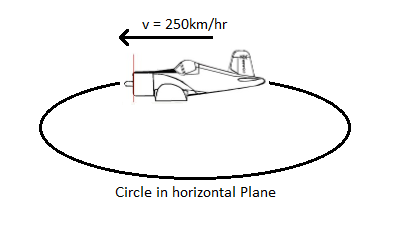
Hence, the change in magnitude of velocity of the plane in half the revolution is zero.
Hence, the correct option is D) 0.
Note: Students must correctly read the wordings, information given and the requirements of such tricky questions. Here the question asks for the change in magnitude of the velocity of the plane (that is the speed) and not the change in velocity of the plane. The change in the velocity of the plane will not be zero in half the revolution since the direction of its velocity will be completely reversed. Velocity is a vector quantity and hence has both direction and magnitude. Therefore, even if the direction changes but the magnitude remains the same, the velocity of the body is said to change. This can confuse a lot of students and lead them to committing silly errors.
Complete step by step answer:
The magnitude of the velocity of a body, that is, its speed, changes only when there is an acceleration of the body in the direction of the velocity. An acceleration that is perpendicular to the velocity changes only the direction of the velocity but not its magnitude.
When a plane moves in a circular path in the horizontal plane, the centripetal acceleration is always perpendicular to the velocity of the plane. Hence, the centripetal acceleration constantly changes the direction of the velocity of the plane and helps it to stay on the circular path. However, it cannot change the magnitude of the velocity. The magnitude of velocity (or the speed) of the body remains constant in this case.
Hence, the change in magnitude of velocity of the plane in half the revolution is zero.
Hence, the correct option is D) 0.
Note: Students must correctly read the wordings, information given and the requirements of such tricky questions. Here the question asks for the change in magnitude of the velocity of the plane (that is the speed) and not the change in velocity of the plane. The change in the velocity of the plane will not be zero in half the revolution since the direction of its velocity will be completely reversed. Velocity is a vector quantity and hence has both direction and magnitude. Therefore, even if the direction changes but the magnitude remains the same, the velocity of the body is said to change. This can confuse a lot of students and lead them to committing silly errors.
Recently Updated Pages
Master Class 11 Social Science: Engaging Questions & Answers for Success

Master Class 11 English: Engaging Questions & Answers for Success
Master Class 11 Accountancy: Engaging Questions & Answers for Success
Master Class 11 Physics: Engaging Questions & Answers for Success
Master Class 11 Computer Science: Engaging Questions & Answers for Success
Master Class 11 Business Studies: Engaging Questions & Answers for Success
Trending doubts
One Metric ton is equal to kg A 10000 B 1000 C 100 class 11 physics CBSE
Find the value of the expression given below sin 30circ class 11 maths CBSE
Draw a diagram of nephron and explain its structur class 11 biology CBSE
10 examples of friction in our daily life
Proton was discovered by A Thomson B Rutherford C Chadwick class 11 chemistry CBSE
The teeth used for biting and cutting food are called class 11 biology CBSE