




An aeroplane flying horizontally 1 km above the ground is observed at an elevation of ${{60}^{\circ }}$. After 10 s, if its elevation is observed to be ${{30}^{\circ }}$, then find the uniform speed of the aeroplane in km/h?
(a) $\dfrac{240}{\sqrt{2}}$,
(b) $240\sqrt{3}$,
(c) $240$,
(d) None of these.
Answer
 Verified
616.5k+ views
Hint: We start solving the problem by drawing the given information to get a better view. We then find the total distance travelled by the aeroplane in the given 10 s using the diagram we just drawn. We then find the speed of the aeroplane by dividing the obtained distance with 10 s. We then use the fact that $1s=\dfrac{1}{3600}h$ to get the required value of speed in km/h.
Complete step-by-step answer:
According to the problem, we have an aeroplane flying horizontally 1 km above the ground which is observed at an elevation of ${{60}^{\circ }}$. We need to find the uniform speed of aeroplane in km/h if the angle of elevation is observed to be ${{30}^{\circ }}$ after 10 s.
Let us draw the given information to get a better view.
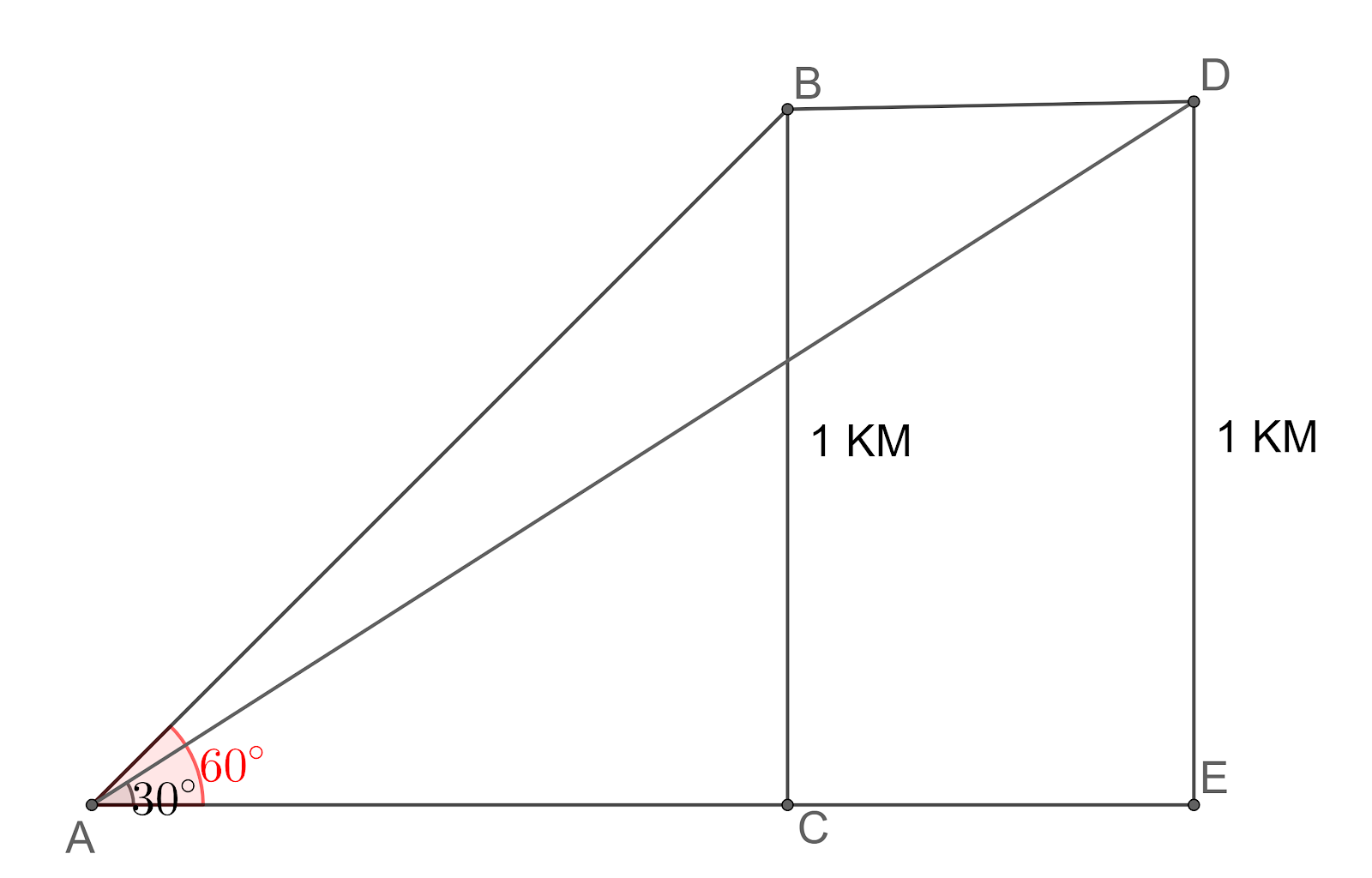
Let us assume that the aeroplane is at point B when the angle of elevation is ${{60}^{\circ }}$ and moves a distance BD after 10 seconds.
Let us first find the distance AC and AD.
From triangle ABC, we get $\tan {{60}^{\circ }}=\dfrac{BC}{AB}$.
$\Rightarrow \sqrt{3}=\dfrac{1}{AB}$.
$\Rightarrow AB=\dfrac{1}{\sqrt{3}}km$ ---(1).
From triangle AED, we get $\tan {{60}^{\circ }}=\dfrac{DE}{AE}$.
$\Rightarrow \dfrac{1}{\sqrt{3}}=\dfrac{1}{AE}$.
$\Rightarrow AE=\sqrt{3}km$ ---(2).
From the figure we can see that $BE=CD=AE-AB$.
$\Rightarrow BE=\sqrt{3}-\dfrac{1}{\sqrt{3}}$.
$\Rightarrow CD=\dfrac{3-1}{\sqrt{3}}$.
$\Rightarrow CD=\dfrac{2}{\sqrt{3}}km$.
So, the aeroplane travelled $\dfrac{2}{\sqrt{3}}km$ in 10 s. Using we get the speed of the aeroplane as $\dfrac{\dfrac{2}{\sqrt{3}}}{10}=\dfrac{1}{5\sqrt{3}}km/s$.
We know that the 1 hour = 3600 s. Using this we get $1s=\dfrac{1}{3600}h$.
So, we get speed of aeroplane as $s=\dfrac{\dfrac{1}{5\sqrt{3}}}{\dfrac{1}{3600}}km/h$.
$\Rightarrow s=\dfrac{720}{\sqrt{3}}km/h$.
$\Rightarrow s=240\sqrt{3}km/h$.
So, we have found the speed of the aeroplane as $240\sqrt{3}km/h$.
So, the correct answer is “Option (b)”.
Note: We should not stop solving the problem after finding the speed in km/s, as it is mentioned km/h in the problem. Whenever we are asked to solve this type of problems we need to draw the diagram first to get a better view. We have assumed that distance of aeroplane above the ground is not changing throughout the problem. We should not make calculation mistakes while solving this problem.
Complete step-by-step answer:
According to the problem, we have an aeroplane flying horizontally 1 km above the ground which is observed at an elevation of ${{60}^{\circ }}$. We need to find the uniform speed of aeroplane in km/h if the angle of elevation is observed to be ${{30}^{\circ }}$ after 10 s.
Let us draw the given information to get a better view.
Let us assume that the aeroplane is at point B when the angle of elevation is ${{60}^{\circ }}$ and moves a distance BD after 10 seconds.
Let us first find the distance AC and AD.
From triangle ABC, we get $\tan {{60}^{\circ }}=\dfrac{BC}{AB}$.
$\Rightarrow \sqrt{3}=\dfrac{1}{AB}$.
$\Rightarrow AB=\dfrac{1}{\sqrt{3}}km$ ---(1).
From triangle AED, we get $\tan {{60}^{\circ }}=\dfrac{DE}{AE}$.
$\Rightarrow \dfrac{1}{\sqrt{3}}=\dfrac{1}{AE}$.
$\Rightarrow AE=\sqrt{3}km$ ---(2).
From the figure we can see that $BE=CD=AE-AB$.
$\Rightarrow BE=\sqrt{3}-\dfrac{1}{\sqrt{3}}$.
$\Rightarrow CD=\dfrac{3-1}{\sqrt{3}}$.
$\Rightarrow CD=\dfrac{2}{\sqrt{3}}km$.
So, the aeroplane travelled $\dfrac{2}{\sqrt{3}}km$ in 10 s. Using we get the speed of the aeroplane as $\dfrac{\dfrac{2}{\sqrt{3}}}{10}=\dfrac{1}{5\sqrt{3}}km/s$.
We know that the 1 hour = 3600 s. Using this we get $1s=\dfrac{1}{3600}h$.
So, we get speed of aeroplane as $s=\dfrac{\dfrac{1}{5\sqrt{3}}}{\dfrac{1}{3600}}km/h$.
$\Rightarrow s=\dfrac{720}{\sqrt{3}}km/h$.
$\Rightarrow s=240\sqrt{3}km/h$.
So, we have found the speed of the aeroplane as $240\sqrt{3}km/h$.
So, the correct answer is “Option (b)”.
Note: We should not stop solving the problem after finding the speed in km/s, as it is mentioned km/h in the problem. Whenever we are asked to solve this type of problems we need to draw the diagram first to get a better view. We have assumed that distance of aeroplane above the ground is not changing throughout the problem. We should not make calculation mistakes while solving this problem.
Recently Updated Pages
Master Class 12 Economics: Engaging Questions & Answers for Success

Master Class 12 English: Engaging Questions & Answers for Success
Master Class 12 Social Science: Engaging Questions & Answers for Success
Master Class 12 Maths: Engaging Questions & Answers for Success
Master Class 12 Physics: Engaging Questions & Answers for Success
Master Class 11 Social Science: Engaging Questions & Answers for Success
Trending doubts
One Metric ton is equal to kg A 10000 B 1000 C 100 class 11 physics CBSE
Difference Between Prokaryotic Cells and Eukaryotic Cells
Find the value of the expression given below sin 30circ class 11 maths CBSE
Two of the body parts which do not appear in MRI are class 11 biology CBSE
Draw a diagram of nephron and explain its structur class 11 biology CBSE
10 examples of friction in our daily life