




An aeroplane flying horizontal 1.2 km above the ground is observed at an $\angle 60{}^\circ $. After 15 sec elevation $\angle $ is observed as $\angle 30{}^\circ $. Find the speed of the aeroplane in km/hr. $\left( \sqrt{3}=1.73 \right)$.
Answer
 Verified
633k+ views
Hint: We will first draw the figure as per the conditions given in the question. An aeroplane is flying horizontal 1.2 km above the ground at an $\angle 60{}^\circ $. We have the height of the perpendicular and the and angle. So, we can find the distance from where we are observing the aeroplane by using the formula, $\tan \theta =\dfrac{perpendicular}{base}$. Similarly, we can find the distance after 15 sec from the point where we are observing the plane to the point on the ground where the aeroplane is perpendicular after 15 sec. Then we can find the distance travelled by plane in 15 sec by subtracting the distances. And finally using the formula of speed, $S=\dfrac{\text{distance}}{\text{time}}$, we can find the speed of the aeroplane.
Complete step by step solution:
We have been given that an aeroplane is flying horizontally 1.2 km above the ground at an $\angle 60{}^\circ $. After 15 sec elevation $\angle $ is observed as $\angle 30{}^\circ $. And we have to find the speed of the aeroplane. We will first draw the figure as per the conditions given in the question as below.
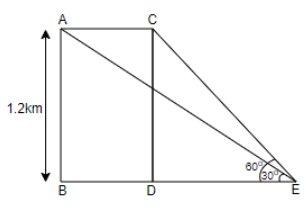
We have been given that the distance from the ground is 1.2 km. Now, using the formula, $\tan \theta =\dfrac{perpendicular}{base}$ in $\Delta CDE$ (as it is a right angled triangle), we have the perpendicular or height = CD, which is equal to AB = 1.2 km. And we have the base as DE, angle is $60{}^\circ $. So, we will get,
$\begin{align}
& \tan 60{}^\circ =\dfrac{1.2}{DE} \\
& \Rightarrow DE=\dfrac{1.2}{\tan 60{}^\circ } \\
\end{align}$
We know that $\tan 60{}^\circ =\sqrt{3}$, so we get,
$DE=\dfrac{1.2}{\sqrt{3}}km\ldots \ldots \ldots \left( i \right)$
We will now rationalise the above equality by multiplying the numerator and denominator by $\sqrt{3}$. So, we get,
$\begin{align}
& DE=\dfrac{1.2}{\sqrt{3}}\times \dfrac{\sqrt{3}}{\sqrt{3}} \\
& \Rightarrow DE=\dfrac{1.2\times \sqrt{3}}{3} \\
& \Rightarrow DE=0.4\times \sqrt{3}km\ldots \ldots \ldots \left( ii \right) \\
\end{align}$
Now, we will take $\Delta ABE$(as it is a right angled triangle), where we have the perpendicular is AB = 1.2 km and the base is BD + DE, which can be written as $BD+0.4\sqrt{3}$ and the angle is $30{}^\circ $. So, putting these values in the formula, we get,
$\begin{align}
& \tan 30{}^\circ =\dfrac{1.2}{BD+0.4\sqrt{3}} \\
& \Rightarrow \tan 30{}^\circ \left( BD+0.4\sqrt{3} \right)=1.2 \\
\end{align}$
We know that $\tan 30{}^\circ =\dfrac{1}{\sqrt{3}}$, so we get,
$\begin{align}
& \dfrac{1}{\sqrt{3}}\left( BD+0.4\sqrt{3} \right)=1.2 \\
& \Rightarrow BD+0.4\sqrt{3}=1.2\sqrt{3} \\
& \Rightarrow BD=1.2\sqrt{3}-0.4\sqrt{3} \\
& \Rightarrow BD=\sqrt{3}\left( 1.2-0.4 \right) \\
& \Rightarrow BD=\sqrt{3}\left( 0.8 \right)km \\
\end{align}$
So, the distance travelled by the aeroplane in 15 sec is $0.8\sqrt{3}km$. Now it is given in the question that $\sqrt{3}=1.73$, So, we get the value of BD as,
$\begin{align}
& BD=0.8\times 1.73 \\
& \Rightarrow BD=1.384km \\
\end{align}$
Now, we have to find the speed in km/hr. So, we have to convert 15 sec into hr. We know that,
$\begin{align}
& 3600\sec =1hr \\
& \Rightarrow 1\sec =\dfrac{1}{3600}hr \\
& \Rightarrow 15\sec =\dfrac{15}{3600}hr \\
\end{align}$
Now, we will use the formula of speed, $S=\dfrac{\text{distance}}{\text{time}}$. So, using the obtained values, we will get,
$\begin{align}
& S=\dfrac{1.384}{\dfrac{15}{3600}}\dfrac{km}{hr} \\
& \Rightarrow S=\dfrac{1.384}{15}\times 3600\dfrac{km}{hr} \\
& \Rightarrow S=\dfrac{4982.4}{15}\dfrac{km}{hr} \\
& \Rightarrow S=332.16\dfrac{km}{hr} \\
\end{align}$
Hence, we get the speed of the aeroplane as 332.16 km/hr.
Note: There are a number of possible mistakes that the students can do while solving this question. They may forget to convert 15 sec into an hour as the question has been asked in km/hr. There is also a chance that they may misinterpret the question and draw the wrong diagram. They can also do simple calculation mistakes also.
Complete step by step solution:
We have been given that an aeroplane is flying horizontally 1.2 km above the ground at an $\angle 60{}^\circ $. After 15 sec elevation $\angle $ is observed as $\angle 30{}^\circ $. And we have to find the speed of the aeroplane. We will first draw the figure as per the conditions given in the question as below.
We have been given that the distance from the ground is 1.2 km. Now, using the formula, $\tan \theta =\dfrac{perpendicular}{base}$ in $\Delta CDE$ (as it is a right angled triangle), we have the perpendicular or height = CD, which is equal to AB = 1.2 km. And we have the base as DE, angle is $60{}^\circ $. So, we will get,
$\begin{align}
& \tan 60{}^\circ =\dfrac{1.2}{DE} \\
& \Rightarrow DE=\dfrac{1.2}{\tan 60{}^\circ } \\
\end{align}$
We know that $\tan 60{}^\circ =\sqrt{3}$, so we get,
$DE=\dfrac{1.2}{\sqrt{3}}km\ldots \ldots \ldots \left( i \right)$
We will now rationalise the above equality by multiplying the numerator and denominator by $\sqrt{3}$. So, we get,
$\begin{align}
& DE=\dfrac{1.2}{\sqrt{3}}\times \dfrac{\sqrt{3}}{\sqrt{3}} \\
& \Rightarrow DE=\dfrac{1.2\times \sqrt{3}}{3} \\
& \Rightarrow DE=0.4\times \sqrt{3}km\ldots \ldots \ldots \left( ii \right) \\
\end{align}$
Now, we will take $\Delta ABE$(as it is a right angled triangle), where we have the perpendicular is AB = 1.2 km and the base is BD + DE, which can be written as $BD+0.4\sqrt{3}$ and the angle is $30{}^\circ $. So, putting these values in the formula, we get,
$\begin{align}
& \tan 30{}^\circ =\dfrac{1.2}{BD+0.4\sqrt{3}} \\
& \Rightarrow \tan 30{}^\circ \left( BD+0.4\sqrt{3} \right)=1.2 \\
\end{align}$
We know that $\tan 30{}^\circ =\dfrac{1}{\sqrt{3}}$, so we get,
$\begin{align}
& \dfrac{1}{\sqrt{3}}\left( BD+0.4\sqrt{3} \right)=1.2 \\
& \Rightarrow BD+0.4\sqrt{3}=1.2\sqrt{3} \\
& \Rightarrow BD=1.2\sqrt{3}-0.4\sqrt{3} \\
& \Rightarrow BD=\sqrt{3}\left( 1.2-0.4 \right) \\
& \Rightarrow BD=\sqrt{3}\left( 0.8 \right)km \\
\end{align}$
So, the distance travelled by the aeroplane in 15 sec is $0.8\sqrt{3}km$. Now it is given in the question that $\sqrt{3}=1.73$, So, we get the value of BD as,
$\begin{align}
& BD=0.8\times 1.73 \\
& \Rightarrow BD=1.384km \\
\end{align}$
Now, we have to find the speed in km/hr. So, we have to convert 15 sec into hr. We know that,
$\begin{align}
& 3600\sec =1hr \\
& \Rightarrow 1\sec =\dfrac{1}{3600}hr \\
& \Rightarrow 15\sec =\dfrac{15}{3600}hr \\
\end{align}$
Now, we will use the formula of speed, $S=\dfrac{\text{distance}}{\text{time}}$. So, using the obtained values, we will get,
$\begin{align}
& S=\dfrac{1.384}{\dfrac{15}{3600}}\dfrac{km}{hr} \\
& \Rightarrow S=\dfrac{1.384}{15}\times 3600\dfrac{km}{hr} \\
& \Rightarrow S=\dfrac{4982.4}{15}\dfrac{km}{hr} \\
& \Rightarrow S=332.16\dfrac{km}{hr} \\
\end{align}$
Hence, we get the speed of the aeroplane as 332.16 km/hr.
Note: There are a number of possible mistakes that the students can do while solving this question. They may forget to convert 15 sec into an hour as the question has been asked in km/hr. There is also a chance that they may misinterpret the question and draw the wrong diagram. They can also do simple calculation mistakes also.
Recently Updated Pages
Master Class 11 English: Engaging Questions & Answers for Success

Master Class 11 Social Science: Engaging Questions & Answers for Success
Master Class 11 Maths: Engaging Questions & Answers for Success
Master Class 11 Biology: Engaging Questions & Answers for Success
Master Class 11 Physics: Engaging Questions & Answers for Success
Master Class 11 Chemistry: Engaging Questions & Answers for Success
Trending doubts
Explain the Treaty of Vienna of 1815 class 10 social science CBSE
What is the full form of CNG A Complete Natural Gas class 10 social science CBSE
In cricket, what is a "Yorker" designed to do?
What is the full form of POSCO class 10 social science CBSE
Define Potential, Developed, Stock and Reserved resources
What were the majoritarian measures taken in Sri Lanka class 10 social science CBSE