




$\alpha $ And $\beta $ forms of Sulphur, both are stable at:
(A) ${369^ \circ }C$
(B) 369K
(C) ${36^ \circ }C$
(D) ${69^ \circ }C$
Answer
 Verified
640.5k+ views
Hint: Sulphur is a chemical element with the symbol S and atomic number 16. It is a non-metal and is obtained as a byproduct after the production of natural gas. It is bright yellow in color. The two most important allotropes of Sulphur are yellow rhombic Sulphur ($\alpha $ Sulphur) and monoclinic ($\beta $ Sulphur).
Complete step by step answer:
Sulphur is the tenth most common element by mass in the universe and the fifth most common on the Earth. It is found in group 16 in the periodic table.
Further, it consists of two main allotropes namely yellow rhombic Sulphur ($\alpha $ Sulphur) and monoclinic ($\beta $ Sulphur). The allotropes of Sulphur are inter-convertible i.e. rhombic Sulphur when heated above $369K$ gives monoclinic Sulphur.
Now, rhombic Sulphur is crystalline in nature and has an octahedral shape. It cannot be dissolved in water but can be dissolved in benzene, ether and alcohol whereas when we take a dish and melt the rhombic sulphur, we obtain monoclinic sulphur after cooling it.
The most interesting fact is that both the allotropes of sulphur are stable at a temperature of $369K$ and this temperature is known as transition temperature. In other words, we can say that $\alpha $ Sulphur is stable below 369K and it becomes $\beta $ Sulphur above that temperature.
Their structures are as shown:
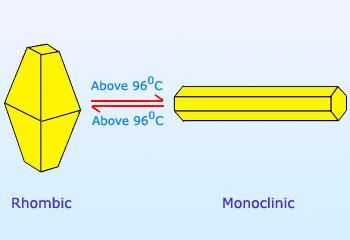
Hence, option B is correct.
Note: Sulphur plays a vital role in our ecosystem by affecting the growth of plants. This has led to the development of many sulphur containing fertilizers. Moreover, it is used in many bleaching agents and also in the manufacturing of carbon disulphide which in turn is used in skin ointments and other such products.
Complete step by step answer:
Sulphur is the tenth most common element by mass in the universe and the fifth most common on the Earth. It is found in group 16 in the periodic table.
Further, it consists of two main allotropes namely yellow rhombic Sulphur ($\alpha $ Sulphur) and monoclinic ($\beta $ Sulphur). The allotropes of Sulphur are inter-convertible i.e. rhombic Sulphur when heated above $369K$ gives monoclinic Sulphur.
Now, rhombic Sulphur is crystalline in nature and has an octahedral shape. It cannot be dissolved in water but can be dissolved in benzene, ether and alcohol whereas when we take a dish and melt the rhombic sulphur, we obtain monoclinic sulphur after cooling it.
The most interesting fact is that both the allotropes of sulphur are stable at a temperature of $369K$ and this temperature is known as transition temperature. In other words, we can say that $\alpha $ Sulphur is stable below 369K and it becomes $\beta $ Sulphur above that temperature.
Their structures are as shown:
Hence, option B is correct.
Note: Sulphur plays a vital role in our ecosystem by affecting the growth of plants. This has led to the development of many sulphur containing fertilizers. Moreover, it is used in many bleaching agents and also in the manufacturing of carbon disulphide which in turn is used in skin ointments and other such products.
Recently Updated Pages
Basicity of sulphurous acid and sulphuric acid are

Master Class 11 English: Engaging Questions & Answers for Success
Master Class 11 Physics: Engaging Questions & Answers for Success
Master Class 11 Computer Science: Engaging Questions & Answers for Success
Master Class 11 Chemistry: Engaging Questions & Answers for Success
Master Class 11 Social Science: Engaging Questions & Answers for Success
Trending doubts
Difference Between Prokaryotic Cells and Eukaryotic Cells
Two of the body parts which do not appear in MRI are class 11 biology CBSE
One Metric ton is equal to kg A 10000 B 1000 C 100 class 11 physics CBSE
10 examples of friction in our daily life
Draw a diagram of nephron and explain its structur class 11 biology CBSE
What will happen if the mucus is not secreted by the class 11 biology CBSE