




All pulleys are light & smooth, strings are light & inextensible. Consider the case when \[\text{M}\to \infty \] (see fig).
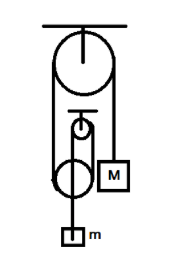
A. Acceleration of \[m\] is \[g\] upwards.
B. Net force of \[m\] is \[\dfrac{mg}{3}\] upwards.
C. Tension in the string connecting \[M\] is \[\dfrac{4mg}{9}\].
D. Tension in the string connecting \[m\] is \[2mg\].
Answer
 Verified
613.8k+ views
Hint: First we need to mark the tension on the strings attached with masses and pulleys. After that we need to equate the tension on smaller mass, with the force generated from the acceleration due to smaller mass and add it with the force generated from the gravity. The formula of tension due to acceleration and gravity is written as:
For Acceleration:
\[T=ma\]
For Acceleration due to gravity:
\[T=mg\]
where \[T\] is the tension applied on the strings, \[m\] is the mass of the blocks, \[a\] is the acceleration and \[g\] is the acceleration due to gravity \[9.8m{{s}^{-2}}\].
Complete step by step solution:
The tension generated from the pulley and the two masses \[m,M\] respectively is given as \[T\] as shown below:
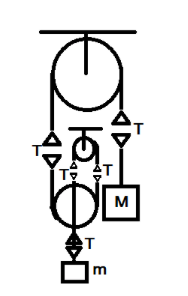
The force generated by the smaller mass \[m\], due to its own weight is given as \[F=ma\].
The force due to acceleration by gravity, generated by the smaller mass \[m\], due to its own weight is given as \[F=mg\].
The force generated by the bigger mass \[M\], due to its own weight is given as \[F=-Ma\]. The force is negative as the mass is small compared to the mass \[m\] and pulley weight together, hence will move upwards instead of downwards.
The force due to acceleration by gravity, generated by the bigger mass \[M\], due to its own weight is given as \[F=Mg\].
The relationship between both the masses along with their tension is given as:
\[T=mg+ma\] …(1)
\[T=Mg-Ma\] …(2)
Placing the values of the tension in the (2) equation to (1) equation. We get the equation between both the masses and acceleration and gravity as:
\[\left( \dfrac{M-m}{M+m} \right)g=a\]
Now, the mass of the bigger block i.e. \[M\] is taken as \[\infty \], the final equation will be:
\[\Rightarrow \left( \dfrac{\dfrac{M-m}{M}}{\dfrac{M+m}{M}} \right)g=a\] (Dividing both the numerator and denominator with \[M\])
\[\Rightarrow \left( \dfrac{1-\dfrac{m}{M}}{1+\dfrac{m}{M}} \right)g=a\]
With \[M\] is taken as \[\infty \], the value of \[\dfrac{1}{\infty }=0\]:
\[\Rightarrow \left( \dfrac{1-0}{1+0} \right)g=a\]
\[\Rightarrow a=g\]
Now both the acceleration and gravity are same in this scenario hence, placing the value of acceleration \[a\], as \[a=g\] in the equations we get:
For mass \[m\]:
\[T=mg+ma\]
\[\Rightarrow T=mg+mg\]
\[\Rightarrow T=2mg\] …(3)
For mass \[M\]:
\[T=Mg-Ma\]
\[\Rightarrow T=Mg-Mg\]
\[\Rightarrow T=0\] …(4)
Therefore, the tension generated due to mass \[m\], is \[2mg\].
So, option D is correct
Note: Students may go wrong while finding the force due to acceleration for the bigger mass which is negative as in this case the mass M is moving upwards due to mass and pulley weight on the other side. When force goes in the same direction they add up but with acceleration going in the opposite direction a negative side has been added to the force to separate the force due to acceleration and force due to gravity.
For Acceleration:
\[T=ma\]
For Acceleration due to gravity:
\[T=mg\]
where \[T\] is the tension applied on the strings, \[m\] is the mass of the blocks, \[a\] is the acceleration and \[g\] is the acceleration due to gravity \[9.8m{{s}^{-2}}\].
Complete step by step solution:
The tension generated from the pulley and the two masses \[m,M\] respectively is given as \[T\] as shown below:
The force generated by the smaller mass \[m\], due to its own weight is given as \[F=ma\].
The force due to acceleration by gravity, generated by the smaller mass \[m\], due to its own weight is given as \[F=mg\].
The force generated by the bigger mass \[M\], due to its own weight is given as \[F=-Ma\]. The force is negative as the mass is small compared to the mass \[m\] and pulley weight together, hence will move upwards instead of downwards.
The force due to acceleration by gravity, generated by the bigger mass \[M\], due to its own weight is given as \[F=Mg\].
The relationship between both the masses along with their tension is given as:
\[T=mg+ma\] …(1)
\[T=Mg-Ma\] …(2)
Placing the values of the tension in the (2) equation to (1) equation. We get the equation between both the masses and acceleration and gravity as:
\[\left( \dfrac{M-m}{M+m} \right)g=a\]
Now, the mass of the bigger block i.e. \[M\] is taken as \[\infty \], the final equation will be:
\[\Rightarrow \left( \dfrac{\dfrac{M-m}{M}}{\dfrac{M+m}{M}} \right)g=a\] (Dividing both the numerator and denominator with \[M\])
\[\Rightarrow \left( \dfrac{1-\dfrac{m}{M}}{1+\dfrac{m}{M}} \right)g=a\]
With \[M\] is taken as \[\infty \], the value of \[\dfrac{1}{\infty }=0\]:
\[\Rightarrow \left( \dfrac{1-0}{1+0} \right)g=a\]
\[\Rightarrow a=g\]
Now both the acceleration and gravity are same in this scenario hence, placing the value of acceleration \[a\], as \[a=g\] in the equations we get:
For mass \[m\]:
\[T=mg+ma\]
\[\Rightarrow T=mg+mg\]
\[\Rightarrow T=2mg\] …(3)
For mass \[M\]:
\[T=Mg-Ma\]
\[\Rightarrow T=Mg-Mg\]
\[\Rightarrow T=0\] …(4)
Therefore, the tension generated due to mass \[m\], is \[2mg\].
So, option D is correct
Note: Students may go wrong while finding the force due to acceleration for the bigger mass which is negative as in this case the mass M is moving upwards due to mass and pulley weight on the other side. When force goes in the same direction they add up but with acceleration going in the opposite direction a negative side has been added to the force to separate the force due to acceleration and force due to gravity.
Recently Updated Pages
Master Class 11 Social Science: Engaging Questions & Answers for Success

Master Class 11 Chemistry: Engaging Questions & Answers for Success
Master Class 12 Business Studies: Engaging Questions & Answers for Success
Master Class 12 Chemistry: Engaging Questions & Answers for Success
Master Class 12 Biology: Engaging Questions & Answers for Success
Class 12 Question and Answer - Your Ultimate Solutions Guide
Trending doubts
One Metric ton is equal to kg A 10000 B 1000 C 100 class 11 physics CBSE
Difference Between Prokaryotic Cells and Eukaryotic Cells
How many of the following diseases can be studied with class 11 biology CBSE
Two of the body parts which do not appear in MRI are class 11 biology CBSE
Which of the following enzymes is used for carboxylation class 11 biology CBSE
Explain zero factorial class 11 maths CBSE