




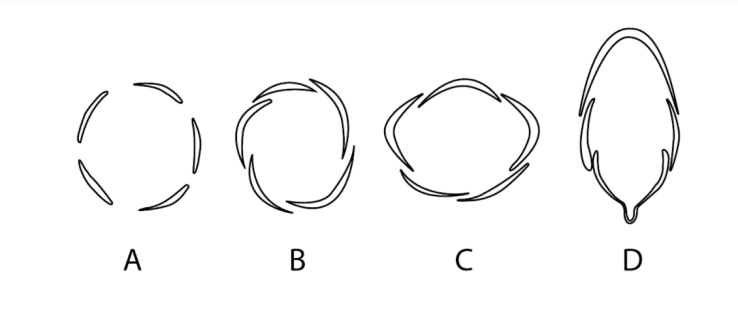
Aestivation of petals in the flowers of cotton is shown correctly in which of the given diagrams?
Answer
 Verified
561.6k+ views
Hint: Aestivation is defined in a flower bud as a mode of organization of petals or sepals. Aestivation of the petals in the cotton flowers suggests overlap. In the entire petals of the individual flower, this overlap is regular.
Complete answer:
Cotton is owned by the Malvaceae family. The corolla of these flowers reveals distorted aestivation, in which the next petal overlaps one edge of the petal and the other overlaps it. This is a kind of regular overlapping.
The margins of sepals or petals converge in one direction in Malvaceae.
China rose is a further example of twisted aestivation.
Additional information:
-(a) In mustard it is valvate aestivation seen. Without overlapping, the sepals/petals are close to each other.
-(b) In cotton, it is a twisted aestivation seen.
-(c) In peas, vexillary aestivation is seen. The posterior one is the largest of the five sepals/petals and the external one almost entirely covers two lateral members, which in turn overlap the two small anterior sepals/petals.
-(d) It is the aestivation of imbricate seen in Cassia. One is totally internal overlapping on both margins out of five sepals/petals and one is totally external with the rest of the members arranged as in twisted aestivation.
So, the correct answer is, option ‘b’.
Note:
Modified leaves that cover the reproductive sections of flowers are petals. In order to attract pollinators, they are often brightly colored or unusually shaped. Together, both of a flower's petals are called the corolla. In general, petals are followed by another group of special leaves, such as structures called sepals, which form the calyx collectively and lie just under the corolla. Both the calyx and the corolla together form the perianth. They are collectively called tepals when the petals and sepals of a flower are difficult to distinguish.
Complete answer:
Cotton is owned by the Malvaceae family. The corolla of these flowers reveals distorted aestivation, in which the next petal overlaps one edge of the petal and the other overlaps it. This is a kind of regular overlapping.
The margins of sepals or petals converge in one direction in Malvaceae.
China rose is a further example of twisted aestivation.
Additional information:
-(a) In mustard it is valvate aestivation seen. Without overlapping, the sepals/petals are close to each other.
-(b) In cotton, it is a twisted aestivation seen.
-(c) In peas, vexillary aestivation is seen. The posterior one is the largest of the five sepals/petals and the external one almost entirely covers two lateral members, which in turn overlap the two small anterior sepals/petals.
-(d) It is the aestivation of imbricate seen in Cassia. One is totally internal overlapping on both margins out of five sepals/petals and one is totally external with the rest of the members arranged as in twisted aestivation.
So, the correct answer is, option ‘b’.
Note:
Modified leaves that cover the reproductive sections of flowers are petals. In order to attract pollinators, they are often brightly colored or unusually shaped. Together, both of a flower's petals are called the corolla. In general, petals are followed by another group of special leaves, such as structures called sepals, which form the calyx collectively and lie just under the corolla. Both the calyx and the corolla together form the perianth. They are collectively called tepals when the petals and sepals of a flower are difficult to distinguish.
Recently Updated Pages
Basicity of sulphurous acid and sulphuric acid are

Master Class 11 English: Engaging Questions & Answers for Success
Master Class 11 Physics: Engaging Questions & Answers for Success
Master Class 11 Computer Science: Engaging Questions & Answers for Success
Master Class 11 Chemistry: Engaging Questions & Answers for Success
Master Class 11 Social Science: Engaging Questions & Answers for Success
Trending doubts
Difference Between Prokaryotic Cells and Eukaryotic Cells
Two of the body parts which do not appear in MRI are class 11 biology CBSE
One Metric ton is equal to kg A 10000 B 1000 C 100 class 11 physics CBSE
10 examples of friction in our daily life
Draw a diagram of nephron and explain its structur class 11 biology CBSE
What will happen if the mucus is not secreted by the class 11 biology CBSE