




What is the advantage of closed stomata to a plant when water is in short supply?
Answer
 Verified
621.9k+ views
Hint: The tiny openings or pores in plant tissue that allow for gas exchange are known as Stomata or stoma. They are found in the epidermis of plant leaves but can also be found in some stems.
Complete Step by Step Answer:
The water vapor leaves the plant and carbon dioxide enters through the stomata in the leaf. A pair of special cells called guard cells which are specialized parenchyma cells to control each pore's opening or closing. These guard cells swell with water becoming bloated and open the stoma, and guard cells release the water present and close the stoma. Transpiration rates increase when stomata are open and transpiration rates decrease when they are closed. They play a major role in the plant for photosynthesis by helping in the intake of carbon dioxide and release of oxygen. There is a loss of water due to gas exchange during this process.
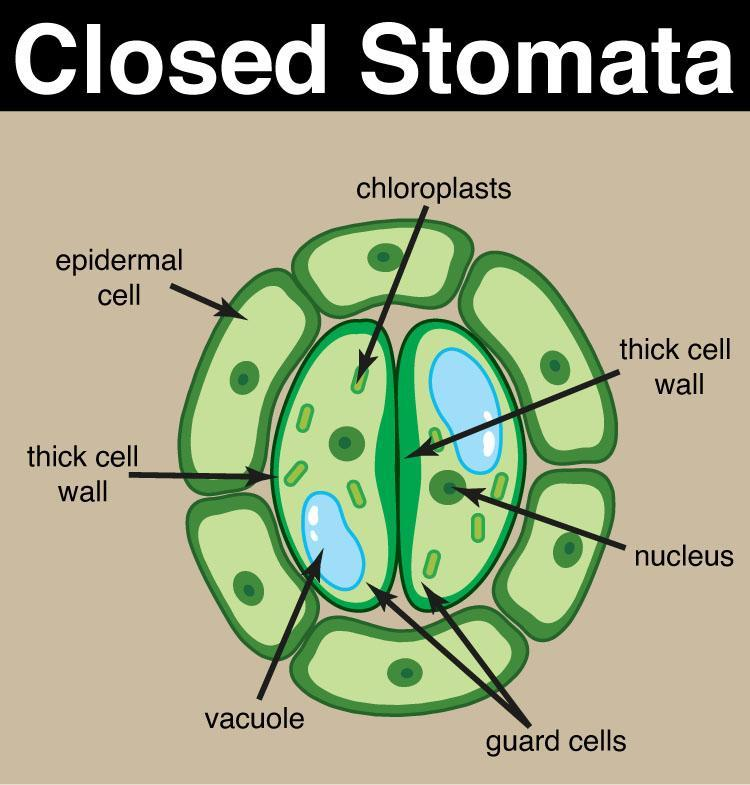
In a shortage of water supply, the stomata help maintain the water level in the plant by saving water. It avoids the evaporation and loss of water content. But this also means that the exchange of gas is no longer possible and limits their carbon supplies. The stomata open during the daytime to ensure less water loss for photosynthesis.
Note: The process of water movement through a plant so there is evaporation from aerial parts like leaves, stems, and a flower is known as transpiration. The water evaporated depends on how much water is present in the soil, environmental conditions like temperature, humidity, and wind. There is a loss of water in the process of transpiration that creates a suction force and pulls up additional water from the roots. This process aids the plant to gather vital minerals from the soil.
Complete Step by Step Answer:
The water vapor leaves the plant and carbon dioxide enters through the stomata in the leaf. A pair of special cells called guard cells which are specialized parenchyma cells to control each pore's opening or closing. These guard cells swell with water becoming bloated and open the stoma, and guard cells release the water present and close the stoma. Transpiration rates increase when stomata are open and transpiration rates decrease when they are closed. They play a major role in the plant for photosynthesis by helping in the intake of carbon dioxide and release of oxygen. There is a loss of water due to gas exchange during this process.
In a shortage of water supply, the stomata help maintain the water level in the plant by saving water. It avoids the evaporation and loss of water content. But this also means that the exchange of gas is no longer possible and limits their carbon supplies. The stomata open during the daytime to ensure less water loss for photosynthesis.
Note: The process of water movement through a plant so there is evaporation from aerial parts like leaves, stems, and a flower is known as transpiration. The water evaporated depends on how much water is present in the soil, environmental conditions like temperature, humidity, and wind. There is a loss of water in the process of transpiration that creates a suction force and pulls up additional water from the roots. This process aids the plant to gather vital minerals from the soil.
Recently Updated Pages
Master Class 11 English: Engaging Questions & Answers for Success

Master Class 11 Social Science: Engaging Questions & Answers for Success
Master Class 11 Maths: Engaging Questions & Answers for Success
Master Class 11 Biology: Engaging Questions & Answers for Success
Master Class 11 Physics: Engaging Questions & Answers for Success
Master Class 11 Chemistry: Engaging Questions & Answers for Success
Trending doubts
One Metric ton is equal to kg A 10000 B 1000 C 100 class 11 physics CBSE
Difference Between Prokaryotic Cells and Eukaryotic Cells
Find the value of the expression given below sin 30circ class 11 maths CBSE
Two of the body parts which do not appear in MRI are class 11 biology CBSE
Draw a diagram of a plant cell and label at least eight class 11 biology CBSE
10 examples of friction in our daily life