




Adjacent sides of polygon are:
A. Any two sides of the polygon
B. Any two sides of connecting two non-consecutive vertices of a polygon
C. Any two sides with a common vertex
D. None of these
Answer
 Verified
645.9k+ views
Hint: Draw a polygon which is a closed figure, bounded by straight line segments. Now compare any 2 sides of the polygon we have drawn. It can be a triangle, rectangle or any figure. Compare the adjacent sides.
Complete step-by-step answer:
Adjacent sides of a polygon are two lines that meet at the vertex of a polygon. They can be usually found in triangles and other polygons. The two sides that meet at a vertex of the polygon are called the adjacent side. This can be understood clearly by the diagram.
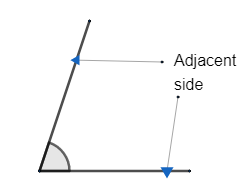
We can also take an example of a different polygon which is a closed figure, bounded by a straight line segment.
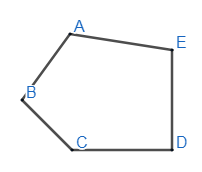
Observe the polygon we have drawn. The line segments forming a polygon are called its sides. The sides of the given polygon are AB, BC, CD, DE and EA.
Let us check the side AB and BC for example. AB has endpoint B and BC has an end point B. in AB and BC has common end point B. Thus, we can call AB and BC as the adjacent sides of the polygon. Thus any two sides having a common end point are adjacent sides. The other pair of adjacent sides of the polygon are B and CD, CD and DE, DE and EA, and EA and AB.
Similarly we can take other examples of polygons like triangle, cube, rectangle or any quadrilateral.
$\therefore $ Adjacent sides of a polygon are any two sides with a common vertex.
$\therefore $ Option (C) is the correct answer.
Note: Now consecutive sides are two sides of a polygon which share a common angle. We can see consecutive sides in any figure such as triangle, rectangle etc.Students should remember 3 characteristics of polygons. (1) Polygon is a closed shape in the plane, (2) the sides of a polygon are line segments, and (3) the sides of a polygon meet only at endpoints.
Complete step-by-step answer:
Adjacent sides of a polygon are two lines that meet at the vertex of a polygon. They can be usually found in triangles and other polygons. The two sides that meet at a vertex of the polygon are called the adjacent side. This can be understood clearly by the diagram.
We can also take an example of a different polygon which is a closed figure, bounded by a straight line segment.
Observe the polygon we have drawn. The line segments forming a polygon are called its sides. The sides of the given polygon are AB, BC, CD, DE and EA.
Let us check the side AB and BC for example. AB has endpoint B and BC has an end point B. in AB and BC has common end point B. Thus, we can call AB and BC as the adjacent sides of the polygon. Thus any two sides having a common end point are adjacent sides. The other pair of adjacent sides of the polygon are B and CD, CD and DE, DE and EA, and EA and AB.
Similarly we can take other examples of polygons like triangle, cube, rectangle or any quadrilateral.
$\therefore $ Adjacent sides of a polygon are any two sides with a common vertex.
$\therefore $ Option (C) is the correct answer.
Note: Now consecutive sides are two sides of a polygon which share a common angle. We can see consecutive sides in any figure such as triangle, rectangle etc.Students should remember 3 characteristics of polygons. (1) Polygon is a closed shape in the plane, (2) the sides of a polygon are line segments, and (3) the sides of a polygon meet only at endpoints.
Recently Updated Pages
Master Class 11 English: Engaging Questions & Answers for Success

Master Class 11 Social Science: Engaging Questions & Answers for Success
Master Class 11 Maths: Engaging Questions & Answers for Success
Master Class 11 Chemistry: Engaging Questions & Answers for Success
Master Class 11 Biology: Engaging Questions & Answers for Success
Master Class 11 Physics: Engaging Questions & Answers for Success
Trending doubts
Explain the Treaty of Vienna of 1815 class 10 social science CBSE
Why is it 530 pm in india when it is 1200 afternoon class 10 social science CBSE
What is the full form of CNG A Complete Natural Gas class 10 social science CBSE
In cricket, what is a "Yorker" designed to do?
What is the full form of POSCO class 10 social science CBSE
Define Potential, Developed, Stock and Reserved resources