




Adjacent sides of a parallelogram are equal and one of diagonals is equal to any one side of this parallelogram. Show that its diagonals are in the ratio $\sqrt 3 :1$.
Answer
 Verified
628.8k+ views
Hint – In this question apply the concept of parallelogram that in parallelogram opposite sides are equal and it is given that adjacent sides of the parallelogram are equal so we can say that all the sides of the parallelogram are equal, later on use the concept of Pythagoras theorem, so use these properties to reach the solution of the question.
Complete step-by-step solution -
Proof –
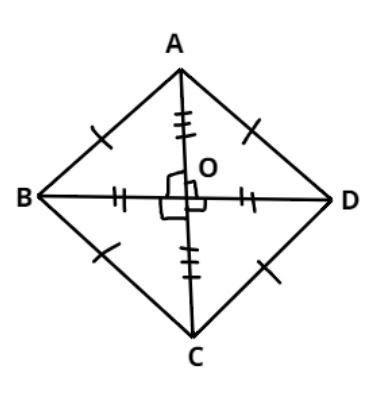
Let ABCD be a parallelogram as shown in figure.
Now it is given that adjacent sides of a parallelogram are equal.
So let AB = BC..................... (1)
And we all know that in the parallelogram opposite sides are equal.
Therefore AB = CD and AD = BC......................... (2)
Now from equation (1) and (2) we can say that
AB = BC = CD = DA
Now we all know if all the sides of a parallelogram are equal than the diagonals of the parallelogram bisect each other and perpendicular to each other.
$
\Rightarrow OB = OD,{\text{ & }}OA = OC..................\left( 3 \right) \\
\angle AOB = \angle AOD = \angle BOC = \angle DOC = {90^0} \\
$
Now it is also given that one diagonal is equal to one side of the parallelogram.
So let us suppose that
AC = AB...................... (4)
Now from figure AC = OA + OC
Now from equation (3) we have,
AC = OA + OA
$ \Rightarrow OA = \dfrac{{AC}}{2}$
And from equation (4) we have,
$ \Rightarrow OA = \dfrac{{AB}}{2}$ ......................... (5)
So in triangle AOB apply Pythagoras Theorem
${\left( {{\text{Hypotenuse}}} \right)^2} = {\left( {{\text{Perpendicular}}} \right)^2} + {\left( {{\text{Base}}} \right)^2}$
$ \Rightarrow {\left( {AB} \right)^2} = {\left( {OA} \right)^2} + {\left( {OB} \right)^2}$
$ \Rightarrow {\left( {OB} \right)^2} = {\left( {AB} \right)^2} - {\left( {OA} \right)^2}$
Now from equation (5) we have,
$ \Rightarrow {\left( {OB} \right)^2} = {\left( {AB} \right)^2} - {\left( {\dfrac{{AB}}{2}} \right)^2} = \dfrac{3}{4}{\left( {AB} \right)^2}$
$ \Rightarrow OB = \dfrac{{\sqrt 3 }}{2}AB$
Now from figure
BD = OB + OD
And from equation (3) we have,
BD = OB + OB
$ \Rightarrow BD = 2OB = 2 \times \dfrac{{\sqrt 3 }}{2}AB = \sqrt 3 AB$
$ \Rightarrow \dfrac{{BD}}{{AB}} = \dfrac{{\sqrt 3 }}{1}$
Now from equation (4) we have,
$ \Rightarrow \dfrac{{BD}}{{AC}} = \dfrac{{\sqrt 3 }}{1}$
So the ratio of the diagonals is $\dfrac{{\sqrt 3 }}{1}$
Hence Proved.
Note –Whenever we face such types of questions the key concept we have to remember that whenever all the sides are equal in a parallelogram then its diagonals bisect each other and perpendicular to each other so using this property apply Pythagoras theorem in any triangle and also using the constraints which is given in the question (such as one diagonal is equal to any one side of the parallelogram) we can easily calculate the ratio of the diagonals (as diagonals bisect each other i.e. OB = OD and OA = OC) , so after this just simplify we will get the required ratio of the diagonals.
Complete step-by-step solution -
Proof –
Let ABCD be a parallelogram as shown in figure.
Now it is given that adjacent sides of a parallelogram are equal.
So let AB = BC..................... (1)
And we all know that in the parallelogram opposite sides are equal.
Therefore AB = CD and AD = BC......................... (2)
Now from equation (1) and (2) we can say that
AB = BC = CD = DA
Now we all know if all the sides of a parallelogram are equal than the diagonals of the parallelogram bisect each other and perpendicular to each other.
$
\Rightarrow OB = OD,{\text{ & }}OA = OC..................\left( 3 \right) \\
\angle AOB = \angle AOD = \angle BOC = \angle DOC = {90^0} \\
$
Now it is also given that one diagonal is equal to one side of the parallelogram.
So let us suppose that
AC = AB...................... (4)
Now from figure AC = OA + OC
Now from equation (3) we have,
AC = OA + OA
$ \Rightarrow OA = \dfrac{{AC}}{2}$
And from equation (4) we have,
$ \Rightarrow OA = \dfrac{{AB}}{2}$ ......................... (5)
So in triangle AOB apply Pythagoras Theorem
${\left( {{\text{Hypotenuse}}} \right)^2} = {\left( {{\text{Perpendicular}}} \right)^2} + {\left( {{\text{Base}}} \right)^2}$
$ \Rightarrow {\left( {AB} \right)^2} = {\left( {OA} \right)^2} + {\left( {OB} \right)^2}$
$ \Rightarrow {\left( {OB} \right)^2} = {\left( {AB} \right)^2} - {\left( {OA} \right)^2}$
Now from equation (5) we have,
$ \Rightarrow {\left( {OB} \right)^2} = {\left( {AB} \right)^2} - {\left( {\dfrac{{AB}}{2}} \right)^2} = \dfrac{3}{4}{\left( {AB} \right)^2}$
$ \Rightarrow OB = \dfrac{{\sqrt 3 }}{2}AB$
Now from figure
BD = OB + OD
And from equation (3) we have,
BD = OB + OB
$ \Rightarrow BD = 2OB = 2 \times \dfrac{{\sqrt 3 }}{2}AB = \sqrt 3 AB$
$ \Rightarrow \dfrac{{BD}}{{AB}} = \dfrac{{\sqrt 3 }}{1}$
Now from equation (4) we have,
$ \Rightarrow \dfrac{{BD}}{{AC}} = \dfrac{{\sqrt 3 }}{1}$
So the ratio of the diagonals is $\dfrac{{\sqrt 3 }}{1}$
Hence Proved.
Note –Whenever we face such types of questions the key concept we have to remember that whenever all the sides are equal in a parallelogram then its diagonals bisect each other and perpendicular to each other so using this property apply Pythagoras theorem in any triangle and also using the constraints which is given in the question (such as one diagonal is equal to any one side of the parallelogram) we can easily calculate the ratio of the diagonals (as diagonals bisect each other i.e. OB = OD and OA = OC) , so after this just simplify we will get the required ratio of the diagonals.
Recently Updated Pages
Basicity of sulphurous acid and sulphuric acid are

Master Class 10 English: Engaging Questions & Answers for Success
Master Class 10 Social Science: Engaging Questions & Answers for Success
Master Class 10 Computer Science: Engaging Questions & Answers for Success
Class 10 Question and Answer - Your Ultimate Solutions Guide
Master Class 10 General Knowledge: Engaging Questions & Answers for Success
Trending doubts
Which country won the ICC Men's ODI World Cup in 2023?
In cricket, how many legal balls are there in a standard over?
Explain the Treaty of Vienna of 1815 class 10 social science CBSE
What does "powerplay" mean in limited-overs cricket?
What is the full form of PNG A Petrol Natural Gas B class 10 chemistry CBSE
What is the "Powerplay" in T20 cricket?