



Addition of HCl to alkenes proceeds in two steps; the first step is the attack of ${{H}^{+}}$ ion to
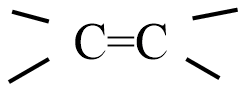 portion which can be shown as:
(A)
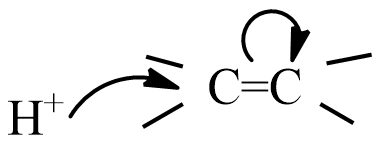
(B)
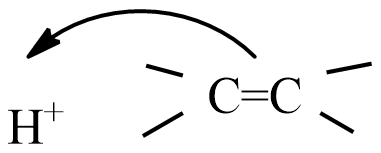
(C)
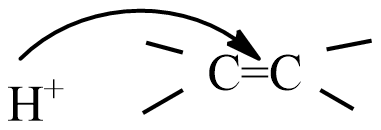
(D) all are possible
Answer
 Verified
650.1k+ views
Hint: Organic reactions are accompanied by breaking and the making of covalent bonds that involve the exchange of electrons. The functional groups of organic compounds also play a very important role in the exchange of electrons. Organic reactions are classified into four types of reactions which are addition reactions, substitution reactions, rearrangement reactions, and elimination reactions.
Complete step by step answer:
The chemical reactions undergone by organic compounds containing carbon are called organic reactions. Based on all fundamental considerations, organic reactions are classified into the following types:
(1) Addition reactions
(2) Substitution reactions
(3) Elimination reactions
(4) Rearrangement reactions
Addition reactions: Addition reactions are the reactions which the compounds are added to the carbon-carbon multiple bonds which are known as unsaturated compounds. These unsaturated compounds form by the addition of some reagent.
For example, $C{{H}_{2}}=C{{H}_{2}}+HCl\to C{{H}_{3}}C{{H}_{2}}Cl$.
Types of addition reactions: depending upon the nature of the attacking agent, the addition reactions are classified as follows:
(i) Electrophilic addition reactions
(ii) Nucleophilic addition reactions
(iii) Free radical addition reactions.
Given reaction is the addition of HCl to an alkene is a type of electrophilic addition reaction, which means the electrophile initiates the reaction and this slow step is the rate determining step.
The electrophile in HCl is ${{H}^{+}}$ an ion, and the mechanism of electrophilic addition is followed by two steps.
Step-1: formation of carbonium ion by the flow of electrons from the$\pi $ bond to electron-deficient ${{H}^{+}}$ion.

Step-2: the carbonium ion forms the final product with $C{{l}^{-}}$ ion

Hence, the correct option is B.
Note: Positively charged or neutral species which are act as Lewis acid are electrophiles, negatively charged or Lewis bases are nucleophiles, and an atom or group of atoms having an unpaired electron that are produced from the homolytic fission of a covalent bond is called as free radical.
Complete step by step answer:
The chemical reactions undergone by organic compounds containing carbon are called organic reactions. Based on all fundamental considerations, organic reactions are classified into the following types:
(1) Addition reactions
(2) Substitution reactions
(3) Elimination reactions
(4) Rearrangement reactions
For example, $C{{H}_{2}}=C{{H}_{2}}+HCl\to C{{H}_{3}}C{{H}_{2}}Cl$.
Types of addition reactions: depending upon the nature of the attacking agent, the addition reactions are classified as follows:
(i) Electrophilic addition reactions
(ii) Nucleophilic addition reactions
(iii) Free radical addition reactions.
Given reaction is the addition of HCl to an alkene is a type of electrophilic addition reaction, which means the electrophile initiates the reaction and this slow step is the rate determining step.
The electrophile in HCl is ${{H}^{+}}$ an ion, and the mechanism of electrophilic addition is followed by two steps.
Step-1: formation of carbonium ion by the flow of electrons from the$\pi $ bond to electron-deficient ${{H}^{+}}$ion.
Step-2: the carbonium ion forms the final product with $C{{l}^{-}}$ ion
Hence, the correct option is B.
Note: Positively charged or neutral species which are act as Lewis acid are electrophiles, negatively charged or Lewis bases are nucleophiles, and an atom or group of atoms having an unpaired electron that are produced from the homolytic fission of a covalent bond is called as free radical.
Recently Updated Pages
If x a + bt + ct2 where x is in meters and t is in class 11 physics CBSE

A car covers the first half distance between two places class 11 physics CBSE
The resultant of two vectors overrightarrow P and overrightarrow class 11 physics CBSE
Find the value of cos 135 class 11 maths CBSE
A mass M is held in place by an applied force F and class 11 physics CBSE
A solution of glucose in water is labelled as 10 dfracwv class 11 chemistry CBSE
Trending doubts
One Metric ton is equal to kg A 10000 B 1000 C 100 class 11 physics CBSE
Find the value of the expression given below sin 30circ class 11 maths CBSE
Draw a diagram of nephron and explain its structur class 11 biology CBSE
10 examples of friction in our daily life
Proton was discovered by A Thomson B Rutherford C Chadwick class 11 chemistry CBSE
Bond order ofO2 O2+ O2 and O22 is in order A O2 langle class 11 chemistry CBSE