




AD is a median of the triangle ABC and E is the midpoint of AD. BE produced meets AC in F, prove that \[AF=\dfrac{1}{3}AC\].
Answer
 Verified
656.4k+ views
Hint: First of all, draw the diagram to get a clear idea of the question. Now construct DG || BF through D. Then take triangles \[\Delta ADG\] and \[\Delta BFC\] and use the converse of the mid-point theorem in them to prove AF = FG and FG = GC. Finally, use all the results to prove the desired result.
Complete step-by-step answer:
Here, we are given that AD is the median of the triangle ABC, and E is the midpoint of AD. BE produced meets AC at F. We have to prove that \[AF=\dfrac{1}{3}AC\]. Let us see the information given in the question diagrammatically.
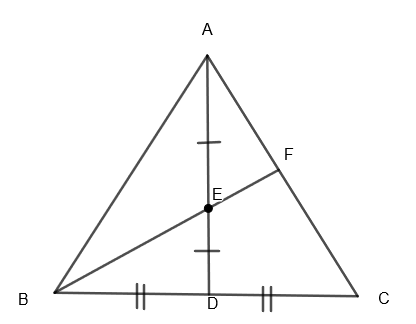
In the above figure, AD is the median of the triangle, therefore, we get, BD = DC …..(i)
Also, E is the midpoint of AD, therefore, we get AE = ED …..(ii)
Here, BE is produced such that it meets AC at F. Now let us construct a line DG parallel to BF through D as follows:
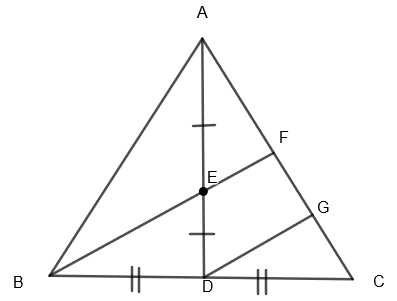
We know that the converse of the midpoint theorem states that “If a line is drawn through the midpoint of one side of a triangle and parallel to other sides, it bisects the third side or the point at which it meets the third side is the midpoint of the third side”.
In \[\Delta ADG\], E is the midpoint of AD and EF is parallel to DG. So, according to the converse of the midpoint theorem, F will bisect the side of AG or F will be the midpoint of the side AG. So, we get, AF = FG …..(iii)
Also, in \[\Delta BFC\], D is the midpoint of BC and DG is parallel to BF. So, according to the converse of the midpoint theorem, G will bisect the side FC or G will be the midpoint of side FC. So, we get, FG = GC….(iv)
From equation (iii) and (iv), we get, AF = FG = GC ……(v)
Now, from the diagram, AF + FG + GC = AC
By substituting FG = AF and GC = AF from equation (v), we get, AF + AF + AF = AC.
3 AF = AC
By dividing 3 on both the sides of the above equation, we get,
\[AF=\dfrac{1}{3}AC\]
Hence proved.
Note: Students must remember the midpoint theorem and its converse properly as it is one of the most important theorems of geometry. Also, in this question, students make mistakes in taking the different triangles to prove the result. So take the triangles which have the sides which are present in the final result to get the desired answer or to prove the desired result.
Complete step-by-step answer:
Here, we are given that AD is the median of the triangle ABC, and E is the midpoint of AD. BE produced meets AC at F. We have to prove that \[AF=\dfrac{1}{3}AC\]. Let us see the information given in the question diagrammatically.
In the above figure, AD is the median of the triangle, therefore, we get, BD = DC …..(i)
Also, E is the midpoint of AD, therefore, we get AE = ED …..(ii)
Here, BE is produced such that it meets AC at F. Now let us construct a line DG parallel to BF through D as follows:
We know that the converse of the midpoint theorem states that “If a line is drawn through the midpoint of one side of a triangle and parallel to other sides, it bisects the third side or the point at which it meets the third side is the midpoint of the third side”.
In \[\Delta ADG\], E is the midpoint of AD and EF is parallel to DG. So, according to the converse of the midpoint theorem, F will bisect the side of AG or F will be the midpoint of the side AG. So, we get, AF = FG …..(iii)
Also, in \[\Delta BFC\], D is the midpoint of BC and DG is parallel to BF. So, according to the converse of the midpoint theorem, G will bisect the side FC or G will be the midpoint of side FC. So, we get, FG = GC….(iv)
From equation (iii) and (iv), we get, AF = FG = GC ……(v)
Now, from the diagram, AF + FG + GC = AC
By substituting FG = AF and GC = AF from equation (v), we get, AF + AF + AF = AC.
3 AF = AC
By dividing 3 on both the sides of the above equation, we get,
\[AF=\dfrac{1}{3}AC\]
Hence proved.
Note: Students must remember the midpoint theorem and its converse properly as it is one of the most important theorems of geometry. Also, in this question, students make mistakes in taking the different triangles to prove the result. So take the triangles which have the sides which are present in the final result to get the desired answer or to prove the desired result.
Recently Updated Pages
Master Class 11 English: Engaging Questions & Answers for Success

Master Class 11 Social Science: Engaging Questions & Answers for Success
Master Class 11 Maths: Engaging Questions & Answers for Success
Master Class 11 Biology: Engaging Questions & Answers for Success
Master Class 11 Physics: Engaging Questions & Answers for Success
Master Class 11 Chemistry: Engaging Questions & Answers for Success
Trending doubts
Explain the Treaty of Vienna of 1815 class 10 social science CBSE
What is the full form of POSCO class 10 social science CBSE
Define Potential, Developed, Stock and Reserved resources
The diagonals of a rhombus are 10cm and 24cm Find the class 10 maths CBSE
Fill the blanks with proper collective nouns 1 A of class 10 english CBSE
What planets have no moons Which one has only one moon class 10 physics CBSE