




Acromion process is found in
A. Coxal bone
B. Scapula
C. Sternum
D. Clavicle
Answer
 Verified
605.1k+ views
Hint: The Acromion process is a kind of bony process, which articulates with collar bone. The bones are joined by tissues called ligaments and cartilage. This process is a part of our shoulder blade.
Complete answer:
Pelvic girdle and Pectoral girdle bones help to join the lower and upper limbs respectively with the axial skeleton. Each girdle is made of two halves.
The pelvic girdle consists of two coxal bones. It is formed by the fusion of three bones that are ilium, ischium, and pubis. A cavity called acetabulum formed at the time of fusion of the above bone. In this cavity the thigh bone articulates.
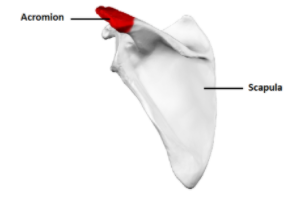
The scapula is a triangular flat bone. It is situated in the dorsal part of the thorax between the second and seventh ribs. The triangular and flat body of the scapula on the dorsal side has a slightly elevated ridge called a spine. Ti has projected as a flat and expended process called the acromion. The clavicle or the collar bone is joining with this. The glenoid cavity is located below the acromion which articulates or joins with the head of the humerus and forms the shoulder joint.
The sternum is a flat bone located on the ventral midline of the thorax. Each rib bone is attached to the ventrally to the sternum and dorsally to the vertebral column.
The clavicle is known as collar bone. It is a long slender bone with two curvatures.
Hence the acromion process is found in the scapula, so the correct answer is option B.
Note: The scapular spine is attached to the acromion process and works with the coracoids process of the scapula to form the stable and solid shoulder joint. The ligament is called Coracoacromial ligament, which attaches the acromion process to the coracoid process.
Complete answer:
Pelvic girdle and Pectoral girdle bones help to join the lower and upper limbs respectively with the axial skeleton. Each girdle is made of two halves.
The pelvic girdle consists of two coxal bones. It is formed by the fusion of three bones that are ilium, ischium, and pubis. A cavity called acetabulum formed at the time of fusion of the above bone. In this cavity the thigh bone articulates.
The scapula is a triangular flat bone. It is situated in the dorsal part of the thorax between the second and seventh ribs. The triangular and flat body of the scapula on the dorsal side has a slightly elevated ridge called a spine. Ti has projected as a flat and expended process called the acromion. The clavicle or the collar bone is joining with this. The glenoid cavity is located below the acromion which articulates or joins with the head of the humerus and forms the shoulder joint.
The sternum is a flat bone located on the ventral midline of the thorax. Each rib bone is attached to the ventrally to the sternum and dorsally to the vertebral column.
The clavicle is known as collar bone. It is a long slender bone with two curvatures.
Hence the acromion process is found in the scapula, so the correct answer is option B.
Note: The scapular spine is attached to the acromion process and works with the coracoids process of the scapula to form the stable and solid shoulder joint. The ligament is called Coracoacromial ligament, which attaches the acromion process to the coracoid process.
Recently Updated Pages
Master Class 12 Business Studies: Engaging Questions & Answers for Success

Master Class 12 Biology: Engaging Questions & Answers for Success
Master Class 12 Chemistry: Engaging Questions & Answers for Success
Class 12 Question and Answer - Your Ultimate Solutions Guide
Master Class 11 Social Science: Engaging Questions & Answers for Success
Master Class 11 English: Engaging Questions & Answers for Success
Trending doubts
Which is more stable and why class 12 chemistry CBSE
Which are the Top 10 Largest Countries of the World?
Draw a labelled sketch of the human eye class 12 physics CBSE
Differentiate between homogeneous and heterogeneous class 12 chemistry CBSE
What are the major means of transport Explain each class 12 social science CBSE
Sulphuric acid is known as the king of acids State class 12 chemistry CBSE