




Acetic acid reacts with $PC{l_5}$ to form:
A. $C{H_2}ClCOOH$
B. $CHC{l_2}COOH$
C. $C{H_3}COCl$
D. $C{H_3}COOCl \\ \\$
Answer
 Verified
614.7k+ views
Hint: Acetic acid is a carboxylic acid, highly polar and exhibits hydrogen bonding as well. it is completely miscible with water. The general reaction given by carboxylic acid is nucleophilic addition elimination also known as acyl substitution.
Step by step answer: It can be further converted into functional derivatives where the –OH of an acid is replaced by –Cl, -OR etc. to yield acid chlorides and esters. These compounds are called functional derivatives of acid as they contain acyl groups. An acid chloride is prepared by the substitution of –Cl for the –OH in a carboxylic acid. Three reagents commonly used for this purpose are: thionyl chloride, phosphorus trichloride and phosphorus pentachloride which has been asked in the question. Therefore the acid chloride formed by nucleophilic addition elimination reaction on acetic acid with phosphorus pentachloride is:
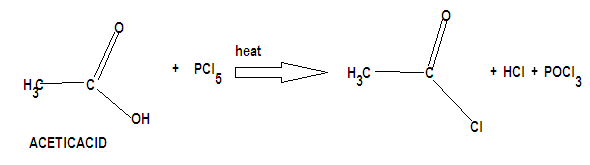
Acyl chlorides are the most reactive of the acid derivatives because they have good leaving group chloride ions attached to the carbonyl carbon atom by protonation. The initial step of the reaction involves nucleophilic addition at the carbonyl carbon atom after this elimination leads to regeneration of the carbon-oxygen double bond and to a substitution product.
Therefore the product formed is acetyl chloride.
Hence the correct option is C.
Note: Thionyl chloride is particularly convenient, since the product formed besides the acid chloride are gases and thus easily separated from the acid chloride; any excess of the thionyl chloride is easily removed by distillation.
Step by step answer: It can be further converted into functional derivatives where the –OH of an acid is replaced by –Cl, -OR etc. to yield acid chlorides and esters. These compounds are called functional derivatives of acid as they contain acyl groups. An acid chloride is prepared by the substitution of –Cl for the –OH in a carboxylic acid. Three reagents commonly used for this purpose are: thionyl chloride, phosphorus trichloride and phosphorus pentachloride which has been asked in the question. Therefore the acid chloride formed by nucleophilic addition elimination reaction on acetic acid with phosphorus pentachloride is:
Acyl chlorides are the most reactive of the acid derivatives because they have good leaving group chloride ions attached to the carbonyl carbon atom by protonation. The initial step of the reaction involves nucleophilic addition at the carbonyl carbon atom after this elimination leads to regeneration of the carbon-oxygen double bond and to a substitution product.
Therefore the product formed is acetyl chloride.
Hence the correct option is C.
Note: Thionyl chloride is particularly convenient, since the product formed besides the acid chloride are gases and thus easily separated from the acid chloride; any excess of the thionyl chloride is easily removed by distillation.
Recently Updated Pages
Master Class 11 English: Engaging Questions & Answers for Success

Master Class 11 Social Science: Engaging Questions & Answers for Success
Master Class 11 Maths: Engaging Questions & Answers for Success
Master Class 11 Chemistry: Engaging Questions & Answers for Success
Master Class 11 Biology: Engaging Questions & Answers for Success
Master Class 11 Physics: Engaging Questions & Answers for Success
Trending doubts
Explain the Treaty of Vienna of 1815 class 10 social science CBSE
Why is it 530 pm in india when it is 1200 afternoon class 10 social science CBSE
What is the full form of CNG A Complete Natural Gas class 10 social science CBSE
In cricket, what is a "Yorker" designed to do?
What is the full form of POSCO class 10 social science CBSE
Define Potential, Developed, Stock and Reserved resources