




Acetic acid reacts with $PCl_{5}$ or $SOCl_{2}$ to give:
A.Acetyl chloride
B.Methyl chloride
C.Dichloroacetic acid
D.Ethanol
Answer
 Verified
606.3k+ views
Hint:Acetic acid is a carboxylic acid, highly polar and exhibits hydrogen bonding as well. It is completely miscible with water. The general reaction is known as acyl substitution which is given by carboxylic acid is nucleophilic addition elimination.
Complete step-by-step answer:The compound is further converted into functional derivatives where the -OH of an acid is replaced by -Cl, -OR etc. in order to yield acid chlorides and esters. These compounds are called functional derivatives of acid as they contain acyl groups. An acid chloride is produced by the substitution of -Cl for the -OH in the presence of an acid.
Three reagents commonly used for this purpose are thionyl chloride, phosphorus trichloride and phosphorus pentachloride which has been asked in the question. Therefore, the acid chloride formed by nucleophilic addition elimination reaction on acetic acid with phosphorus pentachloride is given below.
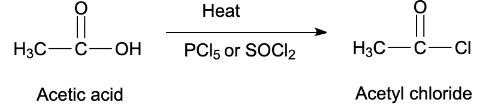
Acyl chlorides are the foremost reactive of the acid derivatives because they need good leaving group chloride ions attached to the carbonyl carbon atom by protonation. The initial step involves nucleophilic addition at the carbonyl carbon atom after this elimination leads to regeneration of the carbon-oxygen double bond and to a substitution product.
Therefore, the correct option is (A).
Note:Thionyl chloride is particularly convenient, since products formed besides the acid chloride are gases and thus can be easily separated from the acid chloride. Moreover, excess of the thionyl chloride is easily removed by distillation.
Complete step-by-step answer:The compound is further converted into functional derivatives where the -OH of an acid is replaced by -Cl, -OR etc. in order to yield acid chlorides and esters. These compounds are called functional derivatives of acid as they contain acyl groups. An acid chloride is produced by the substitution of -Cl for the -OH in the presence of an acid.
Three reagents commonly used for this purpose are thionyl chloride, phosphorus trichloride and phosphorus pentachloride which has been asked in the question. Therefore, the acid chloride formed by nucleophilic addition elimination reaction on acetic acid with phosphorus pentachloride is given below.
Acyl chlorides are the foremost reactive of the acid derivatives because they need good leaving group chloride ions attached to the carbonyl carbon atom by protonation. The initial step involves nucleophilic addition at the carbonyl carbon atom after this elimination leads to regeneration of the carbon-oxygen double bond and to a substitution product.
Therefore, the correct option is (A).
Note:Thionyl chloride is particularly convenient, since products formed besides the acid chloride are gases and thus can be easily separated from the acid chloride. Moreover, excess of the thionyl chloride is easily removed by distillation.
Recently Updated Pages
Which of the following graphs shows the variation of class 12 physics CBSE

Draw a labelled diagram of the human male reproductive class 12 biology CBSE
Describe the experiment to compare the emf of two cells class 12 physics CBSE
What is standard hydrogen electrode
What is conventional current and electric current class 12 physics CBSE
2Bromopentane is treated with an alcoholic KOH solution class 12 chemistry CBSE
Trending doubts
Draw a labelled sketch of the human eye class 12 physics CBSE
Which are the Top 10 Largest Countries of the World?
A member of Simon commission later became Prime Minister class 12 social science CBSE
Draw ray diagrams each showing i myopic eye and ii class 12 physics CBSE
Give one example of a reptile that is viviparous class 12 biology CBSE
Which is the correct genotypic ratio of mendel dihybrid class 12 biology CBSE