




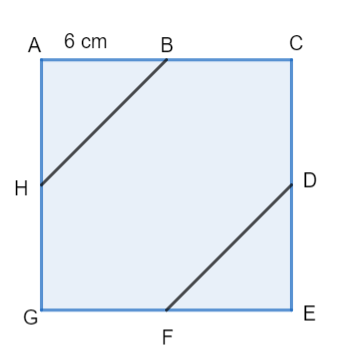
ACEG is a square. AB is \[\dfrac{1}{2}\] of AC. What is the perimeter of square?
\[\begin{align}
& \text{(A) 48 cm} \\
& \text{(B) 40 cm} \\
& \text{(C) 36 cm} \\
& \text{(D) 24 cm} \\
\end{align}\]
Answer
 Verified
670.2k+ views
Hint: From the question, it was given that B is the midpoint of side AC and the length of side AB is equal to 6 cm. Now we have to find the length of BC. We know that the sum of length of AB and length of BC is equal to AC. In the similar way, we should find the length of GA, CE and EG. We know that the perimeter of a figure is equal to the sum of all sides of a figure. So, the perimeter of square ACEG is equal to sum of sides AC, CE, EG and GA. This will give us the perimeter of square ACEG.
Complete step-by-step answer:
From the square ACEG, it is clear that B is the midpoint of side AC. The length of side AB is equal to 6 cm. It is also clear that B is midpoint of AC, D is midpoint of side CE and F is the midpoint of side GE. It was also given that the length of side AB is equal to 6 cm.
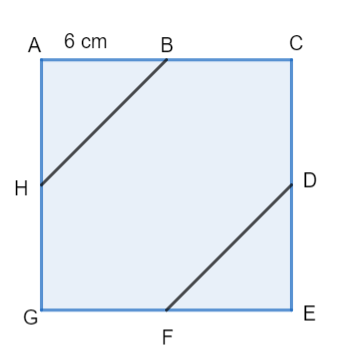
As B is the midpoint of AC, the length of BC is also equal to 6 cm. From the figure, it is clear that the sum of length of AB and length of BC is equal to AC.
\[\begin{align}
& \Rightarrow \text{AC=AB+BC} \\
& \Rightarrow \text{AC=6+6} \\
& \Rightarrow \text{AC=12 cm} \\
\end{align}\]
As D is the mid-point of CE, the length of CE is also equal to 6 cm. From the figure, it is clear that the sum of length of CD and length of DE is equal to CE.
\[\begin{align}
& \Rightarrow CE\text{=CD+DE} \\
& \Rightarrow CE\text{=6+6} \\
& \Rightarrow CE\text{=12 cm} \\
\end{align}\]
As F is the mid-point of GE, the length of GE is also equal to 6 cm. From the figure, it is clear that the sum of length of GF and length of EF is equal to GE.
\[\begin{align}
& \Rightarrow GE\text{=GF+EF} \\
& \Rightarrow GE\text{=6+6} \\
& \Rightarrow GE\text{=12 cm} \\
\end{align}\]
As H is the mid-point of AG, the length of AH is also equal to 6 cm. From the figure, it is clear that the sum of length of AH and length of HG is equal to AG.
\[\begin{align}
& \Rightarrow \text{AG=AH+GH} \\
& \Rightarrow \text{AG=6+6} \\
& \Rightarrow \text{AG=12 cm} \\
\end{align}\]
We know that the sum of all sides is equal to perimeter. Let us assume the perimeter of square ACEG is equal to p.
\[\begin{align}
& \Rightarrow p=AC+CE+EG+GA \\
& \Rightarrow p=12+12+12+12 \\
& \Rightarrow p=48cm \\
\end{align}\]
So, the perimeter of ABCD is equal to 48 cm.
Hence, option A is correct.
Note: This problem can be solved in an alternative way.
From the square ABCD, it is clear that B is the midpoint of side AC. The length of side AB is equal to 6 cm. It is also clear that B is midpoint of AC, D is midpoint of side CE and F is the midpoint of side EG. It was also given that the length of side AB is equal to 6 cm.
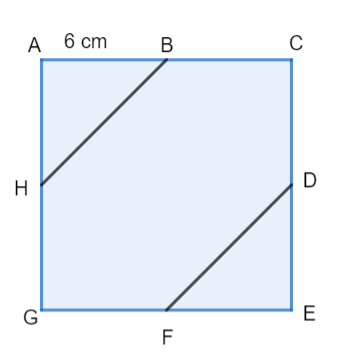
As B is the midpoint of AC, the length of BC is also equal to 6 cm. From the figure, it is clear that the sum of length of AB and length of BC is equal to AC.
\[\begin{align}
& \Rightarrow \text{AC=AB+BC} \\
& \Rightarrow \text{AC=6+6} \\
& \Rightarrow \text{AC=12 cm} \\
\end{align}\]
We know that the lengths of all sides are equal.
\[\Rightarrow AC=CE=EG=GA=12cm\]
We know that the sum of all sides is equal to perimeter. Let us assume the perimeter of square ACFG is equal to p.
\[\begin{align}
& \Rightarrow p=AC+CE+EG+GA \\
& \Rightarrow p=12+12+12+12 \\
& \Rightarrow p=48cm \\
\end{align}\]
So, the perimeter of ACEG is equal to 48 cm.
Complete step-by-step answer:
From the square ACEG, it is clear that B is the midpoint of side AC. The length of side AB is equal to 6 cm. It is also clear that B is midpoint of AC, D is midpoint of side CE and F is the midpoint of side GE. It was also given that the length of side AB is equal to 6 cm.
As B is the midpoint of AC, the length of BC is also equal to 6 cm. From the figure, it is clear that the sum of length of AB and length of BC is equal to AC.
\[\begin{align}
& \Rightarrow \text{AC=AB+BC} \\
& \Rightarrow \text{AC=6+6} \\
& \Rightarrow \text{AC=12 cm} \\
\end{align}\]
As D is the mid-point of CE, the length of CE is also equal to 6 cm. From the figure, it is clear that the sum of length of CD and length of DE is equal to CE.
\[\begin{align}
& \Rightarrow CE\text{=CD+DE} \\
& \Rightarrow CE\text{=6+6} \\
& \Rightarrow CE\text{=12 cm} \\
\end{align}\]
As F is the mid-point of GE, the length of GE is also equal to 6 cm. From the figure, it is clear that the sum of length of GF and length of EF is equal to GE.
\[\begin{align}
& \Rightarrow GE\text{=GF+EF} \\
& \Rightarrow GE\text{=6+6} \\
& \Rightarrow GE\text{=12 cm} \\
\end{align}\]
As H is the mid-point of AG, the length of AH is also equal to 6 cm. From the figure, it is clear that the sum of length of AH and length of HG is equal to AG.
\[\begin{align}
& \Rightarrow \text{AG=AH+GH} \\
& \Rightarrow \text{AG=6+6} \\
& \Rightarrow \text{AG=12 cm} \\
\end{align}\]
We know that the sum of all sides is equal to perimeter. Let us assume the perimeter of square ACEG is equal to p.
\[\begin{align}
& \Rightarrow p=AC+CE+EG+GA \\
& \Rightarrow p=12+12+12+12 \\
& \Rightarrow p=48cm \\
\end{align}\]
So, the perimeter of ABCD is equal to 48 cm.
Hence, option A is correct.
Note: This problem can be solved in an alternative way.
From the square ABCD, it is clear that B is the midpoint of side AC. The length of side AB is equal to 6 cm. It is also clear that B is midpoint of AC, D is midpoint of side CE and F is the midpoint of side EG. It was also given that the length of side AB is equal to 6 cm.
As B is the midpoint of AC, the length of BC is also equal to 6 cm. From the figure, it is clear that the sum of length of AB and length of BC is equal to AC.
\[\begin{align}
& \Rightarrow \text{AC=AB+BC} \\
& \Rightarrow \text{AC=6+6} \\
& \Rightarrow \text{AC=12 cm} \\
\end{align}\]
We know that the lengths of all sides are equal.
\[\Rightarrow AC=CE=EG=GA=12cm\]
We know that the sum of all sides is equal to perimeter. Let us assume the perimeter of square ACFG is equal to p.
\[\begin{align}
& \Rightarrow p=AC+CE+EG+GA \\
& \Rightarrow p=12+12+12+12 \\
& \Rightarrow p=48cm \\
\end{align}\]
So, the perimeter of ACEG is equal to 48 cm.
Recently Updated Pages
Master Class 10 Computer Science: Engaging Questions & Answers for Success

Differentiate between voluntary action and reflex class 10 biology CBSE
The uses of bleaching powder are A It is used bleaching class 10 chemistry CBSE
Fill in the blanks with abstract nouns of the words class 10 english CBSE
How many threedigit numbers are there class 10 maths CBSE
What is a reflex arc class 10 biology CBSE
Trending doubts
Explain the Treaty of Vienna of 1815 class 10 social science CBSE
10 examples of evaporation in daily life with explanations
GST is a direct or indirect tax?
The sum of all even numbers between 21 and 51 is a class 10 maths CBSE
What would happen if platelets were absent in the blood class 10 biology CBSE
Compare the advantages and disadvantages of multipurpose class 10 social science CBSE