




According to Huckel’s rule, a compound is said to be aromatic, if it contains:
a. - (4n+2) $\pi $ bonds
b. - (4n+2) $\sigma $ bonds
c. - (4n+2) carbon atoms
d.- (4n+2) $\pi $ electrons
Answer
 Verified
603.6k+ views
Hint: In organic compounds, Hückel's rule helps in deciding whether a planar ring molecule will have aromatic properties or not.
Complete answer:
Aromatic compounds are more stable than theoretically predicted as for simple alkenes; the additional stability is due to the delocalized cloud of electrons, called resonance energy.
Properties of simple aromatic compound are:
1.-The molecule must have $4n + 2$ electrons in a conjugated system of p orbitals,on \[s{p^2}\]-hybridized atoms ( i.e. huckel’s rule )
2.-The molecule must be (close to) planar (implicit in the requirement for conjugation).
3.-The molecule must be cyclic.
4.-The molecule must have a continuous ring of p atomic orbitals (there cannot be any \[\;s{p^3}\;\] atoms in the ring).
Let’s talk about Huckel’s $4n + 2$ Pi Electron Rule.A ring-shaped cyclic molecule is said to follow the Huckel rule when the total number of pi electrons belonging to the molecule can be equated to the formula ($4n+2$) where n can be any integer with a positive value (including zero).
For example, molecules following Huckel’s rule have only been established for values of ‘n’ ranging from zero to six.
The total number of pi electrons in the benzene molecule depicted below can be found to be 6, obeying the $4n+2$ $\pi $ electron rule where $n=1$.
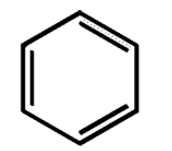
Thus, the benzene molecule is an aromatic compound as it obeys the Huckel rule.
In such way Huckel’s rule is used for identifying aromatic compounds, having ($4n+2$) $\pi $ electrons (values of ‘n’ ranging from zero to six)
Hence the correct option is (d) ($4n+2$) $\pi $ electrons.
Note:
Don’t get confused with ($4n+2$) $\pi $ electrons and ($4n+2$) $\pi $bonds. Both are different things. No. of electrons is always double then the number of bonds.
Complete answer:
Aromatic compounds are more stable than theoretically predicted as for simple alkenes; the additional stability is due to the delocalized cloud of electrons, called resonance energy.
Properties of simple aromatic compound are:
1.-The molecule must have $4n + 2$ electrons in a conjugated system of p orbitals,on \[s{p^2}\]-hybridized atoms ( i.e. huckel’s rule )
2.-The molecule must be (close to) planar (implicit in the requirement for conjugation).
3.-The molecule must be cyclic.
4.-The molecule must have a continuous ring of p atomic orbitals (there cannot be any \[\;s{p^3}\;\] atoms in the ring).
Let’s talk about Huckel’s $4n + 2$ Pi Electron Rule.A ring-shaped cyclic molecule is said to follow the Huckel rule when the total number of pi electrons belonging to the molecule can be equated to the formula ($4n+2$) where n can be any integer with a positive value (including zero).
For example, molecules following Huckel’s rule have only been established for values of ‘n’ ranging from zero to six.
The total number of pi electrons in the benzene molecule depicted below can be found to be 6, obeying the $4n+2$ $\pi $ electron rule where $n=1$.
Thus, the benzene molecule is an aromatic compound as it obeys the Huckel rule.
In such way Huckel’s rule is used for identifying aromatic compounds, having ($4n+2$) $\pi $ electrons (values of ‘n’ ranging from zero to six)
Hence the correct option is (d) ($4n+2$) $\pi $ electrons.
Note:
Don’t get confused with ($4n+2$) $\pi $ electrons and ($4n+2$) $\pi $bonds. Both are different things. No. of electrons is always double then the number of bonds.
Recently Updated Pages
Master Class 11 Economics: Engaging Questions & Answers for Success

Master Class 11 English: Engaging Questions & Answers for Success
Master Class 11 Maths: Engaging Questions & Answers for Success
Class 11 Question and Answer - Your Ultimate Solutions Guide
Master Class 11 Social Science: Engaging Questions & Answers for Success
Master Class 11 Business Studies: Engaging Questions & Answers for Success
Trending doubts
Differentiate between an exothermic and an endothermic class 11 chemistry CBSE
One Metric ton is equal to kg A 10000 B 1000 C 100 class 11 physics CBSE
There are 720 permutations of the digits 1 2 3 4 5 class 11 maths CBSE
In what year Guru Nanak Dev ji was born A15 April 1469 class 11 social science CBSE
Difference Between Prokaryotic Cells and Eukaryotic Cells
Draw a diagram of a plant cell and label at least eight class 11 biology CBSE