




What is the abscissa of any point on y-axis?
Answer
 Verified
645.3k+ views
Hint: In this question, we use the concept of graph and coordinates. We know the representation of coordinates on a graph is like (x, y) where x represents abscissa and y represents ordinate.
Complete Step-by-Step solution:
Now, we assume a coordinate A (x, y) where x represents abscissa and y represents ordinate.
If point A (x, y) moves left and right on a graph so the abscissa of coordinate A becomes changed. For example, a coordinate (2, 3) moves right through 1 unit distance so the coordinates become (3, 3). If a coordinate (2, 3) moves left through 1 unit distance so the coordinates become (1, 3).
If point A (x, y) moves upward and downward on a graph then the ordinate of coordinate A becomes changed. For example, a coordinate (2, 3) moves upward through 1 unit distance so the coordinates become (2, 4). If a coordinate (2, 3) moves downward through 1 unit distance so the coordinates become (2, 2).
Now, if a point on y-axis is the representation of coordinates on y-axis like (0, y) and then if we move point right and left on a graph so the abscissa of coordinates does not change it's always zero (0). But if we move point upward and downward so the ordinate of coordinates becomes changed.
So, the abscissa of any point on the y-axis is always zeros (0).
Note: In such types of problems we have to assume a point on graph and try to move point on graph in all four directions then observe the changes in point while moving in specific direction. In case of any point on y axis so the abscissa of such types of coordinates is always zero (0).
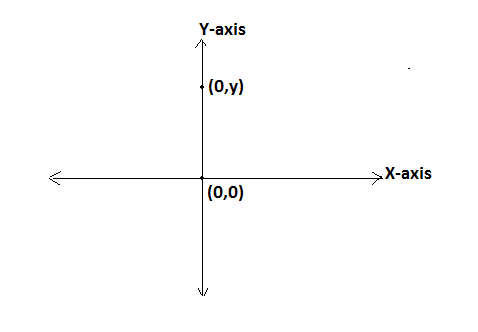
Complete Step-by-Step solution:
Now, we assume a coordinate A (x, y) where x represents abscissa and y represents ordinate.
If point A (x, y) moves left and right on a graph so the abscissa of coordinate A becomes changed. For example, a coordinate (2, 3) moves right through 1 unit distance so the coordinates become (3, 3). If a coordinate (2, 3) moves left through 1 unit distance so the coordinates become (1, 3).
If point A (x, y) moves upward and downward on a graph then the ordinate of coordinate A becomes changed. For example, a coordinate (2, 3) moves upward through 1 unit distance so the coordinates become (2, 4). If a coordinate (2, 3) moves downward through 1 unit distance so the coordinates become (2, 2).
Now, if a point on y-axis is the representation of coordinates on y-axis like (0, y) and then if we move point right and left on a graph so the abscissa of coordinates does not change it's always zero (0). But if we move point upward and downward so the ordinate of coordinates becomes changed.
So, the abscissa of any point on the y-axis is always zeros (0).
Note: In such types of problems we have to assume a point on graph and try to move point on graph in all four directions then observe the changes in point while moving in specific direction. In case of any point on y axis so the abscissa of such types of coordinates is always zero (0).
Recently Updated Pages
Master Class 10 English: Engaging Questions & Answers for Success

Master Class 10 Social Science: Engaging Questions & Answers for Success
Master Class 10 Computer Science: Engaging Questions & Answers for Success
Class 10 Question and Answer - Your Ultimate Solutions Guide
Master Class 10 General Knowledge: Engaging Questions & Answers for Success
Master Class 10 Maths: Engaging Questions & Answers for Success
Trending doubts
Explain the Treaty of Vienna of 1815 class 10 social science CBSE
Who Won 36 Oscar Awards? Record Holder Revealed
What is the median of the first 10 natural numbers class 10 maths CBSE
Why is it 530 pm in india when it is 1200 afternoon class 10 social science CBSE
Define Potential, Developed, Stock and Reserved resources
Fill the blanks with proper collective nouns 1 A of class 10 english CBSE