




ABCD is a trapezium with $AB\parallel DC$ , and its diagonals intersect each other at O. Show that $\dfrac{AO}{BO}=\dfrac{CO}{DO}$
Answer
 Verified
650.7k+ views
Hint: Draw a line parallel to AB through O intersecting BD at E. Apply basic proportionality theorem in triangles ABC and BCD. Hence find the relations for $\dfrac{AO}{OC}$ and $\dfrac{BO}{OD}$. Compare the two relations and hence prove that $\dfrac{AO}{BO}=\dfrac{CO}{DO}$.
Complete step-by-step answer:
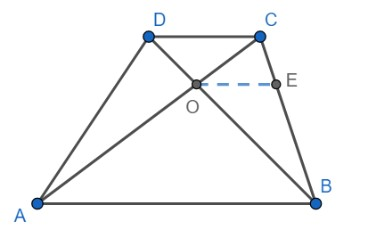
Given: ABCD is a trapezium with $AB\parallel CD$. Diagonals AC and BD intersect each other at O.
To prove: $\dfrac{AO}{BO}=\dfrac{CO}{DO}$
Construction: Draw a line parallel to AB through O and let it intersect BC at E.
Proof:
We know that $AB\parallel OE$ and $AB\parallel CD$.
Hence $OE\parallel CD$.
Now in triangle ABC, we have $OE\parallel AB$(By construction).
We know that a line parallel to one side of a triangle divides the other two sides proportionately (Basic proportionality theorem).
Hence by basic proportionality theorem, we have
$\dfrac{AO}{CO}=\dfrac{BE}{CE}\text{ (i)}$
Also, in triangle BCD, we have $OE\parallel CD$
Hence by basic proportionality theorem, we have
$\dfrac{BO}{DO}=\dfrac{BE}{CE}\text{ (ii)}$
Hence from equation (i) and equation (ii), we get
$\dfrac{AO}{CO}=\dfrac{BO}{DO}$
Multiplying both sides of the equation by $\dfrac{CO}{BO}$, we get
$\begin{align}
& \dfrac{AO}{CO}\times \dfrac{CO}{BO}=\dfrac{BO}{DO}\times \dfrac{CO}{BO} \\
& \Rightarrow \dfrac{AO}{BO}=\dfrac{CO}{DO} \\
\end{align}$
Hence proved.
Note: Alternative method:
Since $AB\parallel CD$, we have
$\angle DCO=\angle OAB$ (alternate interior angles) and $\angle ODC=\angle OBA$ (alternate interior angles).
Hence In triangles OCD and OAB, we have
$\angle DCO=\angle OAB$ (proved above)
$\angle ODC=\angle OBA$(proved above)
$\angle COD=\angle AOB$ (Vertically opposite angles).
Hence, $\Delta COD\sim \Delta AOB$ by AAA similarity criterion.
Hence $\dfrac{AO}{CO}=\dfrac{BO}{DO}$
Multiplying both sides by $\dfrac{CO}{BO}$, we get
$\begin{align}
& \dfrac{AO}{CO}\times \dfrac{CO}{BO}=\dfrac{BO}{DO}\times \dfrac{CO}{BO} \\
& \Rightarrow \dfrac{AO}{BO}=\dfrac{CO}{DO} \\
\end{align}$
Hence proved.
Complete step-by-step answer:
Given: ABCD is a trapezium with $AB\parallel CD$. Diagonals AC and BD intersect each other at O.
To prove: $\dfrac{AO}{BO}=\dfrac{CO}{DO}$
Construction: Draw a line parallel to AB through O and let it intersect BC at E.
Proof:
We know that $AB\parallel OE$ and $AB\parallel CD$.
Hence $OE\parallel CD$.
Now in triangle ABC, we have $OE\parallel AB$(By construction).
We know that a line parallel to one side of a triangle divides the other two sides proportionately (Basic proportionality theorem).
Hence by basic proportionality theorem, we have
$\dfrac{AO}{CO}=\dfrac{BE}{CE}\text{ (i)}$
Also, in triangle BCD, we have $OE\parallel CD$
Hence by basic proportionality theorem, we have
$\dfrac{BO}{DO}=\dfrac{BE}{CE}\text{ (ii)}$
Hence from equation (i) and equation (ii), we get
$\dfrac{AO}{CO}=\dfrac{BO}{DO}$
Multiplying both sides of the equation by $\dfrac{CO}{BO}$, we get
$\begin{align}
& \dfrac{AO}{CO}\times \dfrac{CO}{BO}=\dfrac{BO}{DO}\times \dfrac{CO}{BO} \\
& \Rightarrow \dfrac{AO}{BO}=\dfrac{CO}{DO} \\
\end{align}$
Hence proved.
Note: Alternative method:
Since $AB\parallel CD$, we have
$\angle DCO=\angle OAB$ (alternate interior angles) and $\angle ODC=\angle OBA$ (alternate interior angles).
Hence In triangles OCD and OAB, we have
$\angle DCO=\angle OAB$ (proved above)
$\angle ODC=\angle OBA$(proved above)
$\angle COD=\angle AOB$ (Vertically opposite angles).
Hence, $\Delta COD\sim \Delta AOB$ by AAA similarity criterion.
Hence $\dfrac{AO}{CO}=\dfrac{BO}{DO}$
Multiplying both sides by $\dfrac{CO}{BO}$, we get
$\begin{align}
& \dfrac{AO}{CO}\times \dfrac{CO}{BO}=\dfrac{BO}{DO}\times \dfrac{CO}{BO} \\
& \Rightarrow \dfrac{AO}{BO}=\dfrac{CO}{DO} \\
\end{align}$
Hence proved.
Recently Updated Pages
Master Class 11 English: Engaging Questions & Answers for Success

Master Class 11 Social Science: Engaging Questions & Answers for Success
Master Class 11 Maths: Engaging Questions & Answers for Success
Master Class 11 Biology: Engaging Questions & Answers for Success
Master Class 11 Physics: Engaging Questions & Answers for Success
Master Class 11 Chemistry: Engaging Questions & Answers for Success
Trending doubts
Explain the Treaty of Vienna of 1815 class 10 social science CBSE
What is the full form of POSCO class 10 social science CBSE
Define Potential, Developed, Stock and Reserved resources
The diagonals of a rhombus are 10cm and 24cm Find the class 10 maths CBSE
Fill the blanks with proper collective nouns 1 A of class 10 english CBSE
What planets have no moons Which one has only one moon class 10 physics CBSE