




ABCD is a rectangle. If ABP and BCQ are equilateral triangles, find the $\angle $PBQ.

(a) 65°
(b) 75°
(c) 60°
(d) 90°
Answer
 Verified
648.6k+ views
Hint: It is given in the question that ABCD is a rectangle and we know that all the angles of a rectangle are right angles. It is also known that triangle ABP and triangle BCQ are equilateral triangles. We know that each angle of an equilateral triangle is 60°. With this information, we will find the $\angle $PBC and add it to $\angle $CBQ to find $\angle $PBQ.
Complete step-by-step answer:
The figure for the question is as follows:
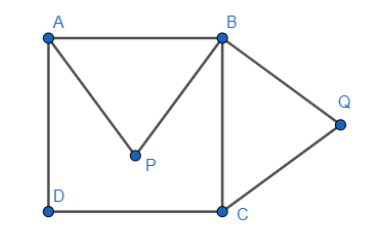
ABCD is a rectangle and each angle of a rectangle is 90°
$\angle $ABC = $\angle $BCD = $\angle $CDA = $\angle $DAB = 90°
Triangle ABP and triangle BCQ are equilateral triangle and each angle of an equilateral triangle is 60°.
$\angle $ABP = $\angle $BPA = $\angle $PAB = $\angle $BQC = $\angle $QCB = $\angle $CBQ = 60°
From the figure, we can deduce that
$\angle $ABC = $\angle $ABP + $\angle $PBC
$\Rightarrow $ 90° = 60° + $\angle $PBC
$\Rightarrow $ $\angle $PBC = 90° ─ 60°
$\Rightarrow $ $\angle $PBC = 30°
We know that, $\angle $CBQ = 60°.
And from the figure, we know that $\angle $PBQ = $\angle $PBC + $\angle $CBQ = 30° + 60° = 90°
Therefore, $\angle $PBQ = 90°
Note: Students are advised to be well-versed with the properties of various standard shapes. This question is relatively simple if the student is well acquainted with the concepts of geometry.
Complete step-by-step answer:
The figure for the question is as follows:
ABCD is a rectangle and each angle of a rectangle is 90°
$\angle $ABC = $\angle $BCD = $\angle $CDA = $\angle $DAB = 90°
Triangle ABP and triangle BCQ are equilateral triangle and each angle of an equilateral triangle is 60°.
$\angle $ABP = $\angle $BPA = $\angle $PAB = $\angle $BQC = $\angle $QCB = $\angle $CBQ = 60°
From the figure, we can deduce that
$\angle $ABC = $\angle $ABP + $\angle $PBC
$\Rightarrow $ 90° = 60° + $\angle $PBC
$\Rightarrow $ $\angle $PBC = 90° ─ 60°
$\Rightarrow $ $\angle $PBC = 30°
We know that, $\angle $CBQ = 60°.
And from the figure, we know that $\angle $PBQ = $\angle $PBC + $\angle $CBQ = 30° + 60° = 90°
Therefore, $\angle $PBQ = 90°
Note: Students are advised to be well-versed with the properties of various standard shapes. This question is relatively simple if the student is well acquainted with the concepts of geometry.
Recently Updated Pages
Basicity of sulphurous acid and sulphuric acid are

Master Class 12 Economics: Engaging Questions & Answers for Success
Master Class 12 Biology: Engaging Questions & Answers for Success
Master Class 11 English: Engaging Questions & Answers for Success
Master Class 11 Physics: Engaging Questions & Answers for Success
Master Class 11 Computer Science: Engaging Questions & Answers for Success
Trending doubts
What is the Total Duration of Football Match?
Explain the Treaty of Vienna of 1815 class 10 social science CBSE
In football, which nation is called "La Roja"?
Why is there a time difference of about 5 hours between class 10 social science CBSE
10 examples of evaporation in daily life with explanations
What is the full form of POSCO class 10 social science CBSE