




ABCD is a parallelogram. The sides AB and AD are produced to E and F respectively, such that AB=BE and AD=DF.
Hence, \[\Delta BEC\cong \Delta DCF\]
If the above statement is true then mention the answer as \[1\], else mention \[0\] if false.
Answer
 Verified
560.1k+ views
Hint: From the question we have been given a statement and we are asked whether the statement is true or false. For solving this question we will take the help of side angle side rule or simply SAS rule in mathematics and see whether the \[\Delta BEC\cong \Delta DCF\] is true or false. So, we proceed with the solution as follows.
Complete step by step solution:
The figure will be as follows.
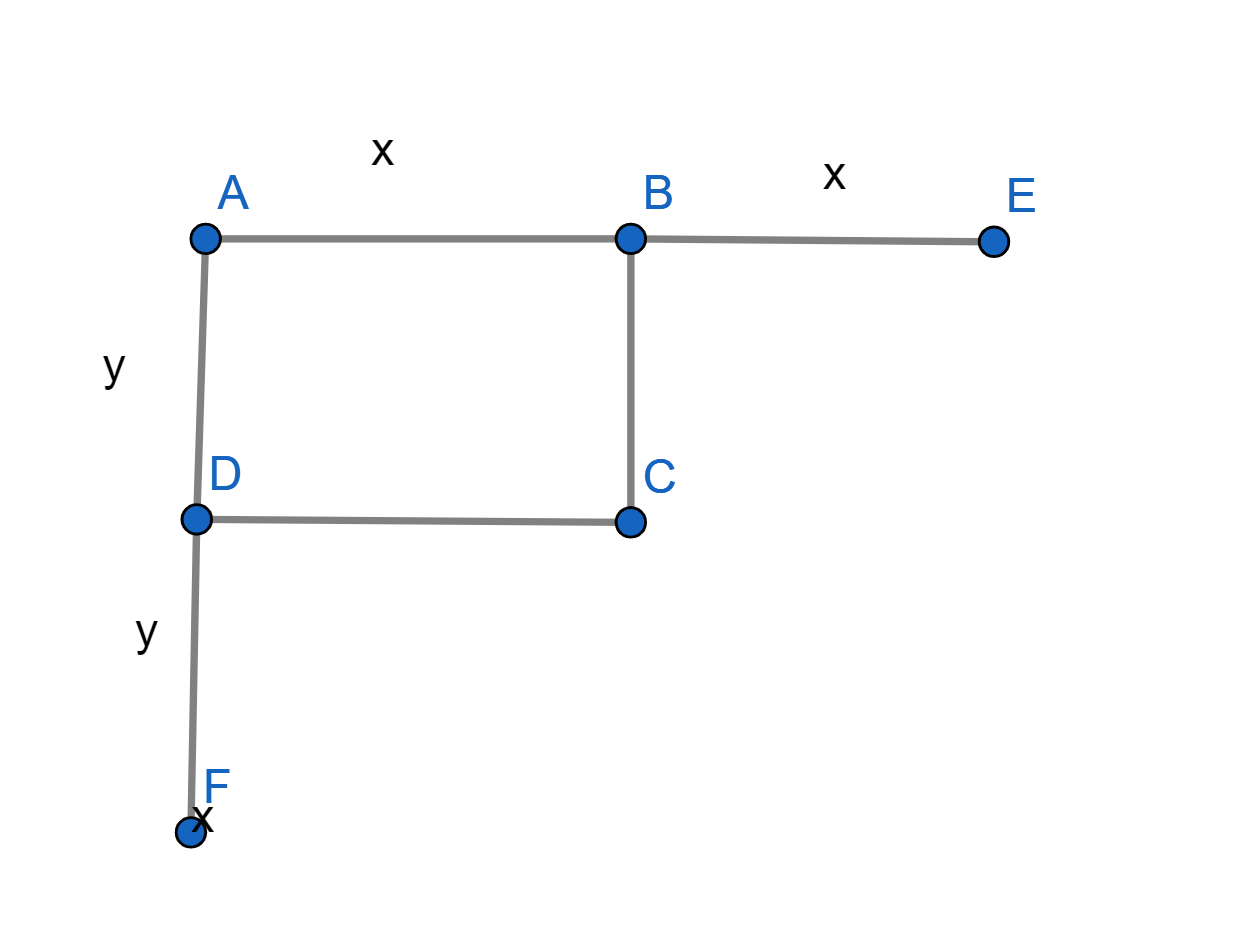
Corresponding angles for parallel lines AB and CD
\[\Rightarrow \angle BAD=\angle CDF\]
Corresponding angles for parallel lines AB and CD
\[\Rightarrow \angle BAD=\angle CBE\]
Thus, \[\Rightarrow \angle CDF=\angle CBE...........(1)\]
We are given that ABCD is a parallelogram so we know that,
\[\Rightarrow AD=BC\]
We are given,
\[\Rightarrow AD=DF\]
\[\therefore DF=BC............(2)\]
In the similar way we get as follows.
\[\therefore BE=CD............(3)\]
Now, consider angles by CDF and CBE.
From the help of equation \[(1)\],
\[\Rightarrow \angle CDF=\angle CBE\]
From equation \[(2)\]
\[\Rightarrow FD=BC\]
From equation \[(3)\]
\[\Rightarrow BE=CD\]
Thus from the side angle side rule that is SAS rule, we get,
\[\Rightarrow \Delta FDC\cong \Delta CBE\]
\[\Rightarrow \Delta BEC\cong \Delta DCF\]
Therefore, the statement given is true.
Note: Students should have good knowledge in the concept of sides and angles of parallelogram. Students should have good knowledge in the SAS rule and its applications to solve these kinds of questions.
Complete step by step solution:
The figure will be as follows.
Corresponding angles for parallel lines AB and CD
\[\Rightarrow \angle BAD=\angle CDF\]
Corresponding angles for parallel lines AB and CD
\[\Rightarrow \angle BAD=\angle CBE\]
Thus, \[\Rightarrow \angle CDF=\angle CBE...........(1)\]
We are given that ABCD is a parallelogram so we know that,
\[\Rightarrow AD=BC\]
We are given,
\[\Rightarrow AD=DF\]
\[\therefore DF=BC............(2)\]
In the similar way we get as follows.
\[\therefore BE=CD............(3)\]
Now, consider angles by CDF and CBE.
From the help of equation \[(1)\],
\[\Rightarrow \angle CDF=\angle CBE\]
From equation \[(2)\]
\[\Rightarrow FD=BC\]
From equation \[(3)\]
\[\Rightarrow BE=CD\]
Thus from the side angle side rule that is SAS rule, we get,
\[\Rightarrow \Delta FDC\cong \Delta CBE\]
\[\Rightarrow \Delta BEC\cong \Delta DCF\]
Therefore, the statement given is true.
Note: Students should have good knowledge in the concept of sides and angles of parallelogram. Students should have good knowledge in the SAS rule and its applications to solve these kinds of questions.
Recently Updated Pages
Master Class 12 Business Studies: Engaging Questions & Answers for Success

Master Class 12 Biology: Engaging Questions & Answers for Success
Master Class 12 Chemistry: Engaging Questions & Answers for Success
Class 12 Question and Answer - Your Ultimate Solutions Guide
Master Class 11 Social Science: Engaging Questions & Answers for Success
Master Class 11 English: Engaging Questions & Answers for Success
Trending doubts
Explain the Treaty of Vienna of 1815 class 10 social science CBSE
Who Won 36 Oscar Awards? Record Holder Revealed
What is the median of the first 10 natural numbers class 10 maths CBSE
Why is it 530 pm in india when it is 1200 afternoon class 10 social science CBSE
What is the full form of POSCO class 10 social science CBSE
The highest temperature in Karnataka is recorded in class 10 social science CBSE