




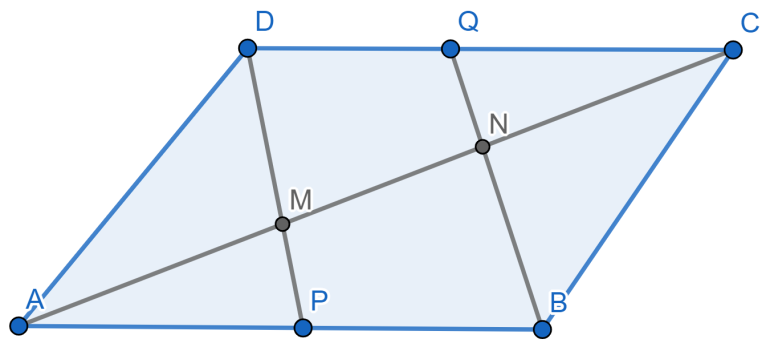
ABCD is a parallelogram. $P,Q$ are the midpoints of the sides $AB$ and $CD$ respectively. Show that $DP$ and $BQ$ trisect $AC$ and are trisected by $AC$.
Answer
 Verified
542.4k+ views
Hint: In this question we have been asked to prove that $BN=\dfrac{2}{3}BQ,DM=\dfrac{2}{3}DP,AM=\dfrac{1}{3}AC,AN=\dfrac{2}{3}AC$ that means $DP$ and $BQ$ trisect $AC$ and are trisected by $AC$ using the given information stated as “$ABCD$ is a parallelogram. $P,Q$ are the midpoints of the sides $AB$ and $CD$ respectively.” For doing that we will assume $A$ as the origin and $\vec{b},\vec{d}$ are the position vectors of $B,D$ respectively.
Complete step by step solution:
Now considering from the question we have been asked to prove that $BN=\dfrac{2}{3}BQ,DM=\dfrac{2}{3}DP,AM=\dfrac{1}{3}AC,AN=\dfrac{2}{3}AC$ that means $DP$ and $BQ$ trisect $AC$ and are trisected by $AC$ using the given information stated as “$ABCD$ is a parallelogram. $P,Q$ are the midpoints of the sides $AB$ and $CD$ respectively.”
For doing that we will assume $A$ as the origin and $\vec{b},\vec{d}$ are the position vectors of $B,D$ respectively.
Now we can say that the position vectors of $AB,AD$ are $\vec{b},\vec{d}$ respectively.
From the basic concepts we know that the parallelogram law is stated as “In a parallelogram $ABCD$ , we have an expression $\overrightarrow{AC}=\overrightarrow{AB}+\overrightarrow{AD}$is a valid expression”.
Hence we can say that the position vector of $AC$ is given as $\vec{b}+\vec{d}$.
Now as it is given that $P$ is the midpoint of $AB$ the position vector of $P$ will be given as $\dfrac{{\vec{b}}}{2}$ Now we can prove that $DM=\dfrac{2}{3}DP$ by substituting the position vectors we will have $\vec{m}-\vec{d}=\dfrac{2}{3}\left( \vec{p}-\vec{d} \right)$ we need to prove this expression where $\vec{m}$ is the position vector of $M$ . Let us assume that this expression is valid and try to prove the other expression $AM=\dfrac{1}{3}AC$ if we are able to prove that then we can say that both the expressions are valid.
Now we will have
$\begin{align}
& \vec{m}=\vec{d}+\dfrac{2}{3}\left( \vec{p}-\vec{d} \right) \\
& \Rightarrow \vec{m}=\dfrac{3\vec{d}+\left( 2\vec{p}-2\vec{d} \right)}{3} \\
& \Rightarrow \vec{m}=\dfrac{2\vec{p}+\vec{d}}{3}\Rightarrow \vec{m}=\dfrac{\vec{b}+\vec{d}}{3} \\
\end{align}$
Hence here it is proved that $AM=\dfrac{1}{3}AC$ . So these two expressions are valid. Similarly we will prove the other two expressions by assuming this expression to be valid $AN=\dfrac{2}{3}AC$ then we will have $\vec{n}=\dfrac{2}{3}\left( \vec{b}+\vec{d} \right)$ . But to prove $BN=\dfrac{2}{3}BQ$ we need to know the position vector of $Q$ we know that $Q$ is the midpoint of $DC$ . So first we will find the position vector of $DC$ . As here $AC=\vec{b}+\vec{d}$ the position vector of $C$ will be $\vec{b}+\vec{d}$ since $A$ is origin. Hence the position vector of $DC$ will be given as $\vec{b}+2\vec{d}$ .
Hence we can say that the position vector of $Q$ is $\dfrac{\vec{b}+2\vec{d}}{2}$ .
So now we will verify $BN=\dfrac{2}{3}BQ$ , for that we will have
$\begin{align}
& \vec{n}-\vec{b}=\dfrac{2}{3}\left( \vec{q}-\vec{b} \right) \\
& \Rightarrow \vec{n}=\vec{b}+\dfrac{2}{3}\left( \vec{q}-\vec{b} \right) \\
& \Rightarrow \vec{n}=\dfrac{3\vec{b}+2\vec{q}-2\vec{b}}{3} \\
& \Rightarrow \vec{n}=\dfrac{2\vec{q}+\vec{b}}{3}\Rightarrow \vec{n}=2\left( \dfrac{\vec{b}+\vec{d}}{3} \right) \\
\end{align}$
Hence it is proved that $DP$ and $BQ$ trisect $AC$ and are trisected by $AC$.
Note: During the process of answering questions of this type we should be very careful with the concepts that we are going to apply and the calculations that we perform and assumptions which are made in between. Someone should practice more questions like this to solve them easily. We can make mistakes while assuming or like we will try assuming the position vector of $C$ as $\vec{c}$ then we will end up having a mess and the answer will not be solved.
Complete step by step solution:
Now considering from the question we have been asked to prove that $BN=\dfrac{2}{3}BQ,DM=\dfrac{2}{3}DP,AM=\dfrac{1}{3}AC,AN=\dfrac{2}{3}AC$ that means $DP$ and $BQ$ trisect $AC$ and are trisected by $AC$ using the given information stated as “$ABCD$ is a parallelogram. $P,Q$ are the midpoints of the sides $AB$ and $CD$ respectively.”
For doing that we will assume $A$ as the origin and $\vec{b},\vec{d}$ are the position vectors of $B,D$ respectively.
Now we can say that the position vectors of $AB,AD$ are $\vec{b},\vec{d}$ respectively.
From the basic concepts we know that the parallelogram law is stated as “In a parallelogram $ABCD$ , we have an expression $\overrightarrow{AC}=\overrightarrow{AB}+\overrightarrow{AD}$is a valid expression”.
Hence we can say that the position vector of $AC$ is given as $\vec{b}+\vec{d}$.
Now as it is given that $P$ is the midpoint of $AB$ the position vector of $P$ will be given as $\dfrac{{\vec{b}}}{2}$ Now we can prove that $DM=\dfrac{2}{3}DP$ by substituting the position vectors we will have $\vec{m}-\vec{d}=\dfrac{2}{3}\left( \vec{p}-\vec{d} \right)$ we need to prove this expression where $\vec{m}$ is the position vector of $M$ . Let us assume that this expression is valid and try to prove the other expression $AM=\dfrac{1}{3}AC$ if we are able to prove that then we can say that both the expressions are valid.
Now we will have
$\begin{align}
& \vec{m}=\vec{d}+\dfrac{2}{3}\left( \vec{p}-\vec{d} \right) \\
& \Rightarrow \vec{m}=\dfrac{3\vec{d}+\left( 2\vec{p}-2\vec{d} \right)}{3} \\
& \Rightarrow \vec{m}=\dfrac{2\vec{p}+\vec{d}}{3}\Rightarrow \vec{m}=\dfrac{\vec{b}+\vec{d}}{3} \\
\end{align}$
Hence here it is proved that $AM=\dfrac{1}{3}AC$ . So these two expressions are valid. Similarly we will prove the other two expressions by assuming this expression to be valid $AN=\dfrac{2}{3}AC$ then we will have $\vec{n}=\dfrac{2}{3}\left( \vec{b}+\vec{d} \right)$ . But to prove $BN=\dfrac{2}{3}BQ$ we need to know the position vector of $Q$ we know that $Q$ is the midpoint of $DC$ . So first we will find the position vector of $DC$ . As here $AC=\vec{b}+\vec{d}$ the position vector of $C$ will be $\vec{b}+\vec{d}$ since $A$ is origin. Hence the position vector of $DC$ will be given as $\vec{b}+2\vec{d}$ .
Hence we can say that the position vector of $Q$ is $\dfrac{\vec{b}+2\vec{d}}{2}$ .
So now we will verify $BN=\dfrac{2}{3}BQ$ , for that we will have
$\begin{align}
& \vec{n}-\vec{b}=\dfrac{2}{3}\left( \vec{q}-\vec{b} \right) \\
& \Rightarrow \vec{n}=\vec{b}+\dfrac{2}{3}\left( \vec{q}-\vec{b} \right) \\
& \Rightarrow \vec{n}=\dfrac{3\vec{b}+2\vec{q}-2\vec{b}}{3} \\
& \Rightarrow \vec{n}=\dfrac{2\vec{q}+\vec{b}}{3}\Rightarrow \vec{n}=2\left( \dfrac{\vec{b}+\vec{d}}{3} \right) \\
\end{align}$
Hence it is proved that $DP$ and $BQ$ trisect $AC$ and are trisected by $AC$.
Note: During the process of answering questions of this type we should be very careful with the concepts that we are going to apply and the calculations that we perform and assumptions which are made in between. Someone should practice more questions like this to solve them easily. We can make mistakes while assuming or like we will try assuming the position vector of $C$ as $\vec{c}$ then we will end up having a mess and the answer will not be solved.
Recently Updated Pages
Master Class 10 Computer Science: Engaging Questions & Answers for Success

Master Class 10 General Knowledge: Engaging Questions & Answers for Success
Master Class 10 English: Engaging Questions & Answers for Success
Master Class 10 Social Science: Engaging Questions & Answers for Success
Master Class 10 Maths: Engaging Questions & Answers for Success
Master Class 10 Science: Engaging Questions & Answers for Success
Trending doubts
What is the median of the first 10 natural numbers class 10 maths CBSE
Which women's tennis player has 24 Grand Slam singles titles?
Who is the Brand Ambassador of Incredible India?
Why is there a time difference of about 5 hours between class 10 social science CBSE
Write a letter to the principal requesting him to grant class 10 english CBSE
State and prove converse of BPT Basic Proportionality class 10 maths CBSE